INTRODUCTION TO 1 CORINTHIANS
STUDY 1 QUESTIONS
STUDY 1 COMMENTS
OUTLINE with links to the question sheets
OUTLINE with links to the comments pages
MAP OF PAUL'S FIRST AND SECOND MISSIONARY JOUNEYS
MAP OF PAUL'S THIRD MISSIONARY JOURNEY
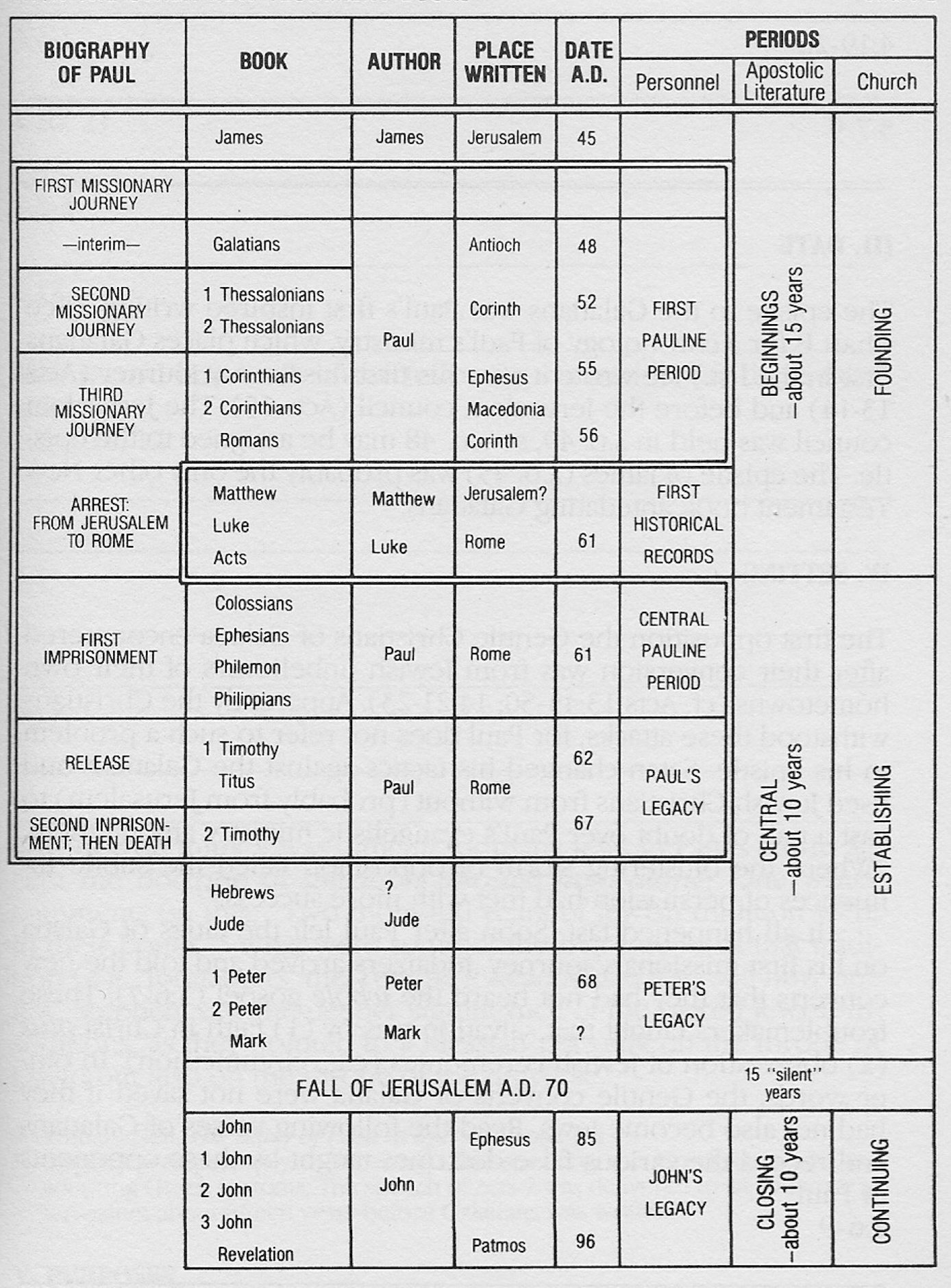
Before analyzing the test of any book of the Bible, it is well to learn the historical background.
Also, it is best to make a "skyscraper" view of its general contents.
- PAUL'S TIMELINE FROM CONVERSION TO ARREST
- Paul meet Christ on the road to Damascus, and thus became a Christian (35 A.D.), five years after Pentecost. (Acts 9:1-22, 26:4-23)
- Paul in approx. 41 A.D., fourteen years before the writing of 2 Corinthians in 55 A.D., was caught up to the third heaven where he heard revelations and also inexpressible things. (Galatians 1:11-12; 2 Corinthians 12:1-7)
- Paul sneaks out of Damascus and goes to Jerusalem and with the help of Barnabas he meets the apostles for the first time. After preaching in Jerusalem his life was threatened. So he was taken to the port city Caesarea and sent to Tarsus, his hometown. (Acts 9:23-30)
- Sometime passed and Paul returned to Antioch. (Acts 13:1) Paul and Barnabas were sent on their first missionary journey which was from 46 to 48 A.D. (Acts 13-14)
- The Jerusalem counsel was held, initiated and attended by Paul and Barnabas in either 49 or 50 A.D. (Acts 15:1-34)
- Some believe that Paul wrote Galatians while at Antioch between the first and second mission trips in 48 A.D. Paul and Barnabas' disagreement as they were planning to leave on their second missionary journey. (Acts 15:36-39)
- Paul and Silas left Antioch to go on Paul's second missionary trip in early 50 A.D. They went through Tarsus on the way to the churches in Galatia where young Timothy joins them. (Acts 15:36-16:10)
- The same year crossing the Aegean Sea arriving at Philippi. (Acts 16:11-40)
- They flee Philippi after considerable time there and went to Thessalonica were they spend considerable time. (Acts 17:1-9)
- Paul and Silas flee from Thessalonica to Berea. Since Timothy is not mentioned, it is possible that he stayed in Thessalonica or Philippi and then rejoined Paul in Silas in Berea. (Acts 17:10-12)
- Paul fled to Athens from Berean persecution, leaving Silas and Timothy in Berea. (Acts 17:13-14) Paul asked Silas and Timothy to join him in Athens. (Acts 17:15, 1 Thessalonians 3:1-2)
- Timothy rejoined Paul at Athens and was sent back to Thessalonica. (1 Thessalonians 3:1-5) Since Silas is not mentioned, it has been conjectured that he went back to Philippi when Timothy went to Thessalonica.
- Paul moved on, arriving in Corinth. (Acts 18:1) Silas and Timothy came to Paul in Corinth. (Acts 18:5, 1 Thessalonians 3:6)
- Paul wrote 1 Thessalonians and sent it to the church. About six months later in late 51 or early 52 A.D. Paul wrote 2 Thessalonians.
- Most believe that Paul wrote Galatians while in Corinth or perhaps when he arrived back at Antioch at the end of his second mission trip (late 52 A.D.)
- Paul returned to Ephesus during the early part of his third missionary journey. (53 A.D.) He stayed there for two years. (Acts 19:1-20)
- After two years in Ephesus, the capital of the Roman providence of Asia, Paul decided to bring a gift to the poor in Jerusalem for there was a drought there, passing through Macedonia and Achaia. He sends letters to the churches to collect gifts. (Acts 19:21-22)
- Paul left Ephesus after a riot in Ephesus, visiting the congregations he had went to on his second missionary trip. (Acts 19:23-20:1)
- Paul stopped at Corinth on the looped journey where he penned the letter to the believers in Rome. He made a short stop in Ephesus and then went to Jerusalem. (56 A.D., Acts 20:2-38)
- Paul ended the third missionary trip in Jerusalem. He presented a gift that was collected for the poor and needy in Jerusalem. (57 A.D., Acts 20:39-21:16)
- Paul was arrested in Jerusalem when the Jews tried to kill him. (57 A.D., Acts 21:17-40)
- Paul is transferred to Rome to stand at trial before Caesar (59-60 A.D., Acts 25:10-28:16)
- Paul awaits for trial in Rome under house arrest. Acts is penned by Luke who was with Paul. (60-61 A.D. Acts 28:17 to end)
- Paul underwent his first Roman imprisonment during which he wrote Colossians, Philippians, Philemon, and this letter. (61-62 A.D.)
- Paul was released from prison between 62 and 64 A.D.

* The map "Geography of the Corinthian Letters" is from "1 Corinthians, A Self-Study Guide" by Irving L. Jensen published by The Moody Bible Institute of Chicago, 1972. Used by permission.
- TIME AND PLACE
- The complicated background behind the writing of the Epistle can best be illustrated through a series of five directional arrows.
Paul ----- A -1---> Church
in <---- B -2---- in
Ephesus ----- C -3---> Corinth
<--- D -4---
Macedonia -- E -5--->
- Paul sends a letter to Corinth and all the congregations to make collections to the improvised and persecuted church in and around Jerusalem. (5:9, arrow 1).
- Corinth sends a response to Paul with questions. (arrow 2).
- Paul sends 1 Corinthians (arrow 3).
- Corinth sends another letter to Paul with more questions. (arrow 4).
- Paul sends 2 Corinthians (arrow 5).
- BACKGROUND
- Author. Apostle Paul according to all scholars for it is heavily quoted by many earlier church followers.
- Date Written. 55 A.D., probably in spring before Pentecost (16:5-8)
- Period Covered. Beginning of the spread of the gospel, during Paul's third missionary journey.
- Geographical Centers. Paul was in Ephesus when he wrote this letter to the congregation in Corinth.
- Main Theme. First Corinthians is a practical letter. Paul dealt with problems concerning the church as a whole and also with personal problems. The letter is relevant for the needs of today. Individuals and churches continue to face many of the same problems encountered at Corinth.
- Audience. A maturing congregation with problems.
- SURVEY
- Paul wrote 1 Corinthians to give instruction and admonition that would lead to the solving of the many problems in the congregation. Some of these problems may have arisen out of a "super spiritualist" group that had been influenced by incipient gnostic teachings. All of the problems in chapters 1-14 were grounded in egocentric or self-centered attitudes in contrast to self-denying, Christ-centered attitudes. Chapter 15 concerning the resurrection may reflect sincere misconceptions on the part of the Corinthians. (Holman Bible Dictionary)
|