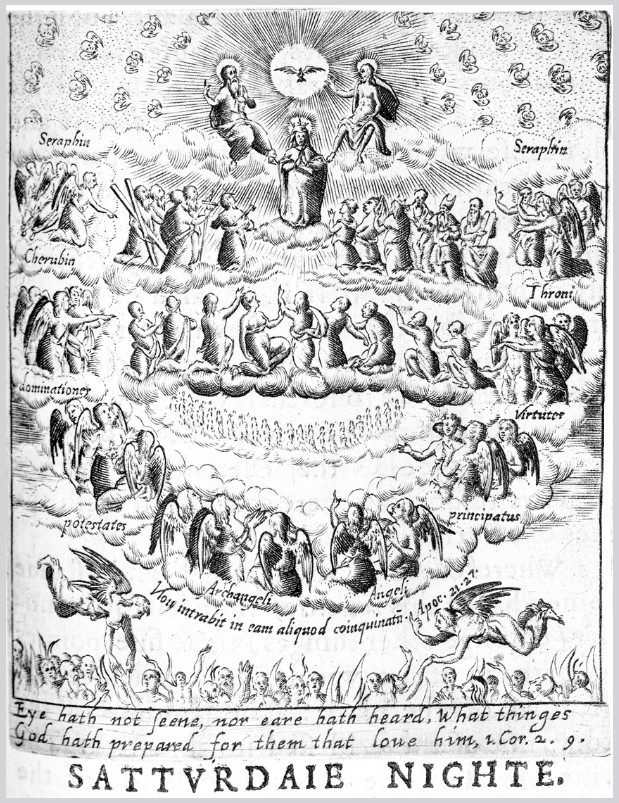
* The engraving titled "Devotional for Saturday Night" is from a book "Of prayer, and meditation : wherein are contained fourteen devote meditations for the seven days of the week, both for the mornings and evenings, and in them is treyted of the consideration of the principal holy mysteries of our faith / written first in the Spanish tongue by Lewis de Granada."
It is by Luis, de Granada, (1504-1588) and is now in public domain.
Angels of all caliber surround Jesus who stands gloriously in the top-center. Near the bottom of the angels, Revelation 21 is presented in Latin. 1 Corinthians 2, located at the bottom, serves as the sixth of seven devotionals selected by the author, Luis de Granada.
Courtesy of the Digital Image Archive, Pitts Theology Library, Candler School of Theology, Emory University: http://www.pitts.emory.edu.
>1. Who is the Lord and glory and what wisdom did he display that is in regard to true believer's future glory? (6-8)
* 1 Corinthians 2:6-8 "We do, however, speak a message of wisdom among the mature, but not the wisdom of this age or of the rulers of this age, who are coming to nothing. No, we speak of God's secret wisdom, a wisdom that has been hidden and that God destined for our glory before time began. None of the rulers of this age understood it, for if they had, they would not have crucified the Lord of glory."
* 1 Corinthians 2 Overview.
Paul was highly educated for his day. Yet, his human education lead him to false beliefs that were reinforced by an impure spirit and mind. Knowledge is one thing, wisdom another, and the truth is absolute. Paul did not know the truth. This lead him to cruel and evil acts.
God's wisdom and truth are not human wisdom and truth. Before I came into a personal relationship with God through Jesus by the power of the Holy Spirit, I was educated but did not know God's truth. Thus like Paul I sinned. Slowly God is revealing his truth to me through His Spirit. So that now, I am known by God and I am knowing God and his will for me.
The Spirit searches all things, even the deep things of God. The Spirit reveals these to me so that I may understand what God has freely given me. (12) I am thankful he brought me out of foolish and dark thinking.
Mature Christian questions examine and apply what the Holy Spirit reveals. An unbeliever cannot judge and understand the believer's spiritual nature. (15) From the soil comes pure white flowers.
Listen to the above comments on 1 Corinthians chapter 2 overview.
* "speak a message of wisdom among the mature" -"Mature", translated "perfect" in the KJV and YLT, and "fullgrown" in the ASV, is the adjective "teleios" in the original Greek meaning "complete in growth -mental and moral character", a full aged person.
When Paul arrived in Corinth, earlier he had said in verse 5 that his message was simple so that the Holy Spirit's power would be revealed. It was. Later, he taught wisdom to those who would be mature enough to understand and comprehend it. "Mature" means having the mental capability, moral aptitude, and willingness to learn more.
* "not the wisdom of this age" -Based on how to improved one's life with improper ethics and morals.
* "who are coming to nothing" -Based on improper ethics and morality. Having a wrong concept of right and wrong. Having a damaged conscience.
* "we speak of God's secret wisdom... hidden" -We need to be very careful here and not fall into a trap that believes it is still hidden. When Paul wrote this letter all the church had was the Old Testament and Jesus' teaches conveyed verbally by the apostles, and perhaps some of the newly transcribed passages by Matthew and Mark. Matthew and Mark finished their gospels five or six years later. Luke and John would write their accounts later.
The secret wisdom is given through the Holy Spirit to our spirit. Paul spoke to the whole congregation. Paul is writing to the whole congregation. The wisdom is hidden by a false concept of right and wrong and a burnt conscience, blinded by a lie.
* "that God destined for our glory before time began" -I, like Augustine in "City of God", do not have the ability to comprehend time (though it is a fun subject to think about), let along before time began. I know Apostle Paul's statement is purely meant to be a reassurance of God's love plan for me all along.
As a side thought, Paul's statement is strong evidence of predestination salvation, another subject that I have a hard time comprehending. I am not saying I do not know what it means and have not thought about, read about, talked about, and studied predestination salvation. All that I am saying is, predestined salvation is to an easy temptation to get bogged down into, as a desire to comprehend it at this time, and even in this lifetime. Well now look, I have deviated from the point at hand and thus, proven the temptation to be real.
* "our glory" -Our glory begins with the indwelling of the Holy Spirit, and will be revealed when Jesus comes again. Our glory is the glory that Christ Jesus now displays. Jesus spoke of his glory often at the end of this ministry. (John 8:54, 17:1, 24)
* "Lord of glory" -While of Old Testament often speaks of the glory of the Lord, the phrase "Lord of glory" is only used here. Why? The NIV text note states Paul is contrasting the cross with the majesty of the victim.
"Commentary on the Holy Bible" states, "The glory is His; and He came to bestow it upon us, to bring us to the perfection of our nature," which does seem to fit within the meaning of Paul's statements here, and thus is why he uniquely uses the phrase "Lord of glory".
Adam Clarke states, "or 'the glorious Lord', infinitely transcending all the rulers of the universe; whose is eternal glory; who gave that glorious Gospel in which his followers may glory, as it affords them such cause of triumph as the heathens had not, who gloried in their philosophers..."
>To whom has God's secret wisdom been revealed? (9-10)
* 1 Corinthians 2:9-10 "However, as it is written: "No eye has seen, no ear has heard, no mind has conceived what God has prepared for those who love him"-- but God has revealed it to us by his Spirit. The Spirit searches all things, even the deep things of God."
* Isaiah 64:1-4 "Oh, that you would rend the heavens and come down, that the mountains would tremble before you! As when fire sets twigs ablaze and causes water to boil, come down to make your name known to your enemies and cause the nations to quake before you! For when you did awesome things that we did not expect, you came down, and the mountains trembled before you. Since ancient times no one has heard, no ear has perceived, no eye has seen any God besides you, who acts on behalf of those who wait for him."
* "No eye... God has prepared for those who love him" -Paul is quoting from Isaiah 64:4 is sense only, not a direct quote. This application, or fulfillment, is not so much the glory to come in the life-after, but as Paul applies it, with the gift of the Holy Spirit for all believers which started on the day of Pentecost. No one before the Holy Spirit was sent, not even the apostles knew that God had planned to send the Spirit to all those who called on the name of Jesus. They did not know how the Holy Spirit worked and what he does in and through a believer. When a prophet or king was filled with the Spirit, it was very strange for the observer to behold.
"God has prepared for those who love him" is a paraphrase of verses Isaiah 64:1-3. God opened the heavens and came down as the Holy Spirit on Pentecost. Jesus told the disciples he would send the Holy Spirit to them, but they needed to wait for it. They did not know the Spirit would come down with wind and flames as of fire resting on their heads and that they would speak languages of other nations, the "nations quaking". This is just the same at Mount Sinai for Israel when they left Egypt. Israel did not know what would happen at Mount Sinai.
Every since Pentecost, the Holy Spirit comes down from heaven at the Father's command and rests within the person who accepts His One and Only Son, Jesus. The Spirit is a testimony to our spirit.
* "God has revealed it to us by his Spirit" -The message that the Spirit of God gives is to our spirit. We can pay attention to the Holy Spirit. Or we can drown the Spirit out. The Spirit testifies to our spirit the things of God.
* "The Spirit searches all things" -Nothing can hold back and block the Spirit of God.
* "even the deep things of God" -The Spirit is one with the Father.
* "deep things" -Paul defines "deep things" so that we can understand. We have thoughts and feeling buried within that nobody knows. They are locked within. God does too. However, the Spirit goes in and out of these locked doors with ease.
>How is it that we have come to know it? (11-12)
* 1 Corinthians 2:11-12 "For who among men knows the thoughts of a man except the man's spirit within him? In the same way no one knows the thoughts of God except the Spirit of God. We have not received the spirit of the world but the Spirit who is from God, that we may understand what God has freely given us."
* "no one knows the thoughts of God except the Spirit of God" -Omniscience is attributed to the Holy Spirit. Omniscience is having total knowledge, knowing everything.
* "that we may understand what God has freely given us." -God has given many things freely. However, staying within the context of the paragraph. God gives us his Spirit freely. God gives us the gospel freely. God sent his Son that whoever believes in him may have eternal life freely.
* Analyze Your Wisdom
Solomon, imprinted by the Holy Spirit, was gifted with God's wisdom as the Corinthians were gifted with knowledge and speech. However, wisdom can be flawed and misguided when based on improper morality and ethics. When one's concept of right and wrong is not based in absolute truth, then the wisdom that comes forth, though it may temporarily show gain, will lead to nothing in the end. Such flawed wisdom led to the crucifixion of the Lord of glory (6-8).
The same Spirit that imprinted Solomon and Apostle Paul was gifted to all those who call on the name of Jesus and he has imprinted a divine message in our soul (10). The Holy Spirit knows the heart of God and reveals the heart of God only to those who he dwells in. The Spirit does not dwell in an unbeliever. The Holy Spirit lives only in us who call on Jesus' name (9-12).
The Spirit has revealed to us a secret message of wisdom. Jesus taught the message. The apostles, including Paul repeated the secret message, and the Holy Spirit testifies to our soul that the message is true.
John 7:37-39 record Jesus saying, "Let anyone who is thirsty come to me and drink. Whoever believes in me, as Scripture has said, rivers of living water will flow from within them." By this he meant the Spirit, whom those who believed in him were later to receive. Up to that time the Spirit had not been given, since Jesus had not yet been glorified." (See also John 14:26)
Listen to the above comments on 1 Corinthians 2:6-12.
>2. How did Paul come to know God's secret wisdom? (13)
* 1 Corinthians 2:13 "This is what we speak, not in words taught us by human wisdom but in words taught by the Spirit, expressing spiritual truths in spiritual words."
* "in words taught" -"Word" in the original Greek is the noun "logos" (a transliteration). "Teach" in the original Greek is the adjective "didaktos" (a transliteration) signifies "instructing, communicating, or explaining".
* "in words taught by the Spirit" -Paul goes into great detail and explanation of the Spirit in this letter, chapters 3, 4, 5, 6, 7, 12, 14, and 15. Verses 10-14 in this chapter is the beginning. Paul, is revealing to those who are proud of their knowledge and speaking gifts, that the Holy Spirit's work is so much more and greater than this.
The message Paul proclaimed was expressed in spiritual words given by the Holy Spirit. Thus, spiritual truth was aptly combined with fitting spiritual words. Paul is doing his best to convey to the baby Christians at Corinth with the limitations of the Greek language what the Holy Spirit is conveying.
* "expressing spiritual truths in spiritual words" -The NIV has a text note (see below). The KJV reads, "comparing spiritual things with spiritual." The ASV reads, "combining spiritual things with spiritual words". The HCSB reads, "explaining spiritual things to spiritual people" and has a text note, "or 'things with spiritual words'". GW reads, "We explain spiritual things to those who have the Spirit" and has the text note, "or 'We explain spiritual things in spiritual words.'" The CSB reads, "explaining spiritual things to spiritual people."
"Spiritual" in both places is the Greek adjective "pneumatikos" (a transliteration) meaning "non-carnal", "ethereal", "divinely supernatural", and "not of this world". This translation everyone agrees.
"Expressing" (and all the other translations) is the Greek verb "synkrino" (a transliteration) from the Greek primary preposition "syn" and verb "krino" meaning "to judge of one thing in connection with another". For example, "combine spiritual ideas with appropriate expressions" or "collate one thing with another by way of contrast or resemblance".
Calvin states it this way, "...and hence "synkrino" (a transliteration) is used to mean what is knit together or glued together, and certainly it suits much better with Paul's context than "compare" or "liken", as others have rendered it. He (Paul) says then that he "adapts spiritual things to spiritual", in accommodating the words to the subject, that is he tempers that heavenly wisdom of the Spirit with a simple style of speech, and of such a nature as carries in its front the native energy of the Spirit."
However, Adam Clarke wrote, "The word "synkrino" (a transliteration) which we translate comparing, rather signifies "conferring", "discussing", or "explaining"; and the word "pneumatikos" (a transliteration) should be rendered to "spiritual men", and not be referred to "spiritual things". The passage therefore, should be thus translated: "explaining spiritual things to spiritual persons." And this sense the following verse absolutely requires." (Adam Clarke's Commentary)
* "the Spirit, expressing spiritual truths in spiritual words." -NIV text note says this can also read, "the Spirit, interpreting spiritual truths to spiritual men."
* So, as the NIV text notes and some other English translations text notes say, the phrase can be understood in two ways, as Calvin sees it one way and Adam Clarke sees it the other. Frankly, both seem to fit in with verses 14 and 15.
>Why even though an unbeliever is told the truth does he not understand and accept it? (14)
* 1 Corinthians 2:14 "The man without the Spirit does not accept the things that come from the Spirit of God, for they are foolishness to him, and he cannot understand them, because they are spiritually discerned."
* "The man without the Spirit" -Those who do not believe in Jesus as presented in the gospel. The gospel is in chapter 15.
* "does not accept the things that come from the Spirit of God" -In keeping with the topic Paul started in 2:6, Paul is speaking of the Spirit's message about Christ as is witnessed to our spirit. Actually, he started speaking of the message of the cross in 1:17-18, but that message was conveyed by Paul, and was confirmed by the Spirit (1:6).
* "he cannot understand them"
* "because they are spiritually discerned."
>What can true believers learn about themselves in verses 15 and 16?
* 1 Corinthians 2:15-16 "The spiritual man makes judgments about all things, but he himself is not subject to any man's judgment: For who has known the mind of the Lord that he may instruct him?" But we have the mind of Christ."
* Paul is quoting Isaiah 40:13. Isaiah 40:13-14 "Who has understood the mind of the LORD, or instructed him as his counselor? Whom did the LORD consult to enlighten him, and who taught him the right way? Who was it that taught him knowledge or showed him the path of understanding?"
* "The spiritual man makes judgments about all things" -"Judgments" is the Greek particle "men" (a transliteration) properly indicative of affirmation or concession (in fact), usually followed by a contrasted clause.
* "not subject to any man's judgment" -"Judgment" is the Greek verb "anakrino" (a transliteration) meaning "examine" from "ana" and "krino" (transliterations), together meaning "scrutinize" and "investigate", "interrogate", and "determine".
* The Spirit Imparts The Mind of Jesus.
Apostle Paul is still redressing the Corinthians Christians, who are proud of the gifts of knowledge and teaching, the gifts they were given upon receiving the Holy Spirit when they first believed. Paul introduces the topic of the office and work of the Holy Spirit in verses 10-16, which he will maintain and build upon in the rest of the letter.
Jesus' words to the knowledgeable Jewish rabbi Nicodemus, "Israel's teacher", are related to those of Apostle Paul in these verses, "Flesh gives birth to flesh, but the Spirit gives birth to spirit. You should not be surprised at my saying, 'You must be born again.' The wind blows wherever it pleases. You hear its sound, but you cannot tell where it comes from or where it is going. So it is with everyone born of the Spirit." (John 3:6-8)
God gives us the Spirit, which communicates to us spiritually, "that we may understand" by experiencing God through Him, "what God has freely given to us", that is God, the very essence of the eternal most high God, within and a part of ourselves. "We had the mind of Christ." (16)
On the night he was betrayed, Jesus gave us this promise, "But the Counselor, the Holy Spirit, whom the Father will send in my name, will teach you all things and will remind you of everything I have said to you... When the Counselor comes, whom I will send to you from the Father, the Spirit of truth who goes out from the Father, he will testify about me." (John 14:26, 15:26) Read also John 16:5-15. Believe Jesus when he says the Spirit within us, testifying spiritually to us, is a very good thing, though it his hard to understand.
Listen to the above comments on 1 Corinthians 2:10-16.
II. Who We Follow and What We Do (3:1-15)
>3. What stage of spiritual life were the Corinthian Christians at? (3:1)
* 1 Corinthians 3:1 "Brothers, I could not address you as spiritual but as worldly--mere infants in Christ."
* "as spiritual but as worldly" -"Worldly" is the Greek adjective "sarkikos" (a transliteration) that the KJV and ASV translates "carnal", the HCSB and CSB (YLT very similar) as "people of the flesh", and GW as "people still influenced by your corrupt nature".
* "mere infants in Christ" -New to the faith in Christ. Paul uses this analogy elsewhere. Several of Jesus' parables imply a growth process.
* Paul is stating that while he was in Corinth around two years ago, and that only for a few months, they were still young in Christ. So, they could not be addressed, or rather, taught the deep things of God.
* 1 Corinthians 3 Overview.
In ancient times people did not go to an institution, school, college, nor university to get an education. Rather, they went to a person and asked them if they could become a disciple. If a Jew wanted to learn about God the same was true. They went to a prominent rabbi to be trained as a disciple.
Proper Jews went to the synagogue every Sabbath to worship and hear the Bible since most did not and could not have a copy at home. They did not go to synagogues to learn as some Christian do today. For small congregations, a prominent visiting rabbi would speak. But that was the exception, not the norm.
God was doing something different in the early church. What he was doing in the church had never been done before in antiquity.
Jesus taught that we should not call a person rabbi nor father. Instead in Christ, people were a community. Everyone had different functions and gifts. Different people preached and taught at different times, taking turns as the Holy Spirit prompted and equipped. No one was a disciple of someone else. That is what Paul is rebuking the Corinthians about in this chapter. They were calling themselves disciples of a human.
Some in the Corinthian congregation were still thinking and doing as others did. They followed people and became their disciples. Paul said, "No. Don't say 'I follow Paul' nor 'I follow Apollos'." This was not the way the Holy Spirit is working amongst them. The same is true today.
I go to and lead Bible studies, talk to other Christians, read books, and study the Bible. The Holy Spirit slowly reveals to me as I pray and humbly submit to him. I have had to change my understanding of truths along the way. I am grateful for the ways of God. No human is my rabbi nor shepherd. I am not a sheep to men. I am God's sheep. I thank God for all the people he leads into my life to show me the truth and the way. Yet, I know it's not them that changes me in character and thought. Its God, my one and only Father.
Listen to the above comments on 1 Corinthians chapter 3 overview.
>What kind of Bible study did they still need? (2)
* 1 Corinthians 3:2 "I gave you milk, not solid food, for you were not yet ready for it. Indeed, you are still not ready."
* "I gave you milk" -Like a baby received mother's milk. The instruction Paul gave them when they first believed was easy mentally and emotionally to digest. Had they practiced Jesus' teaching, which Paul taught, they would have grown spiritually, emotionally, and mentally. Experiencing enhances and expands the learning. We are meant to physically practice, not just study all day. Jesus said, "Do what I say." (Luke 6:46; John 14:15)
* "for you were not yet ready for it" -Jesus said the same thing to Nicodemus. (John 3:12)
* "not solid food" -The basic gospel is spiritual milk. Put that principle into practice, then we learn more through experience. Once that is done, then we can begin to understand new facts about Jesus; who he is and what he had and is doing. Without experiencing and understanding the basics a painter, writer, craftsman, sports player, soldier, and business person cannot became acquainted and understand the details of the profession they seek to master. Same is true of living a life following Christ Jesus. If we do not practice the basic, love for God and neighbor, then we will not grow beyond the infant stage.
>What's a characteristic of an infant in Christ? (3-4)
* 1 Corinthians 3:3-4 "You are still worldly. For since there is jealousy and quarreling among you, are you not worldly? Are you not acting like mere men? For when one says, "I follow Paul," and another, "I follow Apollos," are you not mere men?"
* "worldly" -The same Greek word as in verse 1 is used here. However, The Bible Background Commentary takes objection to the translations of this Greek word in verse 3 (not verse 1) as "wordly" saying, "'Fleshly' (not 'worldly' -NIV) is slightly different from 'as fleshly' (again, not 'worldly', NIV) of verse 1: it means that they were acting fleshly by nature, not that they were fleshly by nature. On "flesh" and Spirit see Romans 8:11."
Paul is saying that they were wrong in thought with feeling (jealousy), word (quarreling), and deed (divisions). Calvin calls it "natural corruption". They were living selfishly, according to one's selfish desires. Living to please one's own flesh. The "world" is contrasted with the "Spirit" from God in heaven.
* "jealousy and quarreling among you" -Jesus' dealing with the religious leaders is an example to us on how to deal with opposition.
* "acting like mere men" -Jesus was not mere man. Knowing what a mere man is can be understood by looking to Jesus and seeing what he was not. Jesus was not a mere man. He was the Son of God. His dealings and interactions with others was not as a mere man, but as the Son of God.
* "I follow" -That is saying they were the disciples of a human.
* Galatians 5:19-21 adds these to the list of the acts of the sinful nature.
* Live By the Spirit?
Apostle Paul presents to his brothers and sisters in Christ at Corinth self-examination questions. Are you not worldly? Are you not acting like mere humans? Doesn't your pledged loyalty to a human instead of Christ Jesus show you are mere human beings? The answer to all these is yes. They were worldly, mere humans. Paul calls them infants in Christ.
Christians are called by God to be more than mere humans. How? We are to live by the Spirit (1). Living by the Spirit has become a modern Christian clique sometimes heard in mostly Pentecostal congregations. Yet, many who attend those congregations are guilty of the same faults found in Corinth in Paul's day.
So, what is living by the Spirit? Living by the Spirit is living in obedience to the will of God. Elsewhere, it is defined as the fruits of the Spirit (Galatians 5:19-23), and the greatest of the fruits is love. So, when the Corinthians argued and divided, they were not living in love. They were not living by the Spirit. They were carnal, mere humans. Be like Jesus means as Jesus himself said loving others as he has loved us, self-deny. Die as a kernel of wheat so that others may live by the Spirit.
Listen to the above comments on 1 Corinthians 3:1-4
>4. Why is paying to much honor and praise to others wrong? (5)
* 1 Corinthians 3:5 "What, after all, is Apollos? And what is Paul? Only servants, through whom you came to believe--as the Lord has assigned to each his task."
* "Only servants" -Lesser than and not much of anything at all. John the Baptist told the people sent by the Jerusalem religious authority the same. He said he was unworthy to untie Jesus' sandals. (Mark 1:7; Luke 3:16) I am only doing what I was instructed to do 30 some years ago. I only repeat what is given me. I make up nothing new. What I say and do is what I have been given. Jesus said everyone who lives by the truth comes into the light, so that it may be seen plainly that what they have done has been done through God. (John 3:21)
* "as the Lord has assigned to each his task" -Just because Jesus gave me a task does not mean I am great or significant. Jesus said when I did what I am told I am to remember that I am an unworthy servant.
* Paul is saying, Why should a party or group be formed named after him? He is nothing great. He did nothing great. He is only doing what he was told to do. He is instructing only what he was taught. The one that sent and the one that taught him is who is important. That person is Jesus Christ.
* The Engraving is from The Art Bible, Comprising the Old and New Testaments with Illustrations, George Newnes, Limited, London, South Hampton Street, Strand ,1896. 1 Corinthians 3:7 is the cited passage.
>Can any man make us grow spiritually? (6-7, 9)
* 1 Corinthians 3:6-7 "I planted the seed, Apollos watered it, but God made it grow. So neither he who plants nor he who waters is anything, but only God, who makes things grow."
* 1 Corinthians 3:9 "For we are God's fellow workers; you are God's field, God's building."
* The details from DNA to photosynthesis is only recently understood by mankind. The entire cycle of plant life is complicated. Comparing that to planting and watering is humbling.
* Paul established the congregation at Corinth. He compares that to a farmer planting a seed with the hopes of a productive plant growing. Jesus used such imagery in some parables when speaking of the gospel work. The Corinthians probably learned of Jesus' parables from either Paul, Apollos, and/or another apostle or teacher visiting the new congregation. This was not a new teaching, only a repeated one.
>Why then should a man be honored?
* "neither he who plants nor he who waters is anything" -Their contribution is so small compared to what God does.
* "Paul... Apollos" -Acts 18:18 states of Paul's time than 18:27 states of Apollos' time there.
* Paul de-emphasizes their involvement.
>How then should God's servants expect to be rewarded? (8; Matt. 16:27)
* 1 Corinthians 3:8 "The man who plants and the man who waters have one purpose, and each will be rewarded according to his own labor."
* Matthew 16:27 "For the Son of Man is going to come in his Father's glory with his angels, and then he will reward each person according to what he has done."
* "each will be rewarded according to his own labor." -Though our involvement is small, God still will recognize it on the day of Jesus' second coming.
* God's reward is all that is needed for those who obey the call to work in the field.
* Only Servants.
Apostle Paul pulls examples from some of Jesus' parables concerning seeds and plants to help the Corinthians congregation understand what he is saying concerning a man's place before the Lord Christ Jesus. Jesus taught that the word of God is like seed which a man took and planted in his field. The field had four different types of soils. Only one produced a crop.
Jesus, in another parable, said that unless a seed falls to the ground and dies it remains only a single seed. But if it dies it produces many seeds.
Apostles Paul, building on these seed parables and illustrations as examples, says he only planted the seed and Apollos only watered the seed, but God makes it grow. God made the complicated DNA inside the seed that instructs it how and when to grow. Also, God designed the delicate and sophisticated photosynthesis process that enables the seed to change into a seed producing plant. Also, consider how the stem of the plant pulls water up to the flower. Finally, consider how plants turn to obtain the most sunlight possible.
How amazing are all these designs! Compare planting the seed and watering the plant. Those are nothing compared to how God makes the seed change, grow, and reproduce. No wonder Paul says that he and Apollos are nothing.
Paul's illustration applies to all of God's chosen. We are only co-workings doing what we are taught and told. God is really the one who does all the work. My labor is small. I do not deserve praise. I have only done my duty. This is what Paul is teaching.
Listen to the above comments on 1 Corinthians 3:5-9
>5. To what is our new life of faith compared to? (10)
* 1 Corinthians 3:10 "By the grace God has given me, I laid a foundation as an expert builder, and someone else is building on it. But each one should be careful how he builds."
* "grace" -unmerited divine assistance.
* "I laid a foundation as an expert builder" -Paul will use this illustration in the next few verses. Paul founded the congregation in Corinth.
* "someone else is building on it" -They are adding by teaching, instructing, and praying. They are giving living example of how to live by doing right and resisting wrong. They are practically living by faith.
* "But each one should be careful how he builds." -Paul is bringing the topic back to an earlier subject, their division and quarreling about different points of view. Some of the teaching was wrong and/or improper.
>What is the foundation that all rest and relies on? (11)
* 1 Corinthians 3:11 "For no one can lay any foundation other than the one already laid, which is Jesus Christ."
* "foundation" -The basis on which a thing stands, is founded, or is supported. The base. For a building the foundation is a row of rock, brick, or concrete on which the building stands.
* "the one already laid" -Paul established the congregation by giving witness to a people the gospel of Jesus Christ.
>What is the Christian acts we do compared to? (12)
* 1 Corinthians 3:12 "If any man builds on this foundation using gold, silver, costly stones, wood, hay or straw,"
* "gold, silver, costly stones" -Precious, durable, and long lasting, standing the test of time, weather, and earthquakes. For the illustration, work that withstands divine judgement, symbolic of pure Christian doctrine and living.
* "wood, hay or straw," -Weak and not long lasting. For the illustration, work that does not withstand divine judgement, symbolic of worthless work, weak, watered-down gospel teaching and life.
* Building Inspection.
Apostle Paul expands upon another of Jesus' teachings as he explains his point that the Corinthian congregation needs to stop arguing and idolizing human teachers. Jesus told his disciples, "If anyone loves me, he will obey my teaching. My Father will love him, and we will come to him and make our home with him." God dwells in the hearts of believers. We are the temple of God.
When Paul first arrived in Corinth, he laid the foundation of Christ and Him crucified (2:2). Others, like Apollos, continued the work of building them up through sound doctrine, just as a good mason and carpenter build floors, walls, and ceilings. Sound doctrine and righteous living were like using gold, silver, and costly stones.
However, others were not teaching sound doctrine. They were twisting the gospel. They countered Jesus' teachings like, "If a person follows me, they must carry their cross." The false builders were teaching the prosperity gospel. They did not deny themselves. They were building with wood, hay, and straw, which would burn on the day of divine judgment (13). Paul is writing only to Christians.
Paul, in his second letter to the Corinthian congregation, will make this point clear again, "For we must all appear before the judgment seat of Christ, that each one may receive what is due him for the things done while in the body, whether good or bad." (2 Corinthians 5:10)
Teach truth and be rewarded. Teach half-truth, which is not the truth, and lose the reward. "He will suffer loss; he himself will be saved, but only as one escaping through the flames" (15). Jesus said similarly about losing one's intended reward, "Take the talent from him and give it to the one who has the ten talents." (Matthew 25:28) Sincerity does not verify doctrine, but it saves the man.
Listen to the above comments on 1 Corinthians 3:10-15.
>6. To what day will all Christians actions be examined? (13-15; Eph. 6:8; Col. 3:24-25; and 2 John 1:8; Rev. 11:18, 22:12)
* 1 Corinthians 3:13 "his work will be shown for what it is, because the Day will bring it to light. It will be revealed with fire, and the fire will test the quality of each man's work. If what he has built survives, he will receive his reward. If it is burned up, he will suffer loss; he himself will be saved, but only as one escaping through the flames."
* Ephesians 6:8 "because you know that the Lord will reward everyone for whatever good he does, whether he is slave or free."
* Colossians 3:24-25 "since you know that you will receive an inheritance from the Lord as a reward. It is the Lord Christ you are serving. Anyone who does wrong will be repaid for his wrong, and there is no favoritism."
* 2 John 1:8 "Watch out that you do not lose what you have worked for, but that you may be rewarded fully."
* Revelation 11:18 "The nations were angry; and your wrath has come. The time has come for judging the dead, and for rewarding your servants the prophets and your saints and those who reverence your name, both small and great-- and for destroying those who destroy the earth."
* Revelation 22:12 "Behold, I am coming soon! My reward is with me, and I will give to everyone according to what he has done."
* "Sincerity does not verify doctrine, but it saves the man," F. W. Robertson. (J. R. Dummelow, ed., A Commentary on the Holy Bible (New York: The Macmillan Company, 1936), 898.)
* Jesus said, "Woe to him who causes one of my little followers to sin. Those people would be better off to have a heavy mill stone tied about the neck and thrown into the sea." (Matthew 18:6; Mark 9:42; Luke 17:2)
III. Temples of God (3:16-4:5)
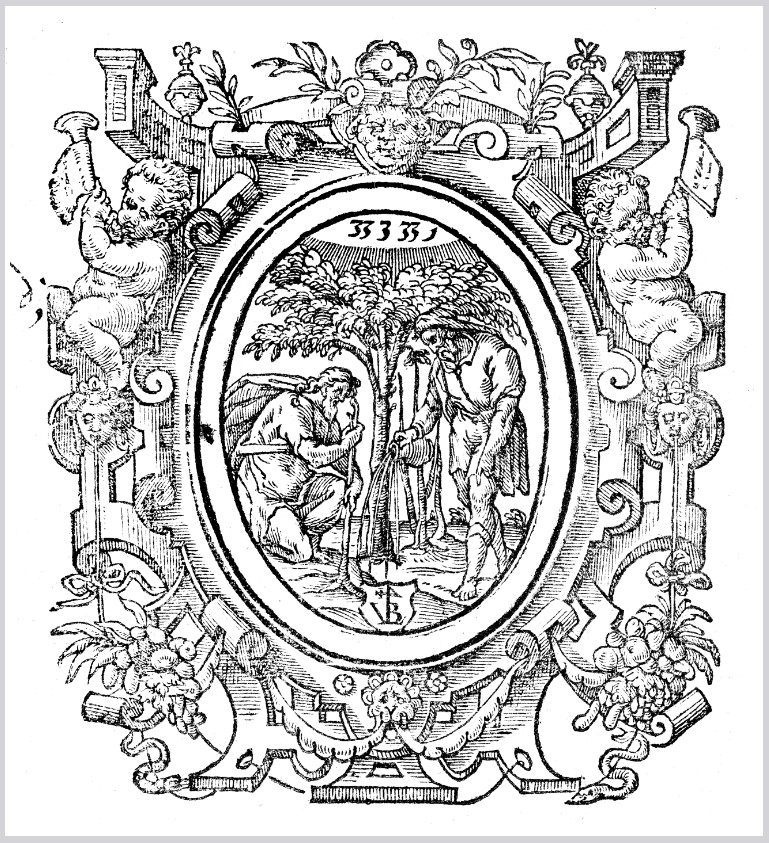
* The engraving titled "One Planted, One Watered" is from a book "La Biblia. que es, los Sacros Libros del Vieio y Nvevo Testamento : Revista y conferida con los textos Hebreos y Griegos y con diversas translaciones / Por Cypriano de Valera"
It is by Valera, Cipriano de, (1532?-1625) and is now in public domain.
A title page illustration featuring one man planting and another watering, surrounded by an ornamental border featuring angels or putti. The title page has been interpreted as representation of 1 Cor 3:6, "I have planted, Apollos watered; but God gave the increase".
Courtesy of the Digital Image Archive, Pitts Theology Library, Candler School of Theology, Emory University: http://www.pitts.emory.edu.
>7. After talking about buildings what does Paul equate the congregation to? (16)
* 1 Corinthians 3:16 "Don't you know that you yourselves are God's temple and that God's Spirit lives in you?"
* "you yourselves" -Plural. Thus, this is the whole congregation as a collective body.
* "God's temple" -Singular. Thus, the congregation is united.
* The Tabernacle and then the Temple was a means that God interacted with his people. God is everywhere. He cannot be confined into one space. He told King Solomon this during the opening of the Temple and Solomon repeated it. (1 Kings 8:27) So, the Temple was not the only place God was located for God is everywhere. Nor was the temple the only place that God interacted with his people. However, it was the place that God chose for his people to come together to interact with him. They were to present sacrifices for atonement for sins, worship, pray, and seek his guidance as a group. (1 Kings 8:31-53)
The body of Christ, is the group of people that God now interacts with on a local basis. The principle is the same with Israel, except it is not a focused around one location or once building nor one nation. Every congregation is to be the place where anyone can come to participate in communion, pray, worship, and seek guidance.
* Some in the church were dividing the congregation through elaborate words. A congregation divided will fail to meet all the needs of people.
>What does verse 17 mean?
* 1 Corinthians 3:17 "If anyone destroys God's temple, God will destroy him; for God's temple is sacred, and you are that temple."
* "If anyone destroys God's temple" -Through division, factions, and constant quarrels. All these are opposed to love, the love Jesus commanded and said "by this all men will know that you are my disciples". (John 13:35) Most commentators distinguish a difference between this person and the person in verse 15, where the faulty Christian worker is saved, but his work is destroyed (he suffers loss).
* "God will destroy him" -Strong words. The Greek verb for "destroy" is the same in both clauses. Paul is only repeating Jesus' words. The destruction is through false doctrine.
* "God's temple is sacred" -Purified. Set apart for a purpose just as the physical building was set apart for a purpose.
* God's Temple.
God's temple is God tangibly being with his people. Apostle Paul, in the previous paragraph, uses an illustration of a building, such as a temple, to describe God using him to establish God's tangible presence with a group of people in Corinth. They were God's temple, a people with whom God interacted continually.
God's Spirit lives in God's people. Collectively, we are a temple. Paul does not mean here that each of his readers is a temple of the Holy Spirit. He says, "You yourselves (plural) are God's temple (singular)." In 6:19, he speaks of each Christian as a temple of the Holy Spirit. But here he is speaking of the congregation as a collective whole because some were dividing the congregation with creative false teachings.
The teachers were sincere, but sincerity does not guarantee that the facts presented are true. The false doctrine, though persuasive, was dividing the congregation, destroying God's temple. Paul warns that God will destroy the members of the church who are dividing God's temple, for God's temple is sacred (17).
My takeaways are many, but one thought lingers- beware of every teacher. Apostle John wrote, "Dear friends, do not believe every spirit, but test the spirits to see whether they are from God, because many false prophets have gone out into the world." (1 John 4:1)
Listen to the above comments on 1 Corinthians 3:16-17.
* At the top of this historiated title-page border by Ortelius, Abraham (1527-1598), two Greek gods recline: Poseidon, the god of the sea, with his trident and Aeolus, the god of the winds with his winnowing fan. The Greek quotation at the head ("foolishness with God") is taken from the Apostle Paul's judgment on the wisdom of the world in 1 Corinthians 3:19. The Latin motto at the base may be translated, "Geography is the eye of history". The artwork is from the book "Parergon, siue, Veteris geographiae aliquot tabulae".
Courtesy of the Digital Image Archive, Pitts Theology Library, Candler School of Theology, Emory University: http://www.pitts.emory.edu.
>8. What does verse 18-19 mean to you especially considering what Paul wrote about wisdom in 1:21?
* 1 Corinthians 3:18-20 "Do not deceive yourselves. If any one of you thinks he is wise by the standards of this age, he should become a "fool" so that he may become wise. For the wisdom of this world is foolishness in God's sight. As it is written: "He catches the wise in their craftiness"; and again, "The Lord knows that the thoughts of the wise are futile."
* 1 Corinthians 1:21 "For since in the wisdom of God the world through its wisdom did not know him, God was pleased through the foolishness of what was preached to save those who believe."
* Job 5:13 "He catches the wise in their craftiness, and the schemes of the wily are swept away."
* Psalm 94:11 "The LORD knows the thoughts of man; he knows that they are futile."
* "Do not deceive yourselves." -Self justification. Perhaps more than self justification. They began believing their own positive press releases. They believed their own self-promotion. They believed they were truly wiser than others. They believed God gave them special inspiration and insight. They were conceited.
* Paul uses irony and sarcasm.
* "Farther, in these words the Apostle does not require, that we should altogether renounce the wisdom that is implanted in us by nature, or acquired by long practice; but simply, that we subject it to the service of God, so as to have no wisdom but through his word. For this is what is meant by becoming a fool in this world, or in our own estimation - when we are prepared to give way to God, and embrace with fear and reverence everything that he teaches us, rather than follow what may appear to us plausible." (Calvin's Commentaries)
>How does this explain why they were arguing about following Christian leaders? (21)
* 1 Corinthians 3:21 "So then, no more boasting about men! All things are yours,"
* No more boasting one teacher is better than another. Or "I prefer this teacher over that teacher". And especially any boasting about any human for God is the source of truth and any truth that a person knows comes from God.
* "All things are yours" -To him who is united to Christ all things belong, contributing to the growth of his Christian character and the increasing perfection of his spiritual life. He learns from all teachers; the world provides him with the means of growth in grace, for all his experiences in its possessions and work influence his spiritual life; life is full of divine meaning and purpose; death is revealed to him as the gate of life; he is delivered from any danger to his spirit arising from the perplexities of the present or the problems of the future (things to come)." (A Commentary on the Holy Bible: The One Volume Bible Commentary)
>How does this understanding make unity in Christ paramount? (22-23)
* 1 Corinthians 3:22-23 "whether Paul or Apollos or Cephas or the world or life or death or the present or the future--all are yours, and you are of Christ, and Christ is of God."
* Paul is saying they belong to you for your benefit, you do not belong to them for their benefit. We are not our teachers' servants, but our teachers are our servants. They belong to Christ and Christ has instructed them to serve us for the benefit of the church. (2 Corinthians 4:5, 15)
* God has employed servants to teach and equip us for service.
* All Things Are Yours.
Apostle Paul concludes the matter, "No more boasting about men! All things are yours..." (21). When stating "all things are yours," he is saying that God supplies many things, including people, the world, life, death, the here and now, and the future, to teach and equip his people. God gives all things for good and righteous purposes and plans he has in store for us.
Christians are not the servants of our teachers and shepherds. Jesus taught us that it is the other way around. Our teachers and shepherds are to serve us for the benefit of the church and those who will come to believe and the glory of God.
If we are teaching others, we should not deceive ourselves into thinking we are better than others. Rather, I need to remember that I have only what God has given me, not for my benefit and glory, but for others' benefit and the glory of God. I am of Christ and Christ is of God, and Christ is subject to his Father, and I am subject to all.
Listen to the above comments on 1 Corinthians 3:18-23.
>9. What did it mean to be a servant in the Roman empire? (1)
* 1 Corinthians 4:1 "So then, men ought to regard us as servants of Christ and as those entrusted with the secret things of God."
* "So then" -Concluding another matter very much relating to the conclusion at the ending of the previous chapter.
* "men ought to regard us as servants of Christ" -The conclusion.
* "as those entrusted" -The Greek underlying this phrase means "house manager" or "steward." (NIV Study Bible)
* "with the secret things of God." -The secret things was first presented in verses 6-10 where Paul wrote that the wise and rulers did not understand God's secret things. Only those whom the Holy Spirit reveals the secret things to will understand it. What is it? The gospel of Jesus Christ which Paul goes into detail of in chapter 15..
* Romans 16:25-26 "Now to him who is able to establish you by my gospel and the proclamation of Jesus Christ, according to the revelation of the mystery hidden for long ages past, but now revealed and made known through the prophetic writings by the command of the eternal God, so that all nations might believe and obey him-- "
* Ephesians 3:4-6 "In reading this, then, you will be able to understand my insight into the mystery of Christ, which was not made known to men in other generations as it has now been revealed by the Spirit to God's holy apostles and prophets. This mystery is that through the gospel the Gentiles are heirs together with Israel, members together of one body, and sharers together in the promise in Christ Jesus.
* 1 Timothy 3:16 "Beyond all question, the mystery of godliness is great: He appeared in a body, was vindicated by the Spirit, was seen by angels, was preached among the nations, was believed on in the world, was taken up in glory."
>How does that equate to a proper view of self and others in Christ?
* A servant did what ever the owner and master wanted before they did anything for themselves. The master did not serve on the servant.
>Who is our master and what has he entrusted us with? (2; Matt. 25:14)
* 1 Corinthians 4:2 "Now it is required that those who have been given a trust must prove faithful."
* Matthew 25:14 "Again, it will be like a man going on a journey, who called his servants and entrusted his property to them."
* Entrusted.
"Again, it will be like a man going on a journey, who called his servants and entrusted his property to them," so begins Jesus Parable of the Talents. (Matthew 25:14-30) The main issue Paul has been addressing for three chapters, Jesus cleverly presents in one brilliant, easy-to-grasp parable.
Apostle Paul concludes his theological dissertation, "So then, men ought to regard us as servants of Christ and as those entrusted with the secret things of God." (1) Paul again calls himself a servant entrusted by God with secret things. He first wrote of this in verses 6-10.
The mysterious secret is the gospel which God made known through the Spirit to the apostles and the prophets that the Gentiles would be saved along with the Jews through Christ Jesus (Romans 16:25-26; Ephesians 3:4-6; 1 Timothy 3:16). This is what God entrusted to all of his people, the message of Christ Jesus, the Savior crucified, died, buried, and risen from the dead.
Filled with the Spirit, Paul's next statement is important for the church to heed: "Now it is required that those who have been given a trust must prove faithful," for it is also the conclusion and warning of Jesus' parable, "For everyone who has will be given more, and he will have an abundance. Whoever does not have, even what he has, will be taken from him. And throw that worthless servant outside, into the darkness, where there will be weeping and gnashing of teeth.'" (Matthew 25:29-30)
Listen to the above comments on 1 Corinthians 4:1-2.
>10. Whose judgment should matter to us? (3-4)
* 1 Corinthians 4:3-4 "I care very little if I am judged by you or by any human court; indeed, I do not even judge myself. My conscience is clear, but that does not make me innocent. It is the Lord who judges me."
* "I care very little if I am judged by you"
* "by any human court"
* "I do not even judge myself" -His judgment was merely human, and his conscience may be mistaken. Only God is fully qualified to judge.
* "My conscience is clear" -The original Greek is "Gar syneidon oudeis emautou" (a transliteration). "Gar" is "for". "Syneidon oudeis" is "consider" and "know nothing" in the sense that he was not conscious that he was guilty of any evil, or have neglected to fulfill faithfully the duty of a steward of Jesus Christ.
"Emauto" is "myself". Paul is not speaking of his whole life for elsewhere he admits that he persecuted the church. (Romans 7:15) No. Here he is speaking of his service under the Lord Jesus as an apostle, especially in regard to his service while at Corinth.
* "but that does not make me innocent."
* "It is the Lord who judges me."
>When he judges us, what will he look at? (5)
* 1 Corinthians 4:5 "Therefore judge nothing before the appointed time; wait till the Lord comes. He will bring to light what is hidden in darkness and will expose the motives of men's hearts. At that time each will receive his praise from God."
* "Therefore judge nothing before the appointed time"
* "wait till the Lord comes."
* "He will bring to light what is hidden in darkness"
* "will expose the motives of men's hearts."
* "At that time each will receive his praise from God."
>How should this mold our decisions and actions?
* The Appointed Judgment.
The point is clear. A judgment is coming. All will be judged, a judgment that Apostle Paul does not exclude himself from. If the man God chose to write a large section of the New Testament is going to stand before the judgment seat of Christ Jesus, then which person who considers themselves a Christian has the audacity to consider themselves free from a cross-examination from their Master?
Or perhaps some say, "Oh, I know I will stand before my Lord Jesus as he sits on the Bema Seat. But all he will say is, 'Well, done, my good and faithful servant. You have been faithful with a few things.'" Yes, Jesus said this in a parable. (Matthew 25:21, 23; Luke 19:17) However, can we be so relaxed and confident that we are doing what has been planned for us? Are we obeying, "Love one another as I have loved you?" and "Love your enemy?"
Even Apostle Paul, in humility, wrote, "My conscience is clear, but that does not make me innocent." When he wrote, "Judge nothing before the appointed time," more than anything, he means do not be conceited into a high and mighty opinion of yourself. "Judge nothing before the appointed time; wait till the Lord comes."
The motive is what matters. (5) Why did I help that person? What was in my heart when I prayed for that person? Why did I say that? Why did I respond that way? Why was I giving? What was my heart when I served? At that time, each will receive his praise from God. (5) Or perhaps there will be a sharp rebuke. Why not examine my heart motive now and repent and make amends?
Listen to the above comments on 1 Corinthians 4:3-5.