>1. How did someone cause the Corinthian believer's grief? (5; and 1 Cor. 5:1)
* 2 Corinthians 2:5 "If anyone has caused grief, he has not so much grieved me as he has grieved all of you, to some extent--not to put it too severely."
* 1 Corinthians 5:1 "It is actually reported that there is sexual immorality among you, and of a kind that does not occur even among pagans: A man has his father's wife."
*
Chapter 2 Overview.
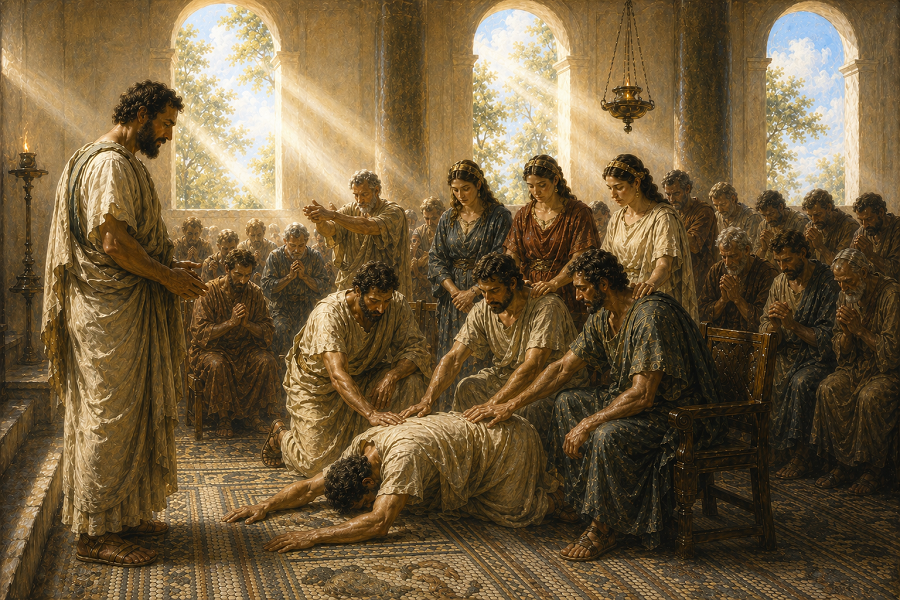
Paul gave instructions in his first letter to the Corinthian congregation in chapter 5 concerning a man engaging in a grievous sexual immorality. He said that they should cast him out of their congregation. Now, Paul reveals two motives behind that directive. (Some point out that he may be referring to another person's sin and/or offense.) First, he did not want to be grieved by them when he arrived (3-4). Second, he was testing their obedience (9). They did as Paul instructed and cast the man out.
The man repented. So now, Paul is encouraging them to forgive and invite him to join them again. Paul had already forgiven him.
One interesting statement here is, "if there was anything to forgive." (The reason some believe it is another offense.) Another is, "that Satan might not outwit us. For we are not aware of his schemes."
Satan wants to destroy all of Christ's congregations. He has various schemes to carry out the destruction. A particularly common one is to divide us. In this case, he used a man who persisted in incest, and the congregation's leadership lacked discipline. Thus, Paul said the man needed to be cast out. They obeyed. He grieved and repented.
Satan's scheme did not stop there. Now the congregation needed to forgive the man and accept him back into the church unconditionally. Forgiveness is an important act of love. Jesus taught me to pray, "forgive us of our sins as we forgive those who sin against us." Holding regret and judgment is self-destructive to me and to congregations. Discernment, separation from persistent sin, and unconditional forgiveness should all be done in love.
Listen to the above Chapter 2 Overview.
* "grief" "grieve" "distressed" -The English words in verses 2, 3, 4, 5, and 7 in the NIV (translated "sorry", "sorrow", and "grieved" in KJV, YLT, and ASV; and "pain", "hurt", and "grief" in HCSB and CSB) is the Greek verb "lypeo" or the noun "lype". "Lypeo" is from the Greek noun "lype" or "lupe". Counter to this are the words "glad" (2), "rejoice" (3), "joy" (3), "love" (4), "forgive" (7), "comfort" (7), "love" (8), and "forgive" (10).
In first-century Greek "lype" refers to deep emotional pain, grief, sorrow, or heavy distress of the mind. In ancient texts, the noun describes an internal anguish that touches both a person's emotions and their will, often resulting in heavy burdens or annoyance.
* "If anyone" -Paul does not name the person not because he did not know the person and not because the person had grieved him for in other places and letters he names people who grieved him with personal attacks. Rather, it is most likely Paul did not name the person because the congregation knew whom he was referring to and no one else needed to know. This letter was distributed to other congregations too.
The offense is also not revealed. This leads us to conjectured based on the sole fact that the person was excommunicated and he was a male. Verse 8 has "autos" usually translated, but not always, as "him", "his", and "he". Most commentators agree that the offender is the one spoken of in chapter 5 of the first letter. However, no one can be sure with so little information given in this letter. One thing to consider is Paul's statement, "if there was anything to forgive". The sin of incest committed by the man and woman in the first letter is very serious in Leviticus. So it can be asked, "Why would Paul state, 'if there was anything to forgive' if this person is indeed the same as the person in chapter 5 of the first letter?" However, Paul could be saying that the sin of incest wasn't against the congregation, but the man's father (who is presumed dead or divorced) and the man himself as the law in Leviticus states. This being true, then the statement, "if there is anything to forgive" would apply to the Corinthian congregation as the specific offense was not directed towards them.
* "If anyone has caused grief" -The one who committed the sin and/or offense grieved them as well as those who had sided with him, even if it was to allow the offense to continue. See notes on verses 1-4 in the previous study's commentary, Section III, question 10. Paul was also grieved "to some extent".
* "he has not so much grieved me as he has grieved all of you" -Paul was not there, but he too grieved, yet not as severe as they. They were in the offenders presence enduring the offense, perhaps every day. Certainly, during every congregational meeting.
* "to some extent--not to put it too severely." -Paul is perhaps being inclusive for offensives within a social group such as a congregation will affect some more than others. He was being gracious to the man who was forgiven, and at the same time recognizing that some where offended to one degree or another. He was grieved, but would not "put it too severely" in this letter as a matter of grace.
* "to some extent" -Paul uses similar general phrases other places in the letter. (i.e. 1:14)
* "This passage, however, is understood by some, as if Paul meant to say: 'He that has given me occasion of grief, has given offense to you also; for you ought to have felt grieved along with me, and yet I have been left almost to grieve alone. For I do not wish to say so absolutely - that I may not put the blame upon you all.' In this way the second clause would contain a correction of the first. Chrysostom's exposition, however, is much more suitable; for he reads it as one continued sentence - 'He hath not grieved me alone, but almost all of you. And as to my saying in part, I do so in order that I may not bear too hard upon him.'
I differ from Chrysostom merely in the clause in part, for I understand it as meaning in some measure. I am aware, that Ambrose understands it as meaning - part of the saints, inasmuch as the Church of the Corinthians was divided; but that is more ingenious than solid." (Calvin's Commentaries)
>What kind of punishment had the unrepentant brother received? (6; 1 Cor. 5:5, 11)
* 2 Corinthians 2:6 "The punishment inflicted on him by the majority is sufficient for him."
* 1 Corinthians 5:5 "hand this man over to Satan, so that the sinful nature may be destroyed and his spirit saved on the day of the Lord."
* 1 Corinthians 5:11 "But now I am writing you that you must not associate with anyone who calls himself a brother but is sexually immoral or greedy, an idolater or a slanderer, a drunkard or a swindler. With such a man do not even eat."
* "The punishment inflicted on him" -Not disclosed. Church discipline is sometimes needed.
* "by the majority" -Not all agreed with the punishment. However, a majority of the congregation was needed. A minority did not rule the majority of the congregation. The majority of the congregation ruled. Elders and deacons were needed and prescribed by Paul. However, the majority of the congregation ruled and elected the elders and deacons. The Greeks was the first known to have a representative government. Jewish synagoues also were maintained by the elders via representation, as did Israel starting from the Covenant based on tribal elders. The Roman's initially had a representative government, but over time changed to a dictatorship.
* "is sufficient for him." -The punishment was excommunication, not physical pain or infliction.
* "By the majority" is undoubtedly a way of saying the community of believers (as in the Dead Sea Scrolls). Pharisaic Judaism also stressed receiving back repentant offenders. Groups like the one reflected in the Dead Sea Scrolls, however, required a time of punishment to elapse before the repentant could be fully restored to the community. Roman and Greek law assumed the carrying out of a sentence. The Corinthian Christians may thus wonder what to do with the man now that he has repented." (Bible Background Commentary - The IVP Bible Background Commentary - New Testament)
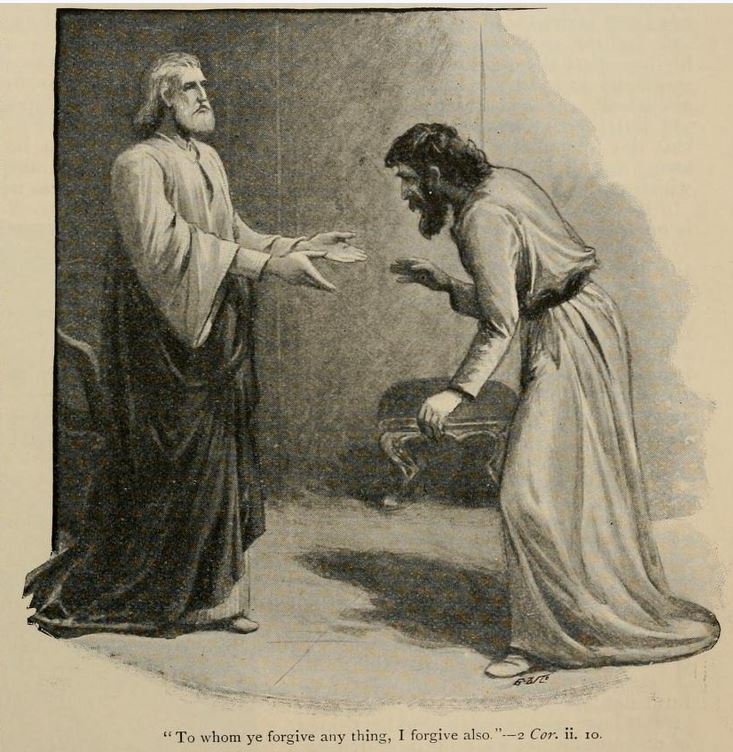
* The illustration is from the Art Bible, 1896, comprising the Old and New Testaments, with numerous illustrations. Publisher, London: G. Newnes.
>2. What was the good response to the punishment? (7-8)
* 2 Corinthians 2:7-8 "Now instead, you ought to forgive and comfort him, so that he will not be overwhelmed by excessive sorrow. I urge you, therefore, to reaffirm your love for him."
* "Now instead" -"Now instead" functions as a conjunctive adverb phrase (also called a transition phrase). The KJV and ASV have "...so that countrariwise..." following a semi-colon at the end of verse 6. The HCSB and CSB translate the Greek "hoste tounantion" (transliterations) with "As a result..." Other English translations have "So now" and "So that", also used as an adverbial conjunction of result (or purpose), connecting the first independent clause to the next action. The church's discipline achieved its goal, resulting in the new, merciful course of action.
* "excessive sorrow" -"Perissoteros lype" (transliterations), a comparative noun pair in the original Greek. Being cast out of the congregation has great effect for the Greek/Roman society in Corinth was so revolting and disgusting because of sin, that once a person is released of it, being tossed back into it without a communal support is emotionally and socially devastating.
* "I urge you, therefore" -Paul is emphasizing that forgiving the repentant believer is an important function of the church.
>What were they to do when he repented?
* "you ought to forgive and comfort him" -Forgiving can be hard, especially if the victim of the sin was severely harmed. Comforting is even harder after forgiving. I was repetitively hurt by someone I trusted and was committed to. I repetitively forgave them, but eventually decided that I can never trust them again. How much more to go beyond and comfort them?
* "reaffirm your love for him" -Openly display love.
>How is this following Jesus' example? (Matt. 6:12)
* Matthew 6:12 "Forgive us our debts, as we also have forgiven our debtors."
*
Grief That Leads to Sorrow and Forgiveness.
Grief, distress, and anguish, especially grief, are repeated ten times in the first ten verses, all deriving from the Greek noun "lype" (a transliteration), referring to deep emotional pain. Contrasting "lype" are forgiveness, joy, comfort, and love; together they are stated twelve times.
One man's sin in the Corinthian congregation led to grief, distress, and anguish, not just for the man when punished, but also for the congregation and Paul. The majority inflicted punishment, likely excommunication, at Paul's direction. The man was grieved and repented. He received forgiveness and was invited back into the fellowship. Without grieving, usually the result of punishment, there is no forgiveness. As the psalmist wrote, "If you, O LORD, kept a record of sins, O Lord, who could stand? But with you there is forgiveness; therefore you are feared." (Psalm 130:3-4)
Apostle John wrote, "This is the message we have heard from him and declare to you: God is light; in him there is no darkness at all. If we claim to have fellowship with him yet walk in the darkness, we lie and do not live by the truth. But if we walk in the light, as he is in the light, we have fellowship with one another, and the blood of Jesus, his Son, purifies us from all sin. If we claim to be without sin, we deceive ourselves and the truth is not in us. If we confess our sins, he is faithful and just and will forgive us our sins and purify us from all unrighteousness. If we claim we have not sinned, we make him out to be a liar and his word has no place in our lives." (1 John 1:5-10)
Listen to the above comments on 2 Corinthians 2:5-11.
>3. To whom was Paul hoping they be obedient to? (9; 10:5-6)
* 2 Corinthians 2:9 "The reason I wrote you was to see if you would stand the test and be obedient in everything."
* 2 Corinthians 10:5-6 "We demolish arguments and every pretension that sets itself up against the knowledge of God, and we take captive every thought to make it obedient to Christ. And we will be ready to punish every act of disobedience, once your obedience is complete."
* "The reason I wrote you" -Some commentators say this is 1 Corinthians. Other say that the second part of this letter was actually a separate letter, sent before the first part of this letter. Still others say that we no longer have the letter that Paul is mentioning here. The offender and circumstances provided here needing forgiving would fit the person in 1 Corinthians (see comments above and below). No matter which is correct, the meaning here does not change.
* "to see if you would stand the test" -Paul reveals that he was not only helping the person and congregation, but also testing them. Why was this important? God tested Adam and Eve by placing a tree with fruit and forbidding them to eat it in the middle of the garden. The Lord's test and Paul's test were for the same reasons.
* "be obedient in everything." -Paul's letters were inspired by the Holy Spirit. Some have abused their position of authority with applying this to their place in a congregation, demanding absolute obedience. They apply disciple at any disobedience and disrespect. They are not the same as Apostle Paul. Yet, their pride does not believe that they are not the same as the apostle inspired completely by the Holy Spirit.
* Separating our hurt feelings from the right thing to do, forgiveness, through the love of Christ, takes mature faith that must be learned through use. Such actions are not natural to the sinful soul.
>How far did Paul trust their judgment and leadership within their congregation? (10)
* 2 Corinthians 2:10 "If you forgive anyone, I also forgive him. And what I have forgiven--if there was anything to forgive--I have forgiven in the sight of Christ for your sake,"
* "If you forgive anyone, I also forgive him." -Paul trusts their judgement and for them to do the right thing.
* "if there was anything to forgive" -This statement is the reason some commentators believe the offense here is not the man who was cast out of the congregation because he lay with his father's wife. (See 1 Corinthians study 4 extra comments at the end of that study.) Their logic then must include that Paul is therefore, referring to a letter besides 1 Corinthians for Paul here said that he gave them instructions concerning someone's sin, and there is only one instruction concerning a punishment in 1 Corinthians.
Leviticus 18:8 says "sexual relations" with one's father's wife dishonor's one's father. The punishment is to be "cut off from their people" in Leviticus 18:29 and Paul told them to do this in his first letter. Leviticus 20:11b says in regard to "sleeping with his father's wife", "Both the man and the woman must be put to death; their blood will be on their own heads." Sleeping with a father's wife might be considered not a sin directly against the congregation. Rather, it is directly against the father. So, if the person here is indeed the same person as 1 Corinthians, then the forgiving here must only mean the forgiving is bringing them back into the congregation. If so, then perhaps it can be said, they were dead to the congregation, and now are brought back to live with the congregation. Yet, this is considered a stretch by some commentators, and therefore, they say it is not the same person, and therefore Paul is referring to another letter that had another directing concerning a punishment for another person.
* "I have forgiven in the sight of Christ for your sake," -Meaning either: in his sight, or in his place, or as having Christ living in me. Jesus said, "If you forgive anyone his sins, they are forgiven; if you do not forgive them, they are not forgiven." (John 20:23)
>How was forgiving a repentant brother part of the spiritual battle? (11)
* 2 Corinthians 2:11 "in order that Satan might not outwit us. For we are not unaware of his schemes."
* "in order that Satan might not outwit us." -By the man being lost to Christ and his congregation.
* "For we are not unaware of his schemes." -Not unaware (ignorant) and schemes (devices) are words akin in sound and root in Greek. We are not without knowledge of his knowing schemes. We should learn his schemes. We should be aware and aleart. And most of all we need Jesus and the wisdom of the Spirit.
* 1 Peter 5:8-9 "Be self-controlled and alert. Your enemy the devil prowls around like a roaring lion looking for someone to devour. Resist him, standing firm in the faith, because you know that your brothers throughout the world are undergoing the same kind of sufferings."
>What was and still is part of Satan's schemes? (Zech. 3:1-4)
* Zechariah 3:1-4 "Then he showed me Joshua the high priest standing before the angel of the LORD, and Satan standing at his right side to accuse him. The LORD said to Satan, "The LORD rebuke you, Satan! The LORD, who has chosen Jerusalem, rebuke you! Is not this man a burning stick snatched from the fire?" Now Joshua was dressed in filthy clothes as he stood before the angel. The angel said to those who were standing before him, "Take off his filthy clothes." Then he said to Joshua, "See, I have taken away your sin, and I will put rich garments on you."
* Satan seeks to destroy all that God does and is doing.
>4. Where was Troas and why had Paul gone there? (12; Acts 16:6-10)
* 2 Corinthians 2:12 "Now when I went to Troas to preach the gospel of Christ and found that the Lord had opened a door for me,"
* Acts 16:6-10 records Paul's first visit to Troas. "Paul and his companions traveled throughout the region of Phrygia and Galatia, having been kept by the Holy Spirit from preaching the word in the province of Asia. When they came to the border of Mysia, they tried to enter Bithynia, but the Spirit of Jesus would not allow them to. So they passed by Mysia and went down to Troas. During the night Paul had a vision of a man of Macedonia standing and begging him, "Come over to Macedonia and help us." After Paul had seen the vision, we got ready at once to leave for Macedonia, concluding that God had called us to preach the gospel to them."
* Acts 20:1-6 records this stop without mentioning Troas. See comments below. "When the uproar had ended, Paul sent for the disciples and, after encouraging them, said good-by and set out for Macedonia. He traveled through that area, speaking many words of encouragement to the people, and finally arrived in Greece, where he stayed three months. Because the Jews made a plot against him just as he was about to sail for Syria, he decided to go back through Macedonia. He was accompanied by Sopater son of Pyrrhus from Berea, Aristarchus and Secundus from Thessalonica, Gaius from Derbe, Timothy also, and Tychicus and Trophimus from the province of Asia. These men went on ahead and waited for us at Troas. But we sailed from Philippi after the Feast of Unleavened Bread, and five days later joined the others at Troas, where we stayed seven days."
* 2 Timothy 4:12-13 records that Paul left a cloak and some parchments (important scrolls, mostly scriptures) upon this visit. "I sent Tychicus to Ephesus. When you come, bring the cloak that I left with Carpus at Troas, and my scrolls, especially the parchments.
* "Troas" -"A city in northwest Asia Minor visited by Paul during his second and third missionary journeys (Acts 16:8,11; 20:5-6; 2 Cor. 2:12; 2 Tim. 4:13). Troas was founded before 300 B.C. by Antigonus, a successor of Alexander the Great and was located about ten miles south of the city of Troy. The emperor Augustus (31 B.C.-14 A.D.) made it a Roman colony. It served as an important seaport in the Roman Empire for those traveling between Asia Minor and Macedonia which are seperated by the Aegean Sea. Today, ruins of the city wall (about six miles in circumference), a theater, and an aqueduct remain." (Holman Bible Dictionary and many other disctionaries)
* "Now when I went to Troas" -Acts 20:1 records that Paul left Ephesus in the Roman providence of Asia and traveled to the providence of Macedonia to the north west, across the Aegean Sea. Acts does not record the quick stop in Troas, but Paul would have stopped in the port city to get a boat to take him across the sea.
* "to preach the gospel of Christ" -Paul stayed for a short while. He did not mean to stay long because he had a tight schedule. But because the people were open to the gospel and he found no opposition, he stayed longer than he originally planned.
* "found that the Lord had opened a door for me" -The people, mostly the congregation, were open to Paul's teaching concerning Christ. They must have asked him to teach them. He did though he had only meant to pass through the city.
>Who was Titus? (13, 8:23; Gal. 2:1; Titus 1:4a)
* 2 Corinthians 2:13 "I still had no peace of mind, because I did not find my brother Titus there. So I said good-by to them and went on to Macedonia."
* 2 Corinthians 8:23 "As for Titus, he is my partner and fellow worker among you; as for our brothers, they are representatives of the churches and an honor to Christ."
* Galatians 2:1 "Fourteen years later I went up again to Jerusalem, this time with Barnabas. I took Titus along also."
* Titus 1:4a "To Titus, my true son in our common faith"
* "I still had no peace of mind" -Paul had a close relationship with Jesus and a clear mission. Yet, at times he did not have peace of mind, he was troubled. In this case, because he wanted to know what was happening in Corinth, but was not getting any news. Paul's love and concern for them is seen in the two letters, especially this one. God at times, allows us to go through a moment of no peace of mind. God is not mean, we are just impatient.
* "I did not find my brother Titus there" -Titus had gone to Corinth and would have been on his way back from there. Paul was going there. They were going in opposite directions. So their paths would meet in between. Paul was hoping they would meet in Troas where Paul could see how the Corinthians were doing and how they responded to his letters.
* "Titus" -Titus is a Greek companion of Paul from the time when the congregation at Antioch was new, shortly after Pentecost. (Acts 11:19-30) He is not mentioned in Acts, but often in Paul's letters, especially 2 Corinthians and Paul's letter addressed only to him. (Acts 15:2; Galatians 2:1-3; Titus 1:4)
*
Endless Tiresome Travels.
A year ago, for a work-related change, my wife and I moved from the East Coast to the center of the country. The trip involved stops at a relative's house, Nashville, and Memphis until we finally arrived at the city where we now live. Normally, a three-night trip to such locations would be very enjoyable. However, since we had a tight schedule, over 1,100 miles to travel, cleaning the old apartment, furniture packing and moving arrangements, and working at a new location and company, we had little peace of mind and physical rest. The trip was not very enjoyable.
Paul's travel from Ephesus was also lacking in peace of mind until he arrived at the troubled new congregation at Corinth (13). Paul's first main stop was at the port city of Troas. The door to preach the gospel was opened to him there. He taught for only a very short time because he was eager to learn if the Corinthian congregation had received his first letter well, and if they were still a congregation. He had hoped he and Titus, who was coming from Corinth, would cross paths in Troas. They did not. So he left Troas and continued to Corinth.
Though we are believers in Jesus and working for the kingdom as we should, we may at times lack peace of mind. An unsettled mind is not because God does not give us peace. Rather, peace of mind is often due to our impatience. The mind controlled by the Spirit is life and peace. (Romans 8:6b) Jesus promised, "But the Counselor, the Holy Spirit, whom the Father will send in my name, will teach you all things and will remind you of everything I have said to you. Peace I leave with you; my peace I give you. I do not give to you as the world gives. Do not let your hearts be troubled and do not be afraid." (John 14:26-27)
Listen to the above comments on 2 Corinthians 2:12-14.
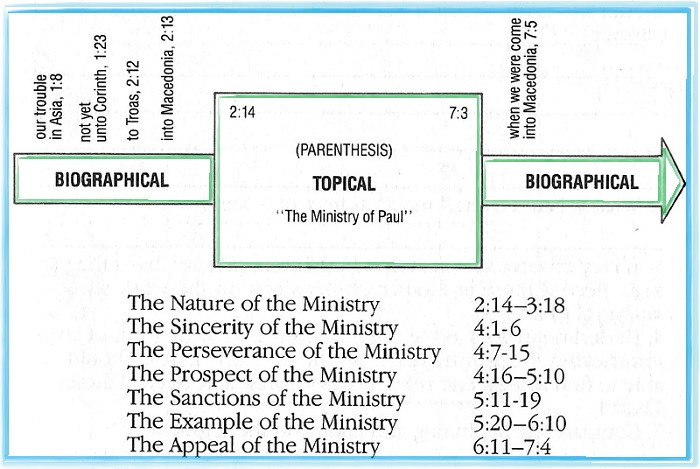
* "2 Corinthian Flow Chart" is from "2 Corinthians, A Self-Study Guide" by Irving L. Jensen published by The Moody Bible Institute of Chicago, 1972. Used by permission.
>5. What is a good reason to thank God? (14)
* 2 Corinthians 2:14 "But thanks be to God, who always leads us in triumphal procession in Christ and through us spreads everywhere the fragrance of the knowledge of him."
* "But thanks be to God,"
* "who always leads us in triumphal procession in Christ" -Most versions read this as "leads us in triumph." Many expositors see this as a reference to a military general leading a train of captives into a city. However, Paul does not seem to be bringing in the idea of captivity here, even though it is true that Christians are bond slaves of Christ. The "Expanded Paraphrase" translates this verse, "Now thanks be to God, who always gives us a place of honor in Christ's triumphal procession!" (A Self-Study Guide" by Irving L. Jensen)
* "in Christ" -This phrase (and similar ones) occurs over fifty times in the New Testament, nearly every time in Paul's writings. Union with Christ Underlies all the other doctrines expounded by the apostle. (A Self-Study Guide" by Irving L. Jensen)
* "through us spreads everywhere the fragrance of the knowledge of him"
>How often are we lead this way even though at times we don't feel like it?
* Paul did not have a piece of mind because Titus was not in Troas to give him a report of what was happening in Corith. However, the gospel door was open in Troas. So Paul praised God.
>What is an one of the great things he does for us?
* God leads us to share the gospel even though we do not feel like it or plan it.
>How does God see us? (15)
* 2 Corinthians 2:15 "For we are to God the aroma of Christ among those who are being saved and those who are perishing."
* "For we are to God the aroma of Christ"
* "among those who are being saved and those who are perishing."
>What are the two ways people received the gospel we preach in word and action? (16)
* 2 Corinthians 2:16 "To the one we are the smell of death; to the other, the fragrance of life. And who is equal to such a task?"
* "To the one we are the smell of death;"
* "to the other, the fragrance of life."
* "And who is equal to such a task?" -"Equal" is variously translated as "capable", "sufficient", "qualified", and "equal to the responsibility". It is derived from a Greek root verb "heko" (a transliteration) meaning "to arrive", i.e. "be present".
*
Fragrance of Life or Smell of Death.
Paul breaks off the narrative of his itinerary and characteristically allows his spontaneous spirit to carry him into a lengthy digression (the narrative is not resumed until 7:5). The digression, however, is quite relevant to the main tenor of this letter, for it is an immensely rich outpouring of triumphant faith in praise of the unfailing adequacy of the grace of God for every conceivable situation, no matter how threatening and destructive it may seem to be.
The imagery is that of a Roman triumph in which the victorious general would lead his soldiers and the captives they had taken in a festive procession. At the same time, the people watched and applauded, and the air was filled with the sweet smell released by the burning of spices in the streets. So the Christian, called to spiritual warfare, is triumphantly led by God in Christ, and it is through him that God spreads everywhere the "fragrance" of the knowledge of Christ.
As the gospel aroma is released in the world through Christian testimony, it is always sweet-smelling, even though it may be differently received. The two ultimate categories of mankind are "those who are being saved and those who are perishing (15). To the latter, testifying Christians are the smell of death, not because the gospel message has become evil-smelling or death-dealing, but because in rejecting the life-giving grace of God, unbelievers choose death for themselves. To those who welcome the gospel of God's grace, Christians with their testimony are the fragrance of life. Who is equal to such a task? God, who is the competence of the Christian (3:5). Keep spreading the sweet-smelling gospel. (NIV Study Bible)
Listen to the above comments on 2 Corinthians 2:14-16.
>6. Is preaching for profit new? (17)
* 2 Corinthians 2:17 "Unlike so many, we do not peddle the word of God for profit. On the contrary, in Christ we speak before God with sincerity, like men sent from God."
* "Unlike so many" -Different English translation state the same idea with different vocabulary (i.e. KJV, YLT, HCSB, and ASV "For we are not as(like the) many"). Many had quickly engaged in preaching and teaching for profit. Paul had said that those who sow the word are entitled to receive support. Paul did not use that right. These people were doing more than receiving support. Not even the Jews did this in their synagogues. When ten for more Jews were in a city they usually formed a synagogue. Each would give ten percent of their income as prescribed by tradition for Abraham gave a tithe. The Paul was speaking of got rich on the gospel. Paul received nothing. Often the people who present false claims against others, in fact are the ones who are committing the vile acts they are falsely saying the others commit.
* 1 Corinthians 9:3-4 "This is my defense to those who sit in judgment on me. Don't we have the right to food and drink?"
* 1 Corinthians 9:7-18 "Who serves as a soldier at his own expense? Who plants a vineyard and does not eat of its grapes? Who tends a flock and does not drink of the milk? Do I say this merely from a human point of view? Doesn't the Law say the same thing? For it is written in the Law of Moses: "Do not muzzle an ox while it is treading out the grain." Is it about oxen that God is concerned? Surely he says this for us, doesn't he? Yes, this was written for us, because when the plowman plows and the thresher threshes, they ought to do so in the hope of sharing in the harvest. If we have sown spiritual seed among you, is it too much if we reap a material harvest from you? If others have this right of support from you, shouldn't we have it all the more?
But we did not use this right. On the contrary, we put up with anything rather than hinder the gospel of Christ. Don't you know that those who work in the temple get their food from the temple, and those who serve at the altar share in what is offered on the altar? In the same way, the Lord has commanded that those who preach the gospel should receive their living from the gospel.
But I have not used any of these rights. And I am not writing this in the hope that you will do such things for me. I would rather die than have anyone deprive me of this boast. Yet when I preach the gospel, I cannot boast, for I am compelled to preach. Woe to me if I do not preach the gospel! If I preach voluntarily, I have a reward; if not voluntarily, I am simply discharging the trust committed to me. What then is my reward? Just this: that in preaching the gospel I may offer it free of charge, and so not make use of my rights in preaching it."
>How should one preach the gospel?
* "the word of God" -The word of God at this time is the Old Testament and Jesus teachings. 1 and 2 Corinthians are among the first letters written by the apostles. 1 and 2 Thessalonians and probably Galatians are older. Some of Jesus' sayings were also perhaps written down. But the four gospels were either not started or not finished at the writting of this letter.
* "we do not peddle... for profit" -The original Greek verb "kapeleuo" (a transliteration) is from "kapelos". "Kapeleuo" means "to retail", by implication "to adulterate (figuratively). "Kapelos" refers to a tavern keeper, signifying acting like an unprincipled vintner. This class of men have ever been notorious for adulterating their wines, mixing them with liquors of no worth, that thereby they might increase their quantity. Thus, the mixture was sold for the same price as the pure wine. Isaiah 1:22 proclaiming of false prophets states, "Your silver has become dross, your choice wine is diluted with water."
* "On the contrary, in Christ we speak before God with sincerity"
* "like men sent from God."
* Paul is referring to false teachers who had infiltrated the Corinthian congregation. Such persons -themselves insincere, self-sufficient and boastful - artfully presented themselves in persuasive manner, and their chief interest was to take money from gullible church members. Paul, by contrast, had preached the gospel sincerely and free of charge, taking care not to be a financial burden to the Corinthian believers (11:7-12; 1 Corinthians 9:7-15) (NIV Study Bible)
* 2 Timothy 2:15 "Do your best to present yourself to God as one approved, a workman who does not need to be ashamed and who correctly handles the word of truth."
*
Preaching for Profit.
When I was young, I would come home from school to see a short commercial called "Bowling for Dollars". Men and women would roll their bowling balls down the alley once or twice to get up to a hundred dollars, according to how many bowling pins they knocked down. I never considered whether the owners of the bowling alleys, who were paying for the ads, rigged the pins so they would be less likely to fall over. The intent was to get people to come to the bowling alley, play a few games, eat some food, drink some alcohol, play jukebox songs, play arcade games, and shoot pool. "Bowling for Dollars" was more about getting dollars than giving dollars.
Later, as cable TV spread, so did TV evangelists. "Preaching for Profit" was blatantly overlooked, even though most took in a million dollars every day. Often, these evangelists went from near-poverty to living in millionaire mansions, only to be convicted of fraud. Today, a new form of "Prosperity Gospel" is preached in many mega-churches and on the internet. Prosperity preachers are the same as the TV evangelists of the 1980s and 90s.
Peddling the word of God for profit is nothing new. Paul and the other apostles saw this in their lifetime, too. Verse 17 says, "Unlike so many, we do not peddle the word of God for profit." The Greek word that Apostle Paul used for peddling for profit was commonly used to describe a bartender who watered down their liquor and sold it at the same price as the best-quality liquor. False preachers corrupted the word of God with the intent to get rich.
I stand before God stating that not only have I not grown rich, but I have not taken in any donations, except for less than $30 several years ago, even after 30 years of online service. The website is ad-free, and I do not collect and sell people's personal information. No subscription is required.
Listen to the above comments on 2 Corinthians 2:17.
>7.What are the credentials that really matter in the kingdom of God? (3:1-3)
* 2 Corinthians 3:1-3 "Are we beginning to commend ourselves again? Or do we need, like some people, letters of recommendation to you or from you? You yourselves are our letter, written on our hearts, known and read by everybody. You show that you are a letter from Christ, the result of our ministry, written not with ink but with the Spirit of the living God, not on tablets of stone but on tablets of human hearts."
* "Are we beginning to commend ourselves again?" -The original Greek verb for "commend" is "synistao" or "synistemi" (transliterations) also translated "approve" ,"consist", "show qualifications", and "recommend". Paul is saying, "Why do I need to tell you my qualifications again? Because people there are still challenging my character and qualifications, claiming I am a fraud."
* "Or do we need, like some people, letters of recommendation to you or from you?" -Paul is being sarcastic. He founded the congregation and had lived there for eighteen months. Paul also founded many other congregations, and those he didn't he visited and taught. God preformed miracles among the apostles, including Paul as a witness to their authenticity. Among the miracles was the gift of the Holy Spirit, and the visible display of the gift given. So, of course he would not need such papers.
* "like some people" -Impostors were becoming frequent. So, letters of authenticity were needed. However, the impostors could forge letters of recommendation rather easily. Wax seals were needed. But they too could be forged.
I know of one man who was in seminary school in Korea. An American missionary he was interested in came to the congregation he was ministering at. Before he finished his degree, because of the missionary's ministry, college students began coming to the church. He did not finish his seminary education and left the denomination, though actually he was forced out due to violating his oaths, obligations, and obedience. The two started their own college student bible fellowship which grew. His organization was accountable to no one; no elders, board, or deacons. His teaching and tactics were challenged, especially encouraging college students to separate from their families. The organization was labeled either cult or near-cult. Years later, to overcome opposition, they suspiciously influenced a university in Korea to give him an honorary seminary degree, letters of recommendation he had not obtained through normal and proper channels. The honorary degree was never recognized by those he studied with and under when his originally studies ended. He enjoyed others referring to him with the title professor.
* "Jewish travelers often carried letters of recommendation indicating that Jewish householders could trust them and give them lodging on their journey. In Greco-Roman society, higher-class patrons would write letters recommending their subordinates; such recommendations naturally carried more weight than the person's own claims. Anyone who was trusted could write letters on someone else's behalf (Acts 15:25-27; Acts 18:27; 1 Cor. 16:3), and by such letters a sender could also authorize a messenger (Acts 9:2). Self-commendation was considered acceptable when necessary to defend oneself or to make a point (see comment on 2 Cor. 5:12)." (Bible Background Commentary - The IVP Bible Background Commentary - New Testament)
* "You yourselves are our letter" -Not only the gifts of the Holy Spirit, but also their changed lives proved Paul was indeed sent by God and his ministry was true.
* "written on our hearts, known and read by everybody." -Everyone could see the change when a person became a follower of Jesus because of the witness and teaching of Paul.
* "You show that you are a letter from Christ, the result of our ministry" -The authenticity of Paul's ministry was easy for anyone to see. Paul was more than being sensitive to the fact that virtually everything he wrote or said was liable to be twisted and used in a hostile manner by the false teachers in Corinth.
* "written not with ink but with the Spirit of the living God" -A greater witness.
* "not on tablets of stone but on tablets of human hearts." -The tablets of stone refer to the ten commandment of the old covenant that Moses received from the Lord and carried down the mountain.
* The Corinthian Christians were the letter. Jesus was the author. The pen was Paul. The ink was the Holy Spirit.
*
Chapter 3 Overview.
Paul presents the Corinthian congregation as a living witness to his credentials as a minister of the New Covenant (1-6). Then, he compares the Old Covenant to the New Covenant (7-18).
The Lord God presented the Old Covenant to Israel at Mount Sinai, in the desert (modern-day western Saudi Arabia), through Moses on two stone tablets (Exodus 19-20). The entire law of the Old Covenant is the first five books of the Bible (though some record historical facts too). When Moses came down the mountain to present the ten commandments to Israel, his face shone with the glory of God. This faded over time (Exodus 34:29-30, 33, 35). The Old Covenant brought condemnation because the Israelites were unable to keep it, for all have a fallen, sinful nature.
The Lord Jesus presented the New Covenant to the world at Mount Zion, where Jerusalem is located. The Holy Spirit writes it on the hearts of those who believe in him. When Jesus rose from the dead and ascended to his Father in heaven, his face shone with the glory of God, which never fades. The New Covenant brings righteousness because it relies solely on Jesus's character, what he did on the cross, and his resurrection (1 Corinthians 15).
When I relied on myself for righteousness in God's eyes, I had a veil over my heart. I tried to be a good person. I tried to be accepted by God. But I could not see God nor his Christ through my self-righteousness. I failed. I was separated from God.
Then God took the veil off my heart (16). Now I see Jesus' sacrifice on the cross, atoning for my sins. Now I solely rely on Jesus - who he is and what he did for my righteousness. Now the Spirit of the Lord is in me. Now my relationship with God does not rely on me. I am free in Christ. I am free of the law and condemnation. I am being transformed into the image of the Son with ever-increasing glory (18). Jesus makes me competent as a minister of the New Covenant (5-6).
Listen to the above Chapter 3 Overview.
*
Authentic or Cult Teacher?
How can it be determined if a person is an authentic instructor or a cult authoritarian with a desire to control people and take their earnings? The Jewish religious leaders insisted that Jesus was a charlatan because he was not "one of us".
Pseudo-apostles insisted that Apostle Paul was a pretender because he was not one of the twelve, was not part of Jesus' earthly ministry, and had persecuted the early believers. The Corinthian congregation would have a hard time knowing who to believe because, unlike us, they did not have the New Testament writings, could not reference-check his teachings (except using the Old Testament), and could not review a letter of recommendation, since Paul did not carry any.
Apostle Paul's response was, "Look at the fruit of my labors and remember my actions when I was with you, when I founded your congregation." Jesus' response was the same. The congregation's changed lives, the manifestations of the Holy Spirit because of his teaching, and the miracles were God's testimony of Paul's authenticity. He didn't need a degree written in ink as proof. The Spirit of the living God written on their hearts proved his authenticity.
Jesus, warning about false prophets, taught, "By their fruit you will recognize them," and, "Make a tree good and its fruit will be good, or make a tree bad and its fruit will be bad, for a tree is recognized by its fruit." (Matthew 7:15-20, 12:33). Are you in a group, church, or campus ministry and have questions about their authenticity and motivations? Research the results of their work, their teachings, and their motivations. Seek to know the sincerity behind the smiles, understanding that you will not find perfection, but you should find fruit that aligns with Biblical teaching.
Listen to the above comments on 2 Corinthians 3:1-3.
> Where should our confidence and competence come from? (4-5)
* 2 Corinthians 3:4-5 "Such confidence as this is ours through Christ before God. Not that we are competent in ourselves to claim anything for ourselves, but our competence comes from God."
* "Such confidence as this is ours through Christ before God." -Paul has confidence about the congregation in God's presence. He is confident that they are God's letter of recommendation of the work he preformed in the foundation of the congregation there. He clarifies that the confidence does not come because of his abilities. Rather, his confidence in Christ and Christ's work in their hearts.
* "Not that we are competent in ourselves to claim anything for ourselves" -"Competent" is both verses is the Greek adjective "hikanos" (a transliteration) in verse 5 and the Greek verb "hikanoo" (a transliteration) in verse 6. "Hikanoo" is from "hikanos". "Hikanos" is from the Greek primary verb "heko" meaning "to arrive, i.e. be present". "Hikanos" primarily meant "sufficient," "enough," or "adequate." Depending on the context, it was used to describe things that were substantial in quantity, or individuals who were qualified and competent for a specific task. Paul is saying he is able not from something within himself. Rather, his ability to do the work properly and righteously comes from God.
* "our competence comes from God." -Not from self.
>Who are the ministers per verse 6?
* 2 Corinthians 3:6 "He has made us competent as ministers of a new covenant--not of the letter but of the Spirit; for the letter kills, but the Spirit gives life."
* "He has made us" -Paul continues to use the plural pronouns "ours", "we", and "us" when referring to himself, for who else would he be referring to here? Paul is defending his ministry to counter the false claims concerning only him.
* "competent" -Paul repeats his ability to complete the work assigned to him comes from God. God gave him the ability and skills needed. This does not mean that he didn't need to learn and study. He spent several years in the desert learning from Jesus. (Galatians 1:17)
* "as ministers" -The Greek noun "diakonos" or "diaconos" (a transliteration) means "servant" and "an attendant". Jesus referred to himself as a servant many times.
"Greek 'diaconos', usually a subordinate officer or assistant employed in relation to the ministry of the gospel, as to Paul and Apollos (1 Corinthians 3:5), Tychicus (Ephesians 6:21), Epaphras (Colossians 1:7), Timothy (1 Thessalonians 3:2), and also to Christ (Romans 15:8)." (Illustrated Bible Dictionary: And Treasury of Biblical History, Biography, Geography, Doctrine, and Literature)
* Ministers are those who serve the cause of God (Romans 15:16; Colossians 1:7, 4:7; 1 Timothy 4:6) Paul will return to the theme of "this ministry" in 4:1. (NIV Study Bible)
* "of a new covenant" -Paul continues "tables of human hearts" mentioned in verse 3. The prophet Jeremiah revealed that the Lord would introduce a New Covenant. (Jeremiah 31:13; Hebrews 8:8) Jesus introduced the New Covenant in his blood at the end of the Last Supper. (Luke 22:20; 1 Corinthians 11:25) "By calling this covenant "new," he has made the first one obsolete; and what is obsolete and aging will soon disappear." (Hebrews 8:13)
"Christ is the mediator of a new covenant, that those who are called may receive the promised eternal inheritance--now that he has died as a ransom to set them free from the sins committed under the first covenant." (Hebrews 9:15) Paul, says he is a minister of the New Covenant meaning a servant.
>What are we ministers of?
* We are ministers of the New Covenant.
* "not of the letter but of the Spirit" -The Old Covenant was was written with letters. The New Covenant was written with the Spirit.
*
Competent Ministers.
The Lord Jesus forgave Paul and called him to minister to the Gentiles and Israel. Jesus, as Lord and God, equipped Paul to accomplish the ministry he had given him. Paul had confidence that God was and would continue to work within the congregation at Corinth through his ministry.
Paul had confidence in God, not in himself. This did not mean that Paul sat back and waited for God to do things. Rather, Paul continued to actively engage in ministry, all the while knowing and believing that God was the one who gave him the abilities needed to accomplish the mission.
God makes us competent as ministers of a new covenant - not of the letter as the old covenant but of the Holy Spirit; for the letter kills, but the Spirit gives life.
When God reveals his purpose within ministry, calling you to purpose within the church, do not let fear of ability stop you from obeying. Know that God who calls us to mission will also equip us for that mission. This does not mean the mission will be easy, nor that we will not need to learn. Rather, it means that he will apply and use all within and without us to do what he had called us to do. We need to have confidence that God will complete his work through us.
Listen to the above comments on 2 Corinthians 3:4-6.
>What is a major difference between the old and the new covenant?
* "for the letter kills" -The Old Covenant laws and stipulations kill because they expose and strengthen our sinful nature which has great power over fallen mankind, causing us to sin all the more. Paul is not saying that the external, literal sense of Scripture is deadly or unprofitable while the inner, spiritual (mystical or mythical) sense is valid. "The letter" is synonymous with the law as an external standard before which all people, because they are lawbreakers, stand guilty and condemned to death. Therefore it is described as the "ministry that brought death" and the "ministry that condemns" (7-8). On the other hand, the Spirit who give life is the "Spirit of the living God" who, in fulfillment of the promise of the New Covenant, writes that same law inwardly "on tablets of human hearts" (3). He thus provides the believer with love for God's law, which previously he had hated, and with power to keep it, which previously he had not possessed. (parts taken from the NIV Study Bible)
* "but the Spirit gives life." -The writing of the law "with the Spirit of the living God... on tablets of human hearts," which was the promise of the New Covenant as foretold by the prophets. (Jeremiah 31:31-34, 32:39-40; Ezekiel 11:19, 36:26)
* Jesus fulfilled and completed the Old Covenant with all its laws, regulations, and requirements. The entire sacrificial and Levitical system was no longer needed for the pointed to Christ, who completed them. The New Covenant provides what the Old Covenant could not. If these were not true, then why did the Messiah make a New Covenant?
>8. How does the law bring death? (7; Rom. 7:7-13)
* 2 Corinthians 3:7 "Now if the ministry that brought death, which was engraved in letters on stone, came with glory, so that the Israelites could not look steadily at the face of Moses because of its glory, fading though it was,"
* Romans 7:7-13 "What shall we say, then? Is the law sin? Certainly not! Indeed I would not have known what sin was except through the law. For I would not have known what coveting really was if the law had not said, "Do not covet." But sin, seizing the opportunity afforded by the commandment, produced in me every kind of covetous desire. For apart from law, sin is dead. Once I was alive apart from law; but when the commandment came, sin sprang to life and I died. I found that the very commandment that was intended to bring life actually brought death. For sin, seizing the opportunity afforded by the commandment, deceived me, and through the commandment put me to death. So then, the law is holy, and the commandment is holy, righteous and good. Did that which is good, then, become death to me? By no means! But in order that sin might be recognized as sin, it produced death in me through what was good, so that through the commandment sin might become utterly sinful."
* Galatians 3:19-22 "What, then, was the purpose of the law? It was added because of transgressions until the Seed to whom the promise referred had come. The law was put into effect through angels by a mediator. A mediator, however, does not represent just one party; but God is one. Is the law, therefore, opposed to the promises of God? Absolutely not! For if a law had been given that could impart life, then righteousness would certainly have come by the law. But the Scripture declares that the whole world is a prisoner of sin, so that what was promised, being given through faith in Jesus Christ, might be given to those who believe."
* "the ministry" -Paul uniquely refers to the Law Moses presenting as stipulations of the Old Covenant (the Law found in the first five books of the Bible) as a ministry. In verses 6 Paul stated he was a competent minister of the New Covenant.
The original Greek noun is "diakonia" from the Greek noun "diakonos" (in verse 6) probably from the obsolete Greek verb "diako" (all transliterations). In the first century, the Greek word "diakonia" meant service, errand-running, or acting as an intermediary. More than a purely religious term, it was used in everyday Hellenistic culture to describe a broad range of practical duties-from waiting tables and managing household affairs to carrying official messages. (See question 7c above.)
* "the ministry that brought death" -Sin, which exists within all mankind, is the problem. Sin has power over us. Sin uses the law to produce death in us. The law says that if we break it, we will die. Sin takes that stipulation and uses it to enact death in my body, soul, and spirit. I decide to submit to the power of sin, breaking the law, and the law pronounces death.
* "which was engraved in letters on stone" -Ten commandments were engraved on stones by the finger of God on the mountain. They were proclaimed to the Israelites at Mount Sinai. (Exodus 24:12, 31:18, 32:15-16; Deuteronomy 9:10)
* Paul contrasting ministers of the New Covenant to ministers of the Old Covenant in verses 6 and 7 is probably renouncing legalism in opposition to the decision of the apostles decision at the council at Jerusalem (Acts 15); that is, Jews who still insisted Gentles must obey Jewish customs and the Old Testament laws. They may have claimed to be associates of Peter (1 Corinthians 1:12) and who are referred to as Hebrews in 11:22.
>What was one way that God displayed that the law was good? (Exodus 34:29-32)
* Exodus 34:29-32 "When Moses came down from Mount Sinai with the two tablets of the Testimony in his hands, he was not aware that his face was radiant because he had spoken with the LORD. When Aaron and all the Israelites saw Moses, his face was radiant, and they were afraid to come near him. But Moses called to them; so Aaron and all the leaders of the community came back to him, and he spoke to them. Afterward all the Israelites came near him, and he gave them all the commands the LORD had given him on Mount Sinai."
* "came with glory" -When Moses came down Mount Sinai his face was radiant because he had spoken with the LORD. (Exodus 34:29-35) Other glories were displayed like the loud trumpet like noise that grew louder and louder, the shaking, the fire, and the lightning.
* The law and stipulations of the Old Covenant given at Mount Sinai with Moses as the minister, was in no way bad or evil. The Old Covenant law was holy, righteous, good, and spiritual (Romans 7:12-14). The evil is those who break the law, for the law declares that if anyone breaks it "they will die". The law of the Old Covenant did not have a permanent mechanism to get rid of the power of sin within. The evil in the hearts remained even after the sacrifice of animals.
* "glory" -The NIV has "glory" twice in verse 7, twice in verse 10, and twice in verse 11. "Glorious" is once in verse 8, twice in verse 9, and once in verse 10. "Radiance" is used in verse 13. The KJV, HCSB, and ASV have "glory" and "glorious" eleven times collectively. GW, CSB, and YLT have them ten times collectively.
The original Greek noun is "doxa" or the Greek verb "doxazo" from "doxa" (transliterations). "Doxa" is from the base of the Greek verb "dokeo", a prolonged form of the primary verb "doko".
The ministry of the Old Covenant's introduction was attended with magnificence and splendor. The glory here referred to consisted in the circumstance of sublimity and grandeur in which the law of Moses was given. It was:
The glory of God, as he was manifested on Mount Sinai, as the Lawgiver and Ruler of the people.
The glory of the attending circumstances, of thunder, fire, etc., in which God appeared. The law was given in these circumstances. Its giving-called here the "ministration"-was amidst such displays of the glory of God. It was
A high honor and glory for Moses to be permitted to approach so near to God; to commune with him; and to receive at his hand the law for his people, and for the world. These were circumstances of imposing majesty and grandeur, which, however, Paul says were eclipsed and surpassed by the ministry of the gospel.
(Barnes' Notes on the New Testament.)
See question 9b below for more comments on glory.
>What does the new ministry give that the old covenant did not? (8-9)
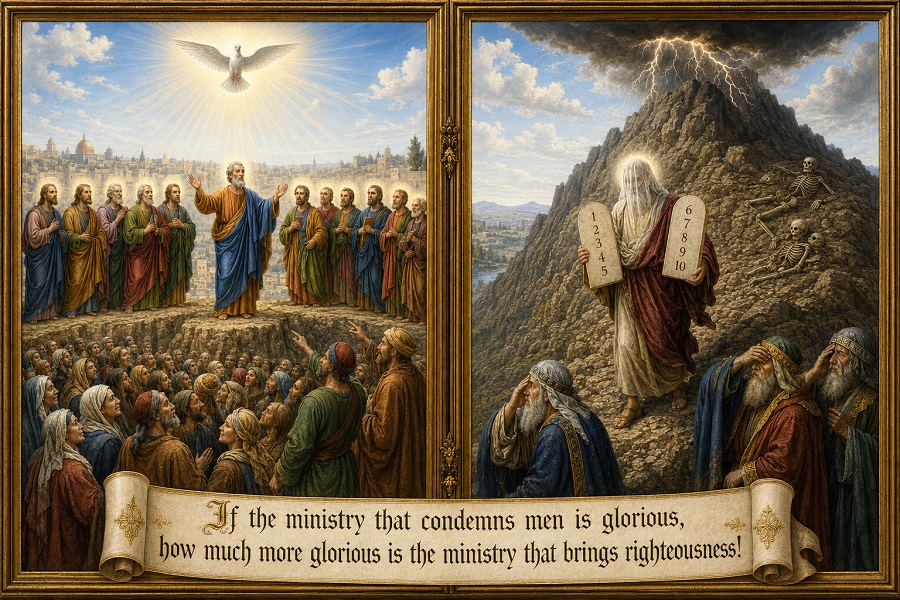
* 2 Corinthians 3:8-9 "will not the ministry of the Spirit be even more glorious? If the ministry that condemns men is glorious, how much more glorious is the ministry that brings righteousness!"
* "condemns" -The law defined sin which has great power, did not give power to resist and overcome sin's power, enabled sin within the body and soul, and condemned death to all who committed even one sin.
* Romans 5:20, 7:7-13.
* "righteousness" -Objective (justification) and personal (sanctification). The Greek words for "righteousness" and "justification" have the same root meaning.
* "brings righteousness" -The ministry of the Spirit gives what the law did not; power to resist and overcome sin's power, and a soul and spirit that is right and pure before and in God.
*
Old Covenant is Death.
The Old Covenant given to Israel at Mount Sinai, as recorded in the first five books of the Bible, is also referred to as the Mosaic Law. Paul, inspired by the Holy Spirit, calls it the letter that kills (6), the ministry that brought death (7), and the ministry that condemns (9). Those who insist on keeping the Old Covenant to this day are dead and are still weak before the power of sin acting within them.
The shortcomings of the Old Covenant, though it is good, defines sin, which has great power, does not give power to resist and overcome sin's power, enables sin within the body and soul, and condemns death to all who commit even one sin. The laws and stipulations of the Old Covenant do not have a permanent mechanism to eliminate the power of sin within. The evil in the heart remains in those following the Mosaic laws even after the sacrifice of animals prescribed by the law.
The New Covenant given by Jesus in his blood at the end of the Last Supper is referred to as the Spirit that gives life (6), more glorious than the old (8), written on human hearts (3), and the ministry that brings righteousness (9). Those under the New Covenant to this day are alive in Christ and have the Spirit's power over sin acting within them.
The excellence of the New Covenant is that it completely removes sin, thus providing righteousness, provides the power to resist and overcome sin, and proclaims life through the Spirit of life. The blood of Christ, on which the New Covenant rests, is a permanent mechanism to eliminate sin and its power within. The evil in the heart is removed from the hearts of those living in the New Covenant after the sacrifice of the Son of God, the Son of Man.
Why claim allegiance to a congregation that claims obedience to the Old Covenant laws is needed to be saved when you can be freed under the New Covenant? Why accept the covenant of death and reject the covenant of life? The only salvation in the old is through absolute obedience all the time. Salvation in the new is through Jesus all the time.
Listen to the above comments on 2 Corinthians 3:7-9.
>9. How sure are we of the glory to come? (10-11)
* 2 Corinthians 3:10-11 "For what was glorious has no glory now in comparison with the surpassing glory. And if what was fading away came with glory, how much greater is the glory of that which lasts!"
* Apostle Paul will compare the Old Covenant to the New Covenant to display the old is inferior and obsolete compared to the new which is greater and lasts. Paul is obviously countering some people who are trying to introduce and force the Mosaic Law on the Corinthian congregation. This was a common problem among the first-century church, and still is today.
* "For what was glorious has no glory now" -The Old Covenant Law was glorious in the fact that it came from God. The obvious fading glory on Moses' face represented the fading glory of the Old Covenant Law. The Old Covenant glory was displayed when the Lord entered the tabernacle and first temple built by Solomon. The display of fire and smoke was momentary, only given once. The glory ceased and is done away when the Messiah came, suffered, died a bloody death, was buried, rose from the dead, and ascended to heaven. Now, Israel does not have access to Mount Sinai in western Saudi Arabia. Now, the tabernacle is gone. Now, the temple is a pile of rubble and the foundation is occupied by a Muslim temple, forbidden to Jews. The Old Covenant has no glory now. The New Covenant has surpassing glory that replaced the old.
* "in comparison with the surpassing glory" -The New Covenant in Jesus' blood as the gospel shares. Jesus rose from dead and presented himself to the Father in perfect holiness, appearing to his disciples in surpassing glory. Jesus sent the Holy Spirit to his disciples in glory.
* "And if what was fading away came with glory" -The Old Covenant of Sinai was not given to endure forever. At the appropriate time it was superseded by the unfading and much more glorious radiance belonging to the New Covenant.
* "how much greater is the glory of that which lasts!" -The New Covenant was for all places, all people, and the remainder of time. God displays his justice, holiness, goodness, grace, love, and majesty. These last.
>How should the hope of what is to come compel us in our ministry now? (12)
* 2 Corinthians 3:12 "Therefore, since we have such a hope, we are very bold."
* "Therefore, since" -The original Greek particle is "oun" usually translated "therefore" including in the KJV and ASV and other English translations, but uniquely translate it "Seeing then" and "Having therefore" respectfully.
* "we have such a hope" -One of the three main elements of Christian character (1Co 13:13). It is joined to faith and love, and is opposed to seeing or possessing (Rom 8:24; 1Jn 3:2). "Hope is an essential and fundamental element of Christian life, so essential indeed, that, like faith and love, it can itself designate the essence of Christianity (1 Peter 3:15; Hebrews 10:23). In it the whole glory of the Christian vocation is centered (Ephesians 1:18. 4:4)." Unbelievers are without this hope (Ephesians 2:12; 1 Thessalonians 4:13). Christ is the actual object of the believer's hope, because it is in his second coming that the hope of glory will be fulfilled (1 Timothy 1:1; Colossians 1:27; Titus 2:13). It is spoken of as "lively", i.e., a living, hope, a hope not frail and perishable, but having a perennial life (1 Peter 1:3). In Romams 5:2 the "hope" spoken of is probably objective, i.e., "the hope set before us," namely, eternal life (Compare Romans 12:12). In 1 John 3:3 the expression "hope in him" ought rather to be, as in the Revised Version, "hope on him," i.e., a hope based on God. (Illustrated Bible Dictionary: And Treasury of Biblical History, Biography, Geography, Doctrine, and Literature)
* "we are very bold." -Exhibiting boldness is requiring or exhibiting courage and bravery. Paul learned boldness from Jesus. Boldness in Christ overcomes in spite of threats of and imposed violence and abuse.
*
Glory Forever More.
Glory is one of those words that has so many meanings and applications that it is hard to define. We can say, "Her hair is her crowning glory." "The sun is a ball of blazing glory." "Give God praise and glory." And here Paul wrote, "If what was fading away came with glory, how much greater is the glory of that which lasts!" (11)
When Moses was on Mount Sinai receiving the Ten Commandments of the Old Covenant, lightning surrounded the top of the mountain, it shook, and a loud trumpet sounded. When he walked down Mount Sinai with the Ten Commandments, his face was radiant. When Moses was in the tabernacle a column of fire entered the tent. (Exodus 19:16-19, 33:9, 34:29-35) Glory was displayed in all this. Yet, the lightning stopped, the face of radiance faded, and the tabernacle is no more.
As the glory of the stars fades away and disappears when the sun rises, so the Old Covenant faded away when the New Covenant came. (10) We of the New Covenant have a hope of the future glory of the Kingdom of God. We see and experience that glory now through the moving of the Spirit. We have a sure hope for our future. So, we are bold in sharing the gospel of the Kingdom of God. "Therefore, prepare your minds for action; be self-controlled; set your hope fully on the grace to be given you when Jesus Christ is revealed." (1 Peter 1:13) Is your hope sure?
Listen to the above comments on 2 Corinthians 3:10-12.
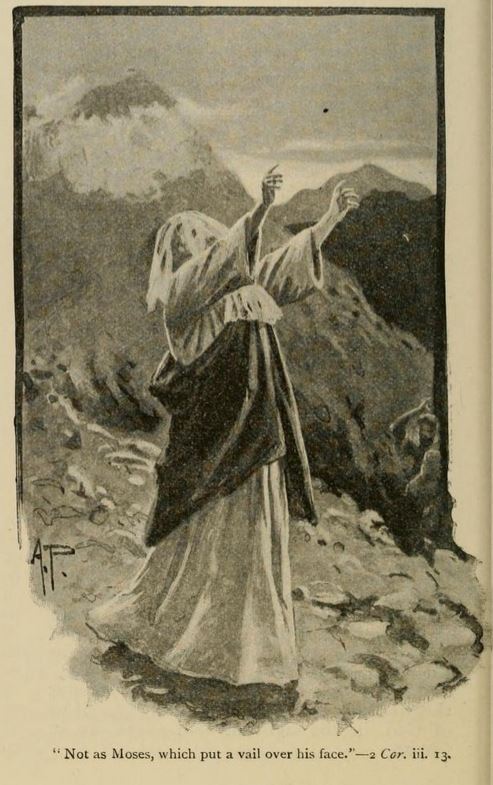
* The illustration is from the Art Bible, 1896, comprising the Old and New Testaments, with numerous illustrations. Publisher, London: G. Newnes.
>What slowly happened after Moses came down the mountain with the law? (13)
* 2 Corinthians 3:13 "We are not like Moses, who would put a veil over his face to keep the Israelites from gazing at it while the radiance was fading away."
* Exodus 34:33-35 "When Moses finished speaking to them, he put a veil over his face. But whenever he entered the LORD's presence to speak with him, he removed the veil until he came out. And when he came out and told the Israelites what he had been commanded, they saw that his face was radiant. Then Moses would put the veil back over his face until he went in to speak with the LORD."
* "while the radiance was fading away." -Note "Bruce's Expanded Paraphrase" translation of 3:13. "He put a veil on his face, to prevent the Israelites from gazing until they saw the end of a glory which was to vanish away." Compare the glory "done away" in verse 7; also compare Exodus 34:30. Paul emphasized in this paragraph that such a veil is "done away in Christ" (14). What does this mean for the Christian? Look at verses 17 and 18 for answers to this. Reading a paraphrased New Testament will also help." (2 Corinthians, A Self-Study Guide" by Irving L. Jensen)
* The Israelites did not notice that the glory was gone because the veil hide it from them. In the same way, the glory of the Old Covenant is long gone, but a veil keeps Jews from seeing and knowing it because a veil is over their heart.
>10. What did Jesus do when he came in regard to the old covenant? (14-16)
* 2 Corinthians 3:14-16 "But their minds were made dull, for to this day the same veil remains when the old covenant is read. It has not been removed, because only in Christ is it taken away. Even to this day when Moses is read, a veil covers their hearts. But whenever anyone turns to the Lord, the veil is taken away."
* Lamentations 3:64-66 "Pay them back what they deserve, O LORD, for what their hands have done. Put a veil over their hearts, and may your curse be on them! Pursue them in anger and destroy them from under the heavens of the LORD."
* "But their minds were made dull" -The Lord did this as prophesied by the author of Lamentations believed to be the prophet Jeremiah when Jerusalem and the Temple were destroyed by Babylon. The prophecy concerned the rejection of Jesus, the Messiah as the Apostle Paul was inspired by the Holy Spirit to revealj.
* "for to this day the same veil remains when the old covenant is read" -Repeated in verse 14.
* "only in Christ is it taken away" -When Israel accepts Jesus is the Messiah foretold by the law and prophets, Jesus removes the veil that keeps them from seeing the truth even though they hear and read the law and stipulations of the Old Covenant, which is superseded by the New Covenant.
* "But whenever anyone turns to the Lord, the veil is taken away." -A repeat that adds the requirement for God to act.
>What does this practically mean to us?
*
Jesus Removed the Veil.
Moses was on Mount Sinai with the Lord, receiving the ten commandments carved in stone. When he came down the mountain, his face was radiant with glory, and Aaron and Israel were afraid to come near him. So, Moses put a veil over his face. The radiance began to fade until it was no more, but Israel did not notice because Moses kept the veil over his face. (Exodus 34:29-35). This is a lesson of the temporary and weak natures of the Old Covenant.
The Lord punished Judah for their sins and for ignoring the prophets he sent them by sending the Babylonians to burn down Jerusalem and completely destroy the temple. When the punishment was completed, the prophet Jeremiah pronounced a punishment for the day they would also reject the Messiah, Jesus, "O LORD, you have heard their insults, all their plots against me- what my enemies whisper and mutter against me all day long. Look at them! Sitting or standing, they mock me in their songs. Pay them back what they deserve, O LORD, for what their hands have done. Put a veil over their hearts, and may your curse be on them! Pursue them in anger and destroy them from under the heavens of the LORD." (Lamentations 3:61-66; See 1 Corinthians 16:22 and Galatians 3:10-13)
The Holy Spirit reveals through the Apostle Paul that the veil remains. Is there any hope for people who have a veil over their hearts? Yes! Only in Christ is it taken away. (14) Whenever anyone turns to the Lord, the veil is taken away. (16) "Christ redeemed us from the curse of the law by becoming a curse for us." (Galatians 3:13a)
Listen to the above comments on 2 Corinthians 3:13-16.
>What does verse 17 mean?
* 2 Corinthians 3:17 "Now the Lord is the Spirit, and where the Spirit of the Lord is, there is freedom."
* "Now the Lord is the Spirit" -"Lord" is the Greek noun "Kyrios" (a transliteration) meaning "a supreme master". "Kyrios" is used in the Septuagint, the oldest Greek translation of the Hebrew Bible (3rd century B.C.). The Hebrew equivalent, "Adonai", is a substitute for what God told Moses his name was, "I AM WHO I AM," "I AM". (Exodus 3:14) "Adonai" is shortening God's name by removing all the consonants. Adonai originated as a scribal and spoken tradition. In the ancient biblical texts, God's personal covenant name is the Tetragrammaton (YHWH/Yahweh). Out of deep reverence and to avoid breaking the commandment against misusing the Lord's name, ancient Israel, then Jewish scribes and readers began substituting the spoken name YHWH with "Adonai". (Leviticus 24:16) "Adonai" appears over 400 times in the Old Testament, with its first recorded use in Genesis 15:2 when Abram addresses God as "Lord God" (Adonai Elohim). It is used frequently by prophets and figures like Moses and Isaiah to express submission and reliance on God.
"Spirit" is the Greek noun "Pneuma". Lord is usually linked with Jesus. Paul links Lord with Spirit here. The Hebrew equivalent is "rauh". They mean "wind" or "breath". When God created man he "breath into his nostrils the breath of life, and the man became a living being." (Genesis 2:7) So, again the Holy Spirit comes and gives life to all who believe and call on the name of the Lord Jesus, the Son of God.
* "where the Spirit of the Lord is, there is freedom." -When the Spirit is in a person he is their Lord and he grants freedom from the previous Lord of death.
* Every English translation has the sentence the same except the last word.
* "freedom" -The HCSB, GW, and CSB also have "freedom". The KJV, ASV, and YLT have "liberty". The original Greek noun is "eleutheria". It was widely used in the first century to describe the opposite of slavery-specifically, a person's physical and social release from being owned, as well as the political independence of a society from foreign domination.
"Eleuatheria" expresses liberation and freedom from the restrictions of the Mosaic law of the Old Covenant, emphasizing a new state of moral and spiritual autonomy, as in this chapter and others. It also expresses freedom from the bondage of sin and the fear of death. The Law was are old lord which killed us. The Spirit freed us from the old lord and became our new Lord of life forever more.
Opposed the the Biblical New Testament view, Hellenistic philosophers like the Stoics used "eleutheria" to describe personal, internal freedom. Because they recognized that physical circumstances couldn't always be controlled, "eleutheria" referred to an individual's ability to master their own desires and emotions. Theirs is the humanistic viewpoint in the fact that it does not included the Lord Spirit. They came from a human point of view, separate from God. Human's can control some parts of their life, but even the humanistic Stoics recognized and accepted our limitations. The Corinthian congregation members needed to put accept the limitations of a humanistic centered viewpoint and accept a God centered Lordship of their person life and being.
>Does the glory come from within us? (18)
* 2 Corinthians 3:18 "And we, who with unveiled faces all reflect the Lord's glory, are being transformed into his likeness with ever-increasing glory, which comes from the Lord, who is the Spirit."
* "And we" -All believers in Jesus. Not just some. This is true because it comes at the beginning of the Spirit and the believer becoming one.
* "who with unveiled faces all reflect the Lord's glory" -The moon reflects the sun's light, a universally accepted first century fact. A mirror reflects light, the common use of the Greek verb "katoptrizo" (a transliteration). The sun is the source of light. The moon and mirror are not the source. Their composition is not they same as the source. The moon and mirror do not produce the light. Our glory is a reflection of God's glory.
* Paul is still comparing Moses and the Old Covenant to Christians and the New Covenant. Christians have unveiled faces, meaning we see clearly and are seen clearly by all. What is seen is the Lord's glory. (See above for comments on "glory".)
>What continual process is being done in true believers?
* "are being transformed" -Grammatically, this is a passive voice verb in the present continuous (or progressive) tense, indicating an ongoing process being done to the subject, "we" by an outside agent, "the Holy Spirit".
The transformation Paul is referring to is not like the Greek philosophers who taught the possibility of becoming "metamorphosed" or "transformed" toward divinity by contemplating divine things. Neither, is the Christian's transformation like a transformation written in the Dead Sea Scrolls for their righteous reflecting divine slender like Moses did because they kept all the laws and stipulations of not only the Old Covenant, but also their sect.
Paul is using Moses radiant face as contrast to the Christian continual transformation. Moses radiance diminished and ceased. Jesus' followers transformation increases in glory.
* "into his likeness with ever-increasing glory"
* "which comes from the Lord, who is the Spirit."
*
From Glory to Glory.
The Spirit is the Lord of those who believe in Jesus (17-18). Lord, in the original Greek, has the equivalent meaning of the Hebrew word Adonai. (Exodus 3:14) The meaning of both is the "Supreme and Almighty Master". Abraham called God, "Adonai Elohim". "Elohim," meaning "Almighty God," is the name for God in Genesis 1:1. The Spirit is, therefore, the Supreme Master Almighty God.
"Where the Spirit of the Lord is, there is freedom." (17b) The Spirit is within those who accept Jesus as Messiah and call on his name. Our Lord the Spirit freed us from our old master, which was the laws and stipulations of the Old Covenant. They ruled over us through death and sin (7). The old master has no power over me. I have a new Master, the Spirit, and he is life everlasting (11b).
The Lord, my master, is transforming me into his likeness with ever-increasing glory. I am like the moon or a mirror reflecting light. I reflect the surpassing glory of the Lord (10), who is the Spirit. My transformation is not physical. My transformation is spiritual. My transformation is not by my power or will. My transformation comes from the Holy Spirit. We see and experience the glory now through the moving of the Spirit.
Remember Apostle Peter's words in the days of persecution upon us and ever-increasing, "Dear friends, do not be surprised at the painful trial you are suffering, as though something strange were happening to you. But rejoice that you participate in the sufferings of Christ, so that you may be overjoyed when his glory is revealed. If you are insulted because of the name of Christ, you are blessed, for the Spirit of glory and of God rests on you." (1 Peter 4:12-14)
Listen to the above comments on 2 Corinthians 3:17-18.