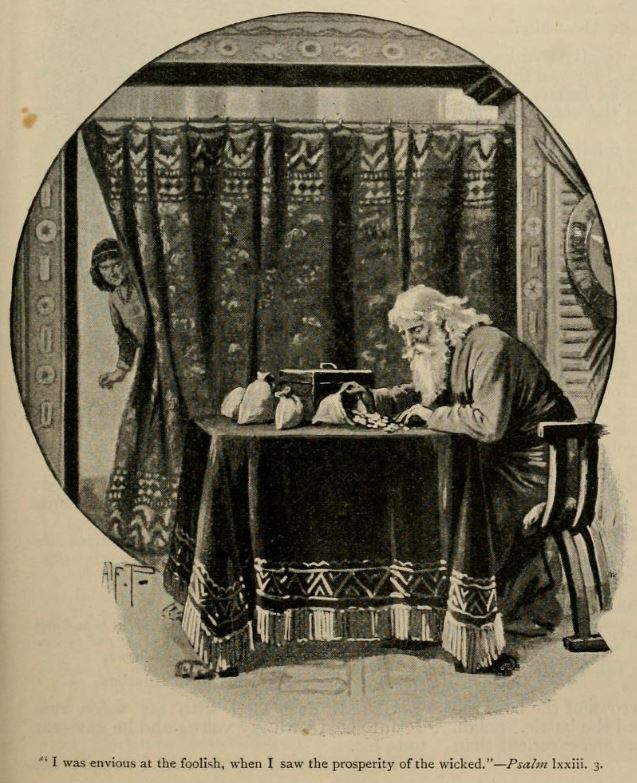
* A depiction of a young man catching a glimpse of a rich old man counting his money. Notice the look on each man's face. Psalm 73:3 is cited.
The artwork is from the Art Bible. The artists initials are in the lower left.
>1. Who is accredited in writing his psalm? What is the opening declaration?
* Psalm 73:1 "Surely God is good to Israel, to those who are pure in heart."
* The title is, "A psalm of Asaph.".
* Psalm 40 begins Book III of the Psalter, the third of the five scrolls.
* Proverb 73 is a proverb-psalm comparing the pure in heart to the wicked. The psalm can be paralleled to Psalm 1, the beginning of the entire book. Psalm 49 is also a proverb-psalms, thematically the same. Psalm 37 might also be labeled a proverb-psalm, but not like Psalms 49 and this one for it is a direct teaching. Thematically, Psalm 37, 49, and 73 are addressing the same subject, the impoverished pure in heart compared to the rich evil wicked.
* The psalm has two diametric antipodal halves, 14 verses each. The psalm is framed by the deeply engraved contrasting verses 1 and 27. Verse 28 is the authors personal resolve.
* "Asaph" -Asaph, the author of this psalm was the Levite musician King David appointed to serve in the Tabernacle until the Temple was completed. (1 Chronicles 6:39) He was the father of the clan of Temple musicians who served throughout the history of the Temple - Solomon's and the rebuild. (1 Chronicles 9:1, 15, 15:19, 16:7, 37) Musical service including writing psalms is considered prophesying. (1 Chronicles 15:1-7) Prophesying is being carried along by the Holy Spirit. (2 Peter 1:21) The entire book of the Psalms derives from the intervention and leading of the Holy Spirit upon unique individuals.
Asaph's first psalm to appear in the Psalter is Psalm 50. Psalm 73 is the first of eleven consecutive in Book III. Some believe that Psalm 50 once belonged to the eleven, but somehow ended up in the Davidic psalms. The Asaph collection seems to contain prayers from a later dated (Psalm 74, 79, 83), references to Asaph himself in these titles must sometimes include his descendants, whose choirs held onto his name, no different than musical groups do to this day.
* Verse 1 is the conclusion of the trial of faith presented in the entire psalm.
* "Surely" -Various English translations express the thought behind the Hebrew phrase here. The KJV has, "Truly God..." The ASV is as the NIV, "Surely God..." The HCSB and CSB have, "God is indeed..." GW has, "God is truly..." YLT has, "Only - good to Israel is God..."
"The Hebrew adverb "ach", does not here imply a simple affirmation 'certainly', as it often does in other places, but is taken adversely for 'yet, notwithstanding', or some similar word. Asaph opens the psalm abruptly; and from this we learn, what is worthy of particular notice, that before he broke forth into this language, his mind had been agitated with many doubts and conflicting suggestions. As a brave and valiant champion, he had been exercised in very painful struggles and temptations; but, after long and arduous exertion, he at length succeeded in shaking off all perverse imaginations, and came to the conclusion that yet God is gracious to his servants, and the faithful guardian of their welfare." (Calvin's Commentaries)
* "God is good to" -The first half of the conclusion, joined with verse 28. The second half of the conclusion is verse 27.
* "Israel, to those who are pure in heart" -Israel is defined as the pure in heart, not the physical descendants of Abraham.
>What almost happened to the author? How might you related? (2)
* Psalm 73:2 "But as for me, my feet had almost slipped; I had nearly lost my foothold."
* "But as for me" -Repeated in verse 28. Verse 2 was as he was at first. Verse 28 was as he was after meeting God.
* "almost slipped... nearly lost my foothold" -And so would have fallen into the pit, that is, the grave (Sheol) with others who are far from God (27).
* The prophet Habakkuk had a similar struggle with the Lord. He was told by the Lord through the prophet Jeremiah, a contemporary prophet, that Babylon was going to completely destroy Judah and Israel as punishment for their sin. Habakkuk argued with God over his ways that appear to him unfathomable, if not unjust. Having receiving replies, he responded, like Asaph, with a beauriful confession of faith.
>What was the specifics of his crisis of faith? (3) Why do people envy the rich? What feelings are added when they are wicked?
* Psalm 73:3 "For I envied the arrogant when I saw the prosperity of the wicked."
* "I envied" -Envy is 1) A feeling of discontent and resentment aroused by and in conjunction with desire for the possessions or qualities of another, 2) The object of such feeling.
* "the arrogant" -Arrogant is 1) Making or disposed to make claims to unwarranted importance or consideration out of overbearing pride and 2) Marked by or arising from arrogance, marked by contempt for the weak and/or people who they see as lesser then them.
* "when I saw the prosperity" -Asaph may have received derogatory remarks from the rich. Yet, he definitely was enticed by their possession and way of life.
* Envy of the Wicked who Prosper.
Asaph, or one of his descendants, whom David assigned to lead the Levitical choirs (1 Chronicles 16:37, 25:1-2, 6), wrote Psalm 73 as well as at least twelve other psalms in the Psalter. Asaph was an important chosen man of faith. Yet, he was little different from the faithful today.
Psalm 73 records a personal crisis of faith on the thematic lines of Psalm 1 (unstated author), 37 (of David), and 49 (of Korah). Every believer has at least once, and probably many more times, envied the arrogant who prosper, though they are wicked evil.
The author surprisingly states half of his conclusion and resolution at the beginning of the psalm and the contrasted second half of his conclusion in verse 27, perhaps to serve as more than a fact that challenges our faith as we struggle with an ever-present snake that often raises its head from the grassy fields of our conscience. Why does God allow the wicked to prosper, and I, who remain faithful to the Lord God and always serve him, remain struggling to pay every bill, and at times cannot? I even tithe, obeying the promise, and here I am watching the wicked get richer and richer, and my sometimes scantiness remains.
Struggling to understand how and why the righteous Lord God of heaven and earth allows these things to continue generation after generation, Asaph analyses the wicked in the first half of the psalm (14 verses) that contrasts with the righteous in the second half (14 verses) of the psalm. Jesus' parable of the rich man and Lazarus is a thematic match to this psalm (Luke 16:19-31). One lesson there is, 'Son, remember that in your lifetime you received your good things, while Lazarus received bad things, but now he is comforted here, and you are in agony. (Luke 16:25)
Listen to the above comments on Psalm 73:1-3.
>2. What two aspects of life did the rich wicked have that Asaph did not in verse 4?
* Psalm 73:4 "They have no struggles; their bodies are healthy and strong."
* "They have no struggles" -Variation in English translations are explained below. The Hebrew is "Harsob mawet" (a transliteration).
* NIV text note, "With a different word division of the Hebrew; Masoretic Text, "struggles at their death; / their bodies are healthy".
The Masoretic Text is the authoritative Hebrew and Aramaic text of the 24 books of the Hebrew Bible in Rabbinic Judaism. The Masoretic Text defines the Jewish canon and its precise letter-text, with its vocalization and accentuation known as the masora.
The Masoretic Text is the basis for most Protestant translations of the Old Testament such as the King James Version (KJV), English Standard Version (ESV), New American Standard Bible (NASVB), and New International Version (NIV). After 1943, it has also been used for some Catholic Bibles, such as the New American Bible (NAB) and the New Jerusalem Bible (NJB). Some Christian denominations instead prefer translations of the Septuagint as it matches quotations in the New Testament.
* "their bodies are healthy and strong." -They have time to exercise and money to eat healthy. They have access to good medical attention.
>What two aspects of life did the rich wicked have that Asaph did not in verse 5?
* Psalm 73:5 "They are free from the burdens common to man; they are not plagued by human ills."
* "They are free from the burdens common to man"
* "they are not plagued by human ills."
* Job 21 addresses more than these four after asking, "When I think abut this, I am terrified; trembling seizes my body. Why do the wicked live on, growing old and increasing in power?"
* They Have, I Like, I Want.
Asaph confessed that he envied the arrogant wicked (3). He presents in verses 4 and 5 four advantages that the righteous faithful often do not have because they are poor. First, the rich wicked have no struggles. When trouble comes, they throw money at the problem, and it goes away. Nothing comes their way that money cannot solve. Money comes easily to them because they steal without conscience or fear of conviction. So they always have enough money to solve problems.
Second, their bodies are healthy and strong. They have time to get good exercise, eat healthy food, and have access to good, reliable medical care.
Third, they are free from the burdens common to man. They do not have a job, they are their own boss. Paying bills and expenses is not a concern. They do not have to worry about how to feed the family. They eliminate all threats through violence and money... and money and violence.
Fourth, they are not plagued by human ills. They enjoy privileges that money buys and fear gains. Calamities do not come their way by the design of God. Therefore, luxurious pleasures and enjoying great ease will be their only pursuit, and they will protect a continual flow of life full of them. Free of burdens, they always enjoy life
Job, while struggling like Asaph, in chapter 21, addresses more than these four after asking, "When I think about this, I am terrified; trembling seizes my body. Why do the wicked live on, growing old and increasing in power?" Job goes on and tells of many things that always go their way because "the rod of God is not upon them".
Listen to the above comments on Psalm 73:4-5.
>3. What are two results listed in verse 6 because of the four conditions of being rich as listed in verses 4 and 5?
* Psalm 73:6 "Therefore pride is their necklace; they clothe themselves with violence."
* "Therefore pride is their necklace" -These people were fellow Israelites, not gentiles. Many ancient Middle Eastern culture civil rulers and officials wore chains of gold and had golden rings. As the chains of power were outward signs to everyone, so they let all know they were violent people who should not be messed around with. The Chaldee, instead of a chain, represented their civil power with a crown or diadem (Proverb 1:9, 3:3, 22), which they had formed out to the plunder of the poor and defenseless.
* "they clothe themselves with violence." -They surrounded themselves with violence in glory so all could see and be awed at their greatness. They glory in their violence and believe everyone will be impressed. They parade it around showing they did not fear man or God. Their pride begets violence.
Clothing and a necklace are not the problem, it is the pride and vanity that can go with them that is the problem.
>What does their callous heart result in? (7)
* Psalm 73:7 "From their callous hearts comes iniquity; the evil conceits of their minds know no limits."
* "callous hearts" -No love, mercy, or compassion. They hate everyone.
* NIV text note says, "Syriac (see also Septuagint); Hebrew 'Their eyes bulge with fat'" Some other English translation have this rendering, leaving the modern ready wondering what it means. The commentaries I have state that translating this "Their eyes bulge with fat" is not a proper rending and should not be used.
* "comes iniquity" -Iniquity means "gross immorality or injustice", which is not pleasant to see.
* "the evil conceits of their minds"
* This verse is an ancient saying of perhaps Chaldee origin meaning over abundance changes a person, like gaining weight due to eating to much unhealthy food changes the appearance of a person's face. The lines of the face go away so that a person does not look like who they were. They become a human hog. Their violence and cruelty is not wonderful to see.
>4. What are two ways their violence and pride expressed per verse 8?
* Psalm 73:8 "They scoff, and speak with malice; in their arrogance they threaten oppression."
* "They scoff" -Believe that others have nothing over them and make it known to others.
* "speak with malice" -Threats to intimidate.
* "in their arrogance they threaten oppression." -Sometimes threats are enough to stop an opponent. Intimidation can win a battle.
>Does their pride know no bound? (9)
* Psalm 73:9 "Their mouths lay claim to heaven, and their tongues take possession of the earth."
* "Their mouths lay claim to heaven" -They claim to take possession. However, no one has ever taken possession of the heavens. The demons tried to take possession, but lost. The tower of Babel was also an attempt. They are foolls, because, if it were not for God's presence, heaven would just be another place. Take God away, and it losses it elegance and grandure.
* "their tongues take possession of the earth." -They claim to take possession. However, no one has ever taken possession of the entire earth.
>Who are "their people"? What do they do? Why? (10)
* Psalm 72:10 "Therefore their people turn to them and drink up waters in abundance."
* "Therefore their people turn to them"
* "drink up waters in abundance."
* NIV text note, "The meaning of the Hebrew for this verse is uncertain."
>Why do they ask the two questions in verse 11? Why are they in error about God?
* Psalm 73:11 "They say, 'How can God know? Does the Most High have knowledge?'"
* "How can God know?" -Irrational thought based on a lack of knowledge of God and an false impression of themselves.
* "Does the Most High have knowledge?" -Because they continually do and nothing happens to stop them, they believe if God exists he either does not know or does not care about the affairs of mankind.
* Callous Hearts.
Asaph, a poor righteous man, compared his life to the rich wicked and saw stark contrasts. He saw four advantages to their wealth (3-4). Now he will determine the effects that their arrogant prosperity has on their personality and relationships.
The rich wicked were prideful (6). They showed off their pride. Ancient Middle Eastern cultures' civil leaders wore necklaces and special clothing, announcing their office. In the same way, the rich wicked announced their pride and violence like a gold chain and special clothing. They wanted everyone to know who they were and what they were capable of to induce fear and awe.
The wicked rich have callous hearts. They do not feel love, mercy, or compassion. Their thoughts are consumed with gross immorality and injustice. They believe they can do anything. They purchase the law and are so full of self-conceit and ability that nothing can stop them (7). They threaten anyone who even thinks of stopping their plans (8).
They set their eyes and plans on conquest not only on earth and the cosmos, but even on heaven. They claim the desire and plan to take everything for themselves and their pleasure (9). Others eagerly believe in their abilities and join in their conquests. They convince themselves that the Most High God does not have the abilities that they do. They say that he does not know that they plan to overthrow him (10-11).
Asaph concludes, "This is what the wicked are like-- always carefree, they increase in wealth." (12) How do I obtain? Am I tempted to bend the truth to obtain a little more? Do I believe that God either doesn't know, or perhaps will allow me to do that which goes against his ways? Does Asaph find resolution to his crisis of faith?
II. In Vain (73:12-22)
* A artwork titled "Reliance on God" is a depiction by Hugo, Herman (1588-1629) from the book "Him[m]lische Nachtigall : singend gottseelige Begirden, der büssend- heilig- und verliebten Seel, nach denen drey Weegen der Reinigung, Erleuchtung, und Vereinigung mit Gott / [Herman Hugo]. Jn hoch-teutscher Sprach verfasst, und mit anmuthigen Kupffern gezieret, durch Joan. Christoph. Hainzmann, Med. D.", of a boy sitting on top of a globe reaching up to heaven towards an angel. The engraver's name, Melchior Kusell, is located in the bottom right corner and the monogram of the artist (SL) is at the lower left. Psalm 73:25 is cited, "Then I have you in heaven and on earth I have no other desire.".
>5. How is verse 12 like verses 4 and 5? How is it different? Why is this possible?
* Psalm 73:12 "This is what the wicked are like always carefree, they increase in wealth."
* "always carefree" -Another way of saying what Asaph did in verse 4, "They have no struggled". They are carefree because like verse 5 states, "they are free from the burdens common to man and are not plagued by human ills" Asaph is saying God keeps them from these. A commentator says that God has set up in every generation a few people that everything goes their way as Asaph describes here, and these people are the worse of the worse, again as Asaph describes here. They always seem to believe that God exists and like the demons shutter, but they still do not live as God desires and made man to life. They are like Asaph describes here. Why? The commentator says to train his people. However, perhaps there are more reasons than that. Still, every example I mention above including Asaph was trained by such evil wicked religious person.
* "they increase in wealth." -Another way of saying what he did in verse 3, "I saw the prosperity of the wicked."
>What did Asaph conclude? (13) What did he assume would happen if he kept his heart pure that did not happen? How was he in error about God? Did Jesus, the Apostles, prophets, and David live like Asaph saw the wicked live?
* Psalm 73:13 "Surely in vain have I kept my heart pure; in vain have I washed my hands in innocence."
* Verse 13 is a summary and conclusion to his initial belief of the life he had lead up till he saw the lifestyle of the wicked rich religious, the moment he had a crisis of faith. Asaph is preparing to move to the next section.
* "in vain" -Repeated twice. His life and belief was not yielding the desired outcome. He was not getting rich. He was not living an easy life. There is no advantage in all his efforts to become pure and holy.
* "my heart pure... my hand in innocence" -Asaph is saying that living according to the covenant law with right motives and attitudes is of no use to a life in this world. Pure heart is also used in verse 1. To wash the hands is emblematic of innocence or purity (Psalm 26:6).
* A possibility exists that Asaph was a young man who had come of age in Jewish Hebrew society no to long before this. While learning the status of Levitical society and organization he also learned that some if not many of the Levitical priest were not as they had appeared from afar. Upon close review, he learned that they were hypocrites who used their positions to make money at the expense of those that God had assigned to them to take care of. They are the same as the priests in Jesus day. Jesus spoke seven woes against the religious leaders as recorded by Matthew.
>How did Asaph describe his life? (14)
* Psalm 73:14 "All day long I have been plagued; I have been punished every morning."
* Verse 14 is the backing evidence to verse 13. This is how he saw his life. God was punishing him for keeping a pure heart while keeping the covenant law and making the religious wicked rich live carefree lives.
* "I am plagued" -Continually living with troubled. He is saying God is giving him trouble. He has not known prosperity.
* "I have been punished every morning" -Punished or chastened by God. The Hebrew word is "towkechah" (a transliteration) implying rebuked and correction as a father keeps his child in check. He is saying God is relentless in supplying him troubles to keep him on the right path.
* 12-14 are best understood as the utterance of Asaph's doubts in God's love and mercy for him. He is saying God loves the wicked religious more than him, a man with pure motives.
* Why Does God Hate Me and Love the Wicked Religious?
Verse 12 stands alone, a conclusion of a man of faith perplexed and embarrassed. Asaph sums up the prior verses, which also acts as an opening statement to the next section, the resolution. Verses 13 and 14 is a firm conclusion to his initial belief when he saw the lifestyle of the wicked rich fellow Israelite, whom appeared religious and compared it to his life. He believed he should be blessed because he kept a pure heart, but instead was punished every morning by a strict God. Then, he learned that God was blessing everything the wicked religious did.
Asaph was a man of faith. He keeps his belief in God in the entire psalm. He had probably believed that a life of faith and obedience would bring prosperity and an easy life. However, when he got a good look at the rich hypocrite he realized they believed in God, but did not serve God and obey his laws. They were wicked evil and yet everything they did succeeded in making them richer and richer. God was blessing them and not him. This lead to his crisis of faith. He began questioning his religion and understanding.
When the Israelites returned from Babylon they said the same thing as Asaph. God rebuked them through the prophet Malachi. "It is futile to serve God." They complained. "What did we gain by carrying out his requirements and going about like mourners before the Lord Almighty? But now we call the arrogant blessed. Certainly the evildoers prosper, and even those who challenge God escape." (Malachi 3:14-15) "You have said harsh things against me," says the Lord. (Malahi 3:13) Some feared the Lord and repented and they were remembered by God. "They will be mine," says the Lord Almighty, "in the day when I make up my treasured possession. I will spare them, just as in compassion a man spares his son who serves him. And you will again see the distinction between the righteous and the wicked, between those who serve God and those who do not." (Malachi 3:15-15) God reveals Asaph the resolution to the spiritual crisis next.
>6. What is Asaph talking about in verse 15?
* Psalm 73:15 "If I had said, I will speak thus, I would have betrayed your children."
* "children" -"Ben" in the original Hebrew (a transliteration) translated elsewhere as "son", "young", and can mean any descendant literally meaning builder of the family.
* He kept his thoughts to himself. If he would have said something, what would his children say? He didn't want to plague his children with such thoughts when he had no resolution. He didn't want them to go down the wrong path. He did not want them to live like the wicked.
* He didn't want to be the cause of the loss of faith the young had in God because of his struggling thoughts.
* He did not like his thoughts, but he could not ignore them either. He faced his doubts alone, without injuring other's faith.
>What changed his mind? How would entering the sanctuary of God change his mind? What does that have to do with the righteous' final destiny? What does that tell us about what makes the final destiny so great?
* Psalm 73:16-17 "When I tried to understand all this, it was oppressive to me till I entered the sanctuary of God; then I understood their final destiny."
* Verses 16 and 17 open the resolution to the crisis of faith.
* "When I tried to understand all this" -He tried to use man's reason. It was not working. He could see no conclusion to his crisis of faith with reasoning.
* "it was oppressive to me" -Asaph could not see a proper conclusion based on what he knew and understand from the Bible and that was oppressive to him. The KJV and ASV translates the Hebrew word "amal" as "painful", while the HCSB and CSB translates it as "hopeless" and the GW as "to difficult for me". YLT has the whole phrase as "And I think to kow this, Perverseness it is in mine eyes". Asaph would have the first five books, Joshua, Judges, Job, 1 & 2 Samuel, and David's Psalms to use to try to find an answer.
* "sanctuary of God" -"Miqdash El" in the original Hebrew (a transliteration". "Miqdash" can also be translated "holy place". It is from the root word meaning consecrated place or thing, a special place, the sanctuary.
* "till I entered the sanctuary of God" -Being of the Levitical line Asaph could enter the Holy Place, but not the Holy of Hollies, which only the High Priest could enter once a year on the Day of Atonement.
* "then I understood their final destiny." -The end judgement and sentence of the wicked.
>7. How did meeting God change his perspective about what is really happening to the wicked? Consider Jesus' parable about the rich man and Lazarus.
* Psalm 73:18 "Surely you place them on slippery ground; you cast them down to ruin."
* "Surely you place them on slippery ground" -They make a choice to defy God. They chose to love money and all that it brings. They chose to not love God. They chose to not love others. Those that chose this slide down farther and farther into the grave into hell. Their prosperity seems to confirm they make right choices. This is an illusion, given to them by the will of God. They get what they want, and what they get in the end is a sudden surprise to them because they find out they are not special.
* "you cast them down to ruin." -The final judgement. The second death.
* Many rich wicked have consumed many things that the human body and soul were never meant to consume and so they are overwhelmed. True. And terror follows. Consider Howard Hughes and Herod, the Great. However, Asaph was revealed their final destiny. This psalm is only is only referring to the final judgement (20, 27).
>What happens to the wicked in the end?
* Psalm 73:19 "How suddenly are they destroyed, completely swept away by terrors!"
* "How suddenly are they destroyed" -Swift. Some say that this is in this life true. However, Asaph is referring only to the judgement to come.
* "completely swept away by terrors!" -Though some rich wicked religious may see sudden ruin in this life and then live a few years, but then again a few do not and pass down their wealth to another. The sudden terror here in not only death, but the judgement that follows.
*
>What event is Asaph referring to in verse 20?
* Psalm 73:20 "As a dream when one awakes, so when you arise, O Lord, you will despise them as fantasies."
* "As a dream when one awakes" -Jesus and the Apostles letters refer to death as sleeping.
* "so when you arise, O Lord" -Jesus arising from his throne in heaven to judge.
* "you will despise them as fantasies." -The wicked's plans as described in verses 7 and 9.
* Much of their plans were dreams that God kept them from accomplishing. Asaph said earlier that all they did they prospered at. However, God had kept the wicked from much of their plans. God held them back. They bragged even claiming heaven and taking all the earth, but they did not.
>After meeting God which changed his life perspective, what did he confess about his previous way of thinking about life? (21-22)
* Psalm 73:21-22 "When my heart was grieved and my spirit embittered, I was senseless and ignorant; I was a brute beast before you."
* "When my heart was grieved and my spirit embittered"
* "I was senseless and ignorant"
* "I was a brute beast before you."
* Till I Entered the Sanctuary.
Asaph, perhaps a young to middle-aged man learning the Levitical priesthood, was in the middle of a crisis of faith in the Lord his God. He kept his burden to himself, not wanting to trouble the religion of his family (15). He had kept a pure life, expecting to be rewarded by God with a prosperous life. Yet, he believed that his piety and obedience to the covenant of the Lord God brought only punishment from the Lord, morning after morning (14). Then, he learned that the religiously wealthy were actually wicked hypocrites and that everything only made them even more prosperous. They were the same as the religious leaders whom Jesus spoke woes to in Matthew 23.
Asaph tried to use human reason to find a solution to his religious problem. He found none, and it was oppressive to him (16). Then, one day, probably serving out his religious duties as a Levitical musician in the temple holy place, that is, the sanctuary of God, the Holy Spirit came upon him, and he was given a new perspective and understanding. Asaph could not understand because he believed that proper religion guaranteed prosperity and easy living. That misconception was part of his false conclusions.
First, God has placed the wicked religious on slippery ground that will cast them down to ruin on the day of judgment (18-19). When Jesus arises from his throne in heaven, he will come to judge a person for the decisions of the heart. Those who reject God and pretend to be religious, but then have a callous heart toward God, and others will be completely swept away by terrors (19).
Second, when Asaph learned of the judgment to come, he realized that when his heart was grieved, and his spirit was embittered, he was senseless and ignorant. He was no more than a beast to God. He did not see the eternal. He only saw the here and now. Consider the hand of God that guides us now the help us as we patiently wait for the eternal glory that we will endure with being with Jesus forever. Nothing compares with being with Jesus. Nothing.
III. It is Good to be Near God (73:23-28)
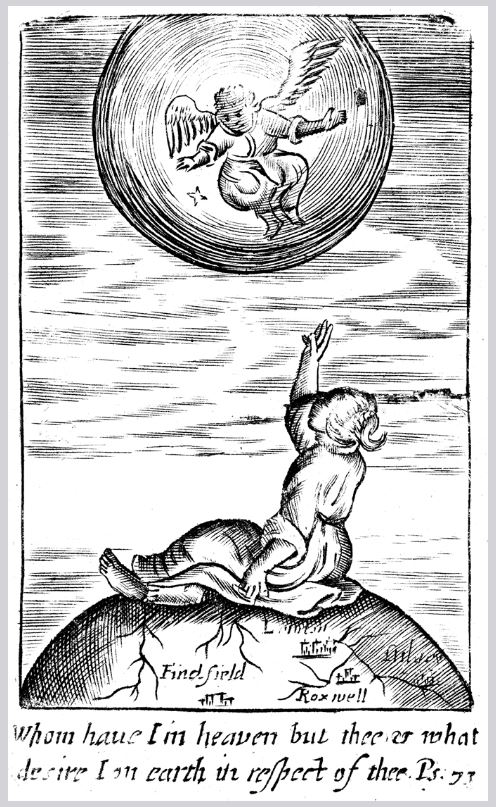
* A artwork titled "Above the Earth" is a depiction by Quarles, Francis (1592-1644) from the book "Emblemes, by Fra. Quarles", of a girl sitting on top of a globe reaching up to heaven towards an angel. Psalm 73:25 is cited.
>8. What did Asaph accept even though he had been wrong?
* Psalm 73:23 "Yet I am always with you; you hold me by my right hand."
* "Yet I am always with you"
* "you hold me by my right hand."
*
>What did he learn about how God dealt with him?
* Psalm 73:24 "You guide me with your counsel, and afterward you will take me into glory."
* "You guide me with your counsel"
* "afterward you will take me into glory."
*
>What was his knew desire and hope? (25)
* Psalm 73:25 "Whom have I in heaven but you? And earth has nothing I desire besides you."
* "Whom have I in heaven but you?"
* "And earth has nothing I desire besides you."
*
>What did he believe about God now?
* Psalm 73:26 "My flesh and my heart may fail, but God is the strength of my heart and my portion forever."
* "My flesh and my heart may fail
* "but God is the strength of my heart and my portion forever."
*
>9. What will happen to those who are far from God?
* Psalm 73:27 "Those who are far from you will perish; you destroy all who are unfaithful to you."
* "Those who are far from you will perish" -"Perish" is the Hebrew verb "adad".
* "you destroy all who are unfaithful to you."
* All that are estranged from thee; all who are not thy friends. They will certainly be destroyed. For them there can be no hope. This is the fact which solved the difficulty of the psalmist in regard to the divine dealings with people. The fact that there will be a righteous judgment, in which God will deal with people according to their deserts, made all plain. (Barnes' Notes on the Old Testament)
>What did he know about his future and how did that change his present life plan?
* Psalm 73:28 "But as for me, it is good to be near God. I have made the Sovereign Lord my refuge; I will tell of all your deeds."
* "But as for me"
* "it is good to be near God"
* "I have made the Sovereign Lord my refuge"
* "I will tell of all your deeds."
* Earth Has Nothing I Desire But You!
Asaph had envied the lifestyle, wealth, possessions, and power of the wicked. Now, after seeing the destiny that awaits the pure in heart, a perfect union with the Holy Almighty Saving God for eternity, Asaph, in peace and contentment, avows with sweet tears, "Whom have I in heaven but you? And earth has nothing I desire besides you. (25) Nothing in heaven or earth is more desirable than God.
Asaph had been like a dumb brute beast before God, senseless and ignorant (22). Polished metal only dimly reflects light. The creator of light wears light that outshines the universe's multitude of stars. Mankind can only claim to own the heavens and earth. Jesus creates and destroys them both. God's counsel overcame Asaph's folly. King Jesus guides his sheep to quiet waters and paths of peace in eternal glory (24).
Those who are far from God will forever remain even farther from God. (27). Even what they think they have will be taken from them and given to another. They will perish (27). Being religious will save no one who is unfaithful to God (27).
"I consider that our present sufferings are not worth comparing with the glory that will be revealed in us." (Romans 8:18) Asaph resolves, "It is good to be near God. I have made the Sovereign LORD my refuge; I will tell of all your deeds.
Apostle Peter wrote, "Praise be to the God and Father of our Lord Jesus Christ! In his great mercy he has given us new birth into a living hope through the resurrection of Jesus Christ from the dead, and into an inheritance that can never perish, spoil or fade--kept in heaven for you, who through faith are shielded by God's power until the coming of the salvation that is ready to be revealed in the last time. (1 Peter 1:3-5)