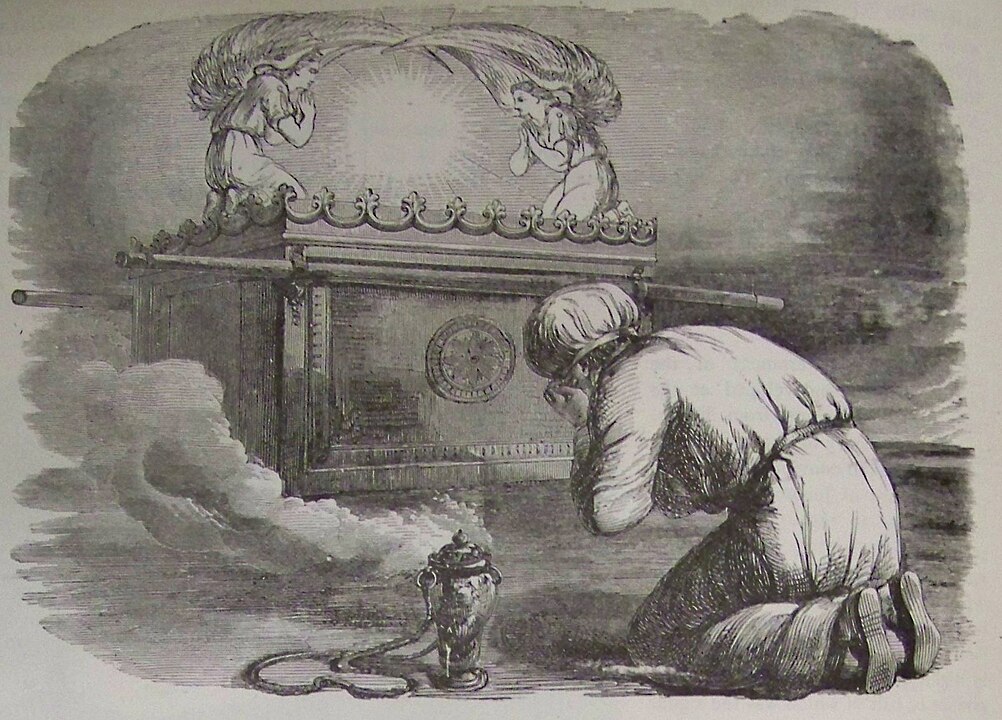
* A depiction of the High Priest at the Mercy Seat, the covering of the Ark of the Covenant which was placed within first the tent of meeting, then the temple in Shiloh, then a tent on Mount Zion, and finally within the temple. The name Mercy Seat is based on the earliest Greek and Latin translations. It is compared to the throne of grace (Hebrews 9:5; Ephesians 2:6). Some suggest that the Mercy Seat was actually the incense that was burned by the high priest on the great day of atonement, and upon or toward which the blood of the goat was sprinkled.
The artwork is in the 1890 Holman Bible.
>1. Who is the author and what is the opening line? What poetic illustration is given? (1)
* Psalm 69:1 "Save me, O God, for the waters have come up to my neck."
* The title is "For the director of music. To the tune of 'Lilies.' Of David." See psalm 45 for another reference to the tune "Lilies". "Lilies" is translated from the Hebrew noun "Shushan" which means "Lily" and "Lilies". That is why the KJV has "To the chief Musician upon Shoshannim..."
Some commentaries wonder if David was the author stating it could be Hezekiah or Jeremiah. I am not sure why someone has a need to suggest someone else based on what they want to suspect with no supporting evidence to support something less than a hunch.
* Psalm 69 can be broken up into these stanzas. I did this trying to follow the logic and flow. See notes on Psalm 68 question one for more about Hebrew Psalms structure. 1-3, 4-5, 6-9, 10-12, 13-15, 16-18, 19-21, 22-25, 26-29, 30-33, 34-36. I also see another grouping set that is logical and follows Hebrew poetic flow, i.e. 1-3 is with 4-5, and with that i.e. 13-18 is grouped with 16-18 being the answer to 13-15 (I pray... Answer me...).
* "The occasion that David wrote this psalm cannot be discovered from the psalm", so some commentaries say, "nor the historical books of the Bible", so they continue. Perhaps this is partly true. However, one possibility is that David is referring to the incident concerning his first son by Bathsheba and the events that lead to the conception as recorded in 2 Samuel 11-12.
One problem with this theory is that psalm 51 title is "A Psalm by David, when Nathan the prophet came to him, after he had gone in to Bathsheba." Yet, Psalm 51 only concerns David asking for forgiveness for his sins, and this one focuses on his enemies response while he is petitioning God. David could have written both for the one event.
Another problem with the theory is after David's sin was exposed by the prophet Nathan, and before the infant dies (He breathed air seven days minimum.), is that 2 Samuel does not record David's enemies rising up against him during that entire incident. Still, David did have many enemies. Human nature would dictate the use of such an event to do just as he says his enemies were doing here. After this event many enemies continued to expose themselves as the Lord foretold through the prophet Nathan.
Also possible is that Psalm 69 happened late in David's life, since some of David's psalms in Books I and II of the Psalter are in somewhat of a chronological order.
So, I believe it is possible that David wrote Psalm 69 sometime after the infants death and that is concerns what took place after Nathan exposed his sin in the royal court.
* Psalm 69 is the second most quoted psalm in the New Testament, seven times, because it foreshadows Jesus' suffering. Psalm 22 is the most quoted in the New Testament.
* John 15:24 quotes Jesus quoting verse 4a. John 2:17 quotes verse 9a, Jesus clearing out the temple during the beginning of his ministry. Apostle Paul, in Romans 15:3 quotes 9b. Matthew 27:48, Mark 15:23, and John 19:29-30 quotes verse 21, the solders offering Jesus vinegar on the cross. Apostle Paul quotes verse 22 in Romans 11:9 as a prophecy of the wickedness of the Jews, and the punishment they were to receive. He also quotes verse 23 in the same way in Romans 11:10. Matthew 23:38 has Jesus quoting almost identical 25a.
* Psalm 69 and other Davidic psalms are the reason why many classify David as a type of Christ, or in other words, a person whose life typified the type of life that Jesus lived. I like to believe that those who live by the truth of God and live by faith will experience the things that Jesus, David, the prophets, and the apostles did. Jesus said so.
* Compare similar Psalms 22, 31, 35, 38, 40, 51, and 109.
* When studying this psalm, taking lead from the Apostle writers quotes from this psalm, we should consider Jesus first and second coming with hints of the Church age.
* "Save me, O God" -"Yasha Elohim" in the original Greek. "Elohim" being the first word for God in the Bible (Genesis 1:1). "Yasha" is a primitive root verb.
* "for the waters have come up to my neck" -A common mediator in Biblical poetry. i.e. Psalm 40:2 and Jonah 2:5 which reads, "The engulfing waters threatened me, the deep surrounded me; seaweed was wrapped around my head."
* Introduction.
Psalm 69 is the first of three prayer-psalms asking for deliverance when threatened by enemies. It is the prayer of one who is in deep distress by wounds inflicted by God (26), wrongfully persecuted by enemies, and conscious that, though he knows he is with sin, yet, still innocent of any crime (5), his sufferings are due to his obligations to God.
This, according to the New Testament authors, is Jesus, who is suffering because of the sins of others, placed on him while on the cross, while himself remains innocent of sin. This psalm, like Psalm 22, is an expression of feelings of our Savior in the flesh and the coming punishment of those who placed him there.
This psalm also stands as an encouragement because we live like Jesus, and yet are persecuted just like he was. As Jesus rose from death and was exalted, so we will be saved and exalted with him.
Listen to the above comments on Psalm 69 introduction.
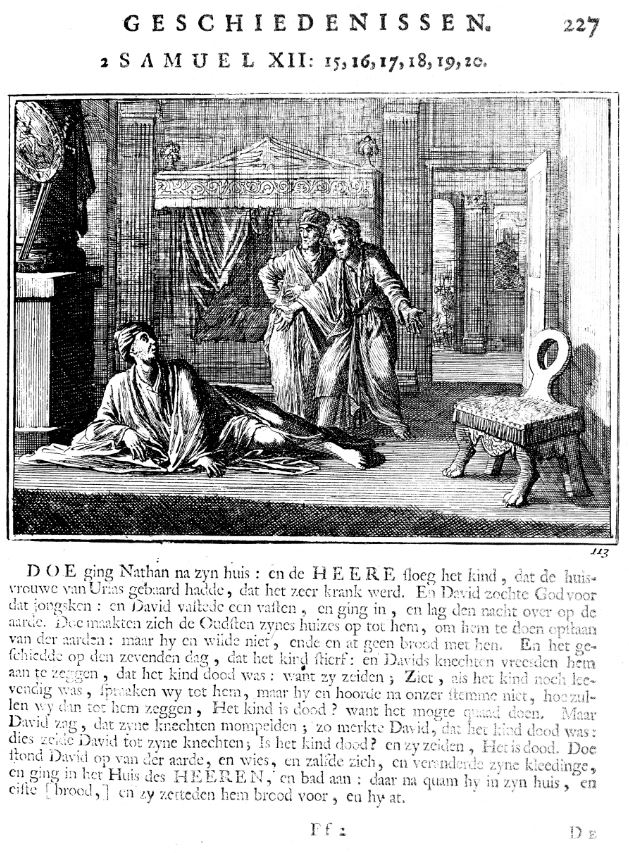
* The artwork title is "David in Penitence for the Child of Bathsheba". The book by Jan Luiken is titled, " De schriftuurlyke geschiedenissen en gelykenissen van het Oude en Nieuwe Verbond / Vertoonende drie honderd zeven en dertig konstige figuuren ; verrykt met bybelse verklaaringen en stichtelyke verzen, door Joannes Luiken, met het leven van den dichter."
David lying on the ground in sackcloth during the illness of the child of Bathsheba. The Dutch artist Caspar Luiken (1672-1708) drew and etched this emblem, and his father, Johannes Luyken (1649-1712), wrote the accompanying poem.
From The the Pitts Library.
>How does the author continue the illustration of danger of nearly drowning in verse 2? What is David portraying? How might this be like being in the grave (consider what water baptism represents)? (Romans 6:4 Colossians 2:12, 1 Peter 3:21)
* Psalm 69:2 "I sink in the miry depths, where there is no foothold. I have come into the deep waters; the floods engulf me."
* Romans 6:4 "We were therefore buried with him through baptism into death in order that, just as Christ was raised from the dead through the glory of the Father, we too may live a new life."
* Colossians 2:12 "having been buried with him in baptism and raised with him through your faith in the power of God, who raised him from the dead."
* 1 Peter 3:20-22 "who disobeyed long ago when God waited patiently in the days of Noah while the ark was being built. In it only a few people, eight in all, were saved through water, and this water symbolizes baptism that now saves you also--not the removal of dirt from the body but the pledge of a good conscience toward God. It saves you by the resurrection of Jesus Christ, who has gone into heaven and is at God's right hand--with angels, authorities and powers in submission to him."
* See question 5 for more on the similarity to baptism. Verses 13-15 are a repeat of verses 1-3, but with different sentence structure.
* Verse 2 has similarity to Psalm 40:2 and to Jonah 2:5, who centuries after David, wrote of being thrown overboard and being swallowed by a fish.
* David, using poetry creates a vision of being totally surrounded. Like pushing away water, David has no hope of escaping.
>How long and passionately has David been praying? (3)
* Psalm 69:3 "I am worn out calling for help; my throat is parched. My eyes fail, looking for my God."
* "My eyes fail, looking for..." -Similar to Psalm 119:82, "My eyes fail, looking for your promise; I say, 'When will you comfort me?'"
* "I am worn out calling for help" -He has a will to call out, but is physically unable to. Romans 8:26-27 says, "In the same way, the Spirit helps us in our weakness. We do not know what we ought to pray for, but the Spirit himself intercedes for us with groans that words cannot express. And he who searches our hearts knows the mind of the Spirit, because the Spirit intercedes for the saints in accordance with God's will."
* Having no answer when we desperately want one, and yet we keep praying takes faith.
* So many questions goes through our heads when we seek God's help. Jesus cried out on the cross, "My God, my God, why have you forsaken me." He was quoting Psalm 22:1. Psalm 42:9 and 43:2 are similar.
* Why does God not answer us right away much of the time? Answers to this question abound. But, do they matter when all we want is to be rescued the way we envision it? Consider Job's questions on the ash heap. He wanted to know why he suffered so much. He was righteous and sought to Lord. Even the Bible records the Lord acknowledging that.
* Save Me God.
Will faith be choked to death? Will hope wither on the vine? Will love fail to produce fruit? "The one who received the seed that fell among the thorns is the man who hears the word, but the worries of this life and the deceitfulness of wealth choke it, making it unfruitful," Jesus told his disciples. (Matthew 13:22)
"I went past the field of the sluggard, past the vineyard of the man who lacks judgment; thorns had come up everywhere, the ground was covered with weeds, and the stone wall was in ruins. I applied my heart to what I observed and learned a lesson from what I saw," Solomon told his son. (Proverbs 24:30-32)
Psalm 69 begins with a call for God's salvation that seems to fall on deaf ears. Will David's faith, hope, and love for God remain? Will his heart prove pure?
Similar to Job on the trash heap and Jonah in the belly of the beast, many of life's miseries have befallen David. Every possible hope for deliverance fails him. He poetically describes being in the middle of a vast, lonely swamp.
The waters have come up to his neck. His body is weak. He tires of swimming, and he can no longer float. The mirk slowly pulls his body under. The grave is hungry. His feet find nothing to keep him high enough to bring in air. Death desires its prey. Will I be crushed by despair?
David looks for God. His eyes go dim from trying so long and not finding. Every day, we struggle to push away the waters of despair that try to engulf us. We ask, "Where is my God?" just as David did. Will faith be choked to death? Will hope wither on the vine? Will love fail to produce fruit? Let's look at the rest of Psalm 69.
Listen to the above comments on Psalm 69:1-3.
>2. What are some of the specifics of David's problems? (4) How are "without reason", "without cause", and "rationalization" the same? What is their intent? Consider Cain and Able. What do his enemies want and how did they get it? (4)
* Psalm 69:4 "Those who hate me without reason outnumber the hairs of my head; many are my enemies without cause, those who seek to destroy me. I am forced to restore what I did not steal."
* "Those who hate me without reason" -John 15:24 quotes this verse. Though they rationalize, they do not have a valid reason. The religious and social leaders did not have a valid reason to crucify Jesus though they claimed to have one.
* "more than the hairs on my head" -Psalm 40:12 also states this.
* "many are my enemies without cause" -Enemies do not need a reason (cause) to hate. They just do. Many times trying to blame ourselves for others hating us is a waste of time and only brings false self condemnation. Other hate for no reason that is our fault. Cain hated Able beause he really hated himself, but didn't want to change. He had no desire to master sin crouching at his door.
* "those who seek to destroy me" -So they can take from their enemy.
* "I am forced to restore what I did not steal." -Get rich.
* Hate Without Reason.
David is more specific about his problems in verses 4 and 5. Everyone has others that hate them without reason. As time moves closer to the end of the age, hearts are growing colder and colder. Hate is being expressed in ways seldom seen in generations past. Reason is not needed for many attackers in this generation. David experienced such hate. Those who hated him without reason outnumbered the hairs of his head. Such cold hearts are poised for violence. David prayed, but their death chants only grew louder.
David's enemies, once silent, see his vulnerability, isolation, and their new strength in numbers as time to force him to restore what he did not steal. They steal in the name of false justice, using twisted courts run by bribes and winking eyes. The law that was meant to protect the helpless, innocent, and poor is used to further enrich and empower endless greed. David prayed, but wicked ways grew. The defender of orphans and widows is left defenseless.
Is this not what happened to Jesus? Is this not what happened to the Apostles? Is this not what happened to like the prophets? Is this not what happened to Job whose wife deserted him and friends accused him?
Listen to the above comments on Psalm 69:4-5.
>What does David realize and confess? When was a time that David tried to cover up his sin, but God exposed it to everyone? (2 Samuel 11-12)
* Psalm 69:5 "You know my folly, O God; my guilt is not hidden from you."
* "folly" -The original Hebrew noun is "iwwelet" (a transliteration) from the adjective "wil" translated as silliness.
* "You know my folly" -In the Bible, "folly" is a moral and spiritual deficiency characterized by a rejection of God's wisdom, rather than just a lack of intelligence. It is synonymous with foolishness and sin, involving thoughtlessness, disobedience, and a lack of moral insight that leads to sinful and self-deceptive behavior.
* "guilt" -The original Hebrew noun is "ashma" (a transliteration) from "asham" meaning "trespass" and "sin".
* "my guilt is not hidden from you." -Guilt is being personally accountable for going against God's will, violating God's law.
* David is not confessing of sin in particular. Rather, he is stating that God knows his folly and guilt. In other words, he knows he is a sinner, and he knows that God knows all his sins. David tried to cover up his sin with Bathsheba and her husband, but God knew and exposed it to everyone. So, here David is saying, "I cannot him anything from you."
* Contrary to above, someone else wrote, "This may be regarded as an appeal, vindicating his innocence, as if he had said, "If sinful, thou knows," &c. Though David's condition as a sufferer may typify Christ's, without requiring that a parallel be found in character." (A Commentary: Critical, Experimental, and Practical on the Old and New Testaments)
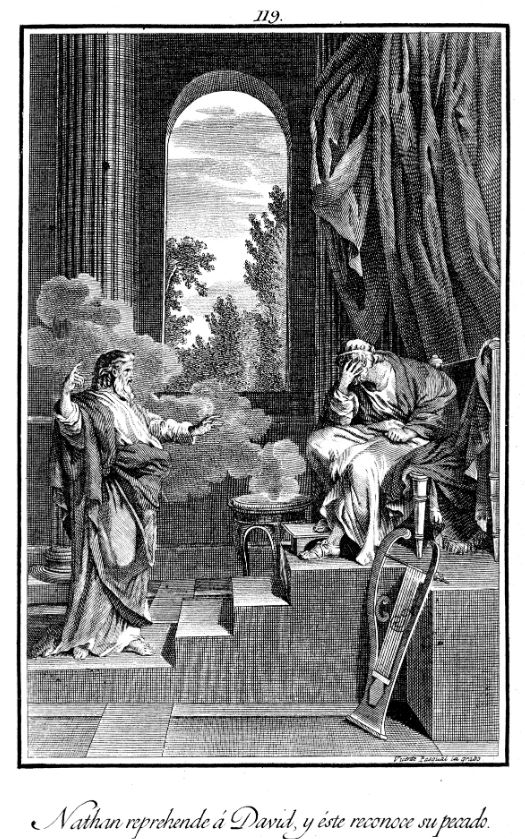
* The artwork title is "Nathan Confronts David". The book by Scio de San Miguel, Phelipe is titled, "La Biblia Vulgata Latina / traducida en español y anotada conforme al sentido de los padres y expositires catholicos, por el Rmo. P. Phelipe Scio de S. Miguel, de las escuelas pias obispo electo de Segovia ..."
The prophet Nathan confronts David about his affair with Bathsheba and the consequent murder of Uriah the Hittite. The engraver's name is located at the lower right corner.
From The the Pitts Library.
>3. What was David concerned would happen because he sinned and his sin was exposed? (6) What does he ask God to do? How does our decisions affect others whether are believe in God or not?
* Psalm 69:6 "May those who hope in you not be disgraced because of me, O Lord, the LORD Almighty; may those who seek you not be put to shame because of me, O God of Israel."
* "May those who hope in you... may those who seek you" -They hope and seek God. However, it is easy to become confused when we mingle faith in God with looking up to other's who we believe are faithful and true do wrong things, even terribly bad sins.
* "not be disgraced because of me... not be put to shame because of me" -David knew that people looked to him, his teaching, and life of faith as examples to follow. Now he has publicly been exposed as doing something very wrong and others will faulted in their walk with God because of him.
* "O Lord, the LORD Almighty" -"Adonay Yehwih" in the original Hebrew (a transliteration).
* "O God of Israel." -"Elohim Yisrael" in the original Hebrew (a transliteration).
>How would his enemies response be a discouragement to others who seek the Lord? (7)
* Psalm 69:7 "For I endure scorn for your sake, and shame covers my face."
* "face" -The original Hebrew noun is "paniym" (a transliteration) also translated "presence", countenance", "person", "me", and "before".
* "For I endure scorn... shame covers my face." -David was not ashamed of God. He suffered shame from others. They shamed him.
* "for your sake" -David publicly confessed faith in the Lord God of Israel. He trusted in God and God's promise, even though he had sinned and was now being punished by God. People were probably pointing out how foolish he was for still trusting in God.
* The true reason why he endured this kind of public humiliation and scorn was because he was a friend of God and served God. The enmity between God's people and Satan's people will naturally bring persecution to those who confess faith in the Lord Jesus.
>Did his family accept him? Did they disown him?
* Psalm 69:8 "I am a stranger to my brothers, an alien to my own mother's sons;"
* "I am a stranger to my brothers" -Fulfilled by Jesus according to Mark 3:21, "When his family heard about this, they went to take charge of him, 'He is out of his mind.', and John 7:5, "For even his own brothers did not believe in him."
* "an alien to my own mother's sons;" -After Jesus was born, Joseph and Mary had children according to the gospel writers, and the letter of James' was written by Jesus younger sibling, the son of Joseph.
* Jesus told his disciples that families would be divided because of his teaching. Some would believe. Others would reject.
>Why? (9) How does John relate this to Jesus? (John 2:17)
* Psalm 69:9 "for zeal for your house consumes me, and the insults of those who insult you fall on me."
* "for zeal for your house consumes me" -John 2:17 quotes verse 9a during the first time Jesus upset the money changes in the temple courts.
* "the insults of those who insult you fall on me." -Romans 15:3 quotes 9b when saying that we should bear the failings of the weak and not please ourselves, to build them up.
* John 2:17-19 "His disciples remembered that it is written: "Zeal for your house will consume me." Then the Jews demanded of him, "What miraculous sign can you show us to prove your authority to do all this?" Jesus answered them, "Destroy this temple, and I will raise it again in three days."
* Romans 15:1-4 "We who are strong ought to bear with the failings of the weak and not to please ourselves. Each of us should please his neighbor for his good, to build him up. For even Christ did not please himself but, as it is written: "The insults of those who insult you have fallen on me." For everything that was written in the past was written to teach us, so that through endurance and the encouragement of the Scriptures we might have hope."
* Zeal For Your House.
David knows that he is a sinner and he accepts that God knows it too (5). He learned this when Nathan, the prophet revealed his sin with Bathsheba and the murder of her husband, Uriah in the presence of the royal court. Whether David had this, or another specific sin in mind, or is thinking of his sinful nature in general, is not clear. What is understood is that David accepts that he does not have a special claim to have access to God and an answer to his request because his is a sinner. He is aware that God is not indebted to him. Rather, he is indebted to God.
David's thought moves from his sinful nature to the disgrace that he has brought to those who have faith in the Lord Almighty (6). Many influential pastors' and evangelists' sins and hypocrisy have been publicly exposed in my generation. These once proud men and women brought shame and disgrace to many believes more than perhaps, they have been willing to accept. David asks God that his sin not become a stench to the wicked's fuel against the faithful. A prayer that will be a miracle to answer, for once he sinned the wicked's hearts immediately raged and rejoiced. The deed was already done.
David's prayer for his fellow believes was sincere for he knew what they would endure. He lists them in verses 7-9. The Apostles John cites verse 9 when Jesus cleared the money changes and animal sellers out of the temple. These acts of righteousness enraged the religious leaders who permitted them to make money. Jesus, his disciples, and his family were insulted by the religious leaders.
The message to consider here is that my actions will affect others. Whether unrighteous or righteous actions, the wicked will find reasons to persecute and shame me and others who believe in Jesus and know me. Whether living by faith in Jesus or not, decision have effect. However, be sure that the decisions made in zeal for Jesus' house is righteous. Jesus' house is his people.
Listen to the above comments on Psalm 69:6-9.
>4. When David was down in spirit and seeking God did he find comfort from others? (10)
* Psalm 69:10 "When I weep and fast, I must endure scorn;"
* "When I weep and fast" -Weeping because of his pain. Fasting is part of prayer and drawing closer to God, focusing the mind. David wept away his soul.
* "I must endure scorn;" -David was seeking God, but others was interrupting his time with God. His enemies were perverse.
* David humbled himself in repentance before the Lord to have mercy.
* David did not seek retribution. He presented his problem with them to the Lord.
>What did it mean to put on sackcloth in those days? What does it mean that people made sport of him? (11)
* Psalm 69:11 "when I put on sackcloth, people make sport of me."
* "sackcloth" -Cloth made of black goats' hair, coarse, rough, and thick, used for sacks, and also worn by mourners (Genesis 37:34, 42:25; 2 Samuel 3:31; Esther 4:1, 2; Psalm 30:11), and as a sign of repentance (Matthew 11:21). (Illustrated Bible Dictionary: And Treasury of Biblical History, Biography, Geography, Doctrine, and Literature)
* "when I put on sackcloth" -Humbling ourselves. Psalm 35:13 "Yet when they were ill, I put on sackcloth and humbled myself with fasting. When my prayers returned to me unanswered,"
* "sport" -The original Hebrew noun is "mashal" translated as "proverb" (KJV), "byword" (ASV), "joke" (HCSB and CSB), "object of ridicule" (GW), and "simile" (YLT).
* "people make sport of me." -David is giving an example of what he said in verse 10, he endured scorn. They scorned him for wearing sackcloth.
* They used David's name proverbially like any person whom they thought vainly and foolishly religious. (Matthew Poole's Commentary on the Holy Bible)
>What kind of people sat at the gate? What kind of songs do drunk people sing?
* Psalm 69:12 "Those who sit at the gate mock me, and I am the song of the drunkards."
* "Those who sit at the gate mock me" -The city gates was a business trade location in ancient days. This kept strangers out of the city, protecting family and goods. At the same time, those who trade first often get the best price.
* "I am the song of the drunkards." -When people are drunk they often ridicule others is harsh ways. They sing songs that glorify sin.
* David is pointing out that the social status did not matter. The rich and powerful and the fool were all making fun of his religious practice.
* When I...
David's troubles surrounded him like a torrent sea storm, a bottomless marsh, and an endless pit - the only escape being death. God remains silent to his cries. David's enemies take advantage of his downfall. David wept and fasted. He lay in sackcloth, a sign of repentance and humility. Compassion did not occupy the hearts of those who saw him. They either scorned or laughed at him. Whether rich or poor, no one showed compassion. They had their reasons, but none was justified before God.
Jesus' troubles surrounded him. Religious leaders made sport of him, "He saved others. Let him save himself." They snarled and spit at him like a torrent sea storm. Solders mocked him like drunkards in a bottomless bottle. God remained silent. "My God, my God, why have you forsaken me?" "I must endure scorn."
Jesus' disciples, those he called his brothers, deserted him. Only his mother, a few women, and young man, John remained at the foot of the cross.
What compassion is in my heart when I pass by a lonely person in the street? When those who made themselves my enemy fall, do I pray for them? Do I repay their violence with vengeance? Do I help a brother or sister in their time of need? Do I give them a glass of water? Or am I a torrent sea storm, a bottomless marsh, and an endless pit?
Listen to the above comments on Psalm 69:10-12.
II. Come Near and Rescue Me (69:13-21)
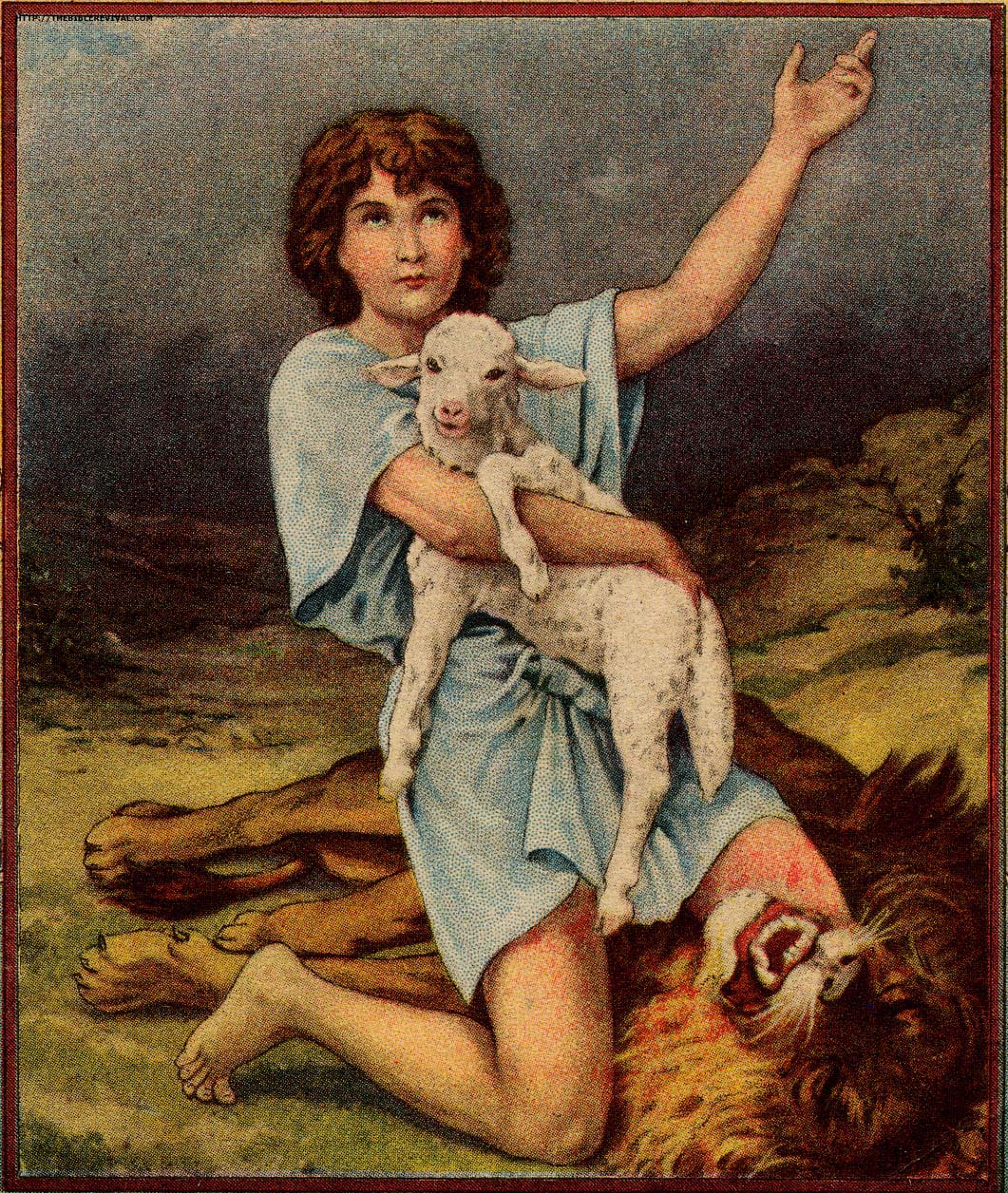
* David kills a lion, thus saving a lamb. Author unknown. This is a fine example of pointillism.
>5. Did David give up and stop praying? Why? (13) What was he sure of?
* Psalm 69:13 "But I pray to you, O LORD, in the time of your favor; in your great love, O God, answer me with your sure salvation."
* "But I pray to you" -David did not give up even though his social standing though one says this is meaning "in a time you chose" or "your good pleasure".
* "in the time of your favor; in your great love" -When God is near to save. How David was sure of this neither I nor the commentaries I have can say.
* "answer me with your sure salvation." -Repeating "answer me" in verses 16 and 17 too. He means give him what he wants.
* "It was a sign of uncommon virtue in David, that even this hard treatment could not shake his mind, and sink him into despondency.
He informs us of the means by which he fortified himself against that terrible stumbling-block. When the wicked directed against him their witty and scoffing remarks, as if engines of war, to overthrow his faith, the means to which he had recourse for repelling all their assaults was pouring out his heart in prayer to God. He was constrained to keep silence before men, and, being thus driven out from the world, he betook himself to God.
In like manner, although the faithful in the present day may be unable to make any impression upon the wicked, yet they will ultimately triumph, provided they retire from the world, and go directly to God to present their prayers before him. The meaning, in short, is, that David, having tried every means in his power, and finding that his labor was to no purpose, left off dealing with men, and dealt with God only. (Calvin's Commentaries)
>Is verses 13-15 a repeat of verses 1-3? What does this say of David's faith in God?
* Psalm 69:14 "Rescue me from the mire, do not let me sink; deliver me from those who hate me, from the deep waters."
* "Rescue me from the mire" -A repeat of verses 2.
* "deliver me from those who hate me" -A repeat of verse 4.
* "from the deep waters." -A repeat of verse 2.
>What is David portraying once again? How might this be like being in the grave (consider what water baptism represents)? (Romans 6:4 Colossians 2:12, 1 Peter 3:21)
* Psalm 69:15 "Do not let the floodwaters engulf me or the depths swallow me up or the pit close its mouth over me."
* The verses quoted in the question are quoted in question 1.
* Though in verse 3 David is worn out calling for help, he again asks for help.
* "Do not let the floodwaters engulf me" -Buried in the sea.
* "or the depths swallow me up" -The grave is often portrayed as hungry and swallowing its prey.
* "or the pit close its mouth over me." -Pit is grave.
* Baptism in the New Testament is seen as burial of the old self.
* Sinking Still in Deep Waters.
The first stanza, verses 1 through 3, and the fifth stanza, verses 13 through 15, are identical poetic expressions, praying for salvation from sure death. The basis of the continuing request is the love of God during the time of his favor (13). David has not given up hope in the Lord Almighty. David still has faith in the compassion of the Lord. His prayers continue. Though all he can do is repeat himself, David prays yet again. Though no one cares and he is mocked, David believes.
The lonely, who have faith in Jesus, when hurting is perhaps the hardest test one can undergo. When the trial continues, and prayer is not answered in the way desired, and tears return every morning, though taken out of the murk, some mud remains on the clothes we put in the closet unwashed.
The first and the fifth stanza remind me of being baptized in the name of the Father, the Son, and the Holy Spirit. "We are therefore buried with him in baptism into death in order that, just as Christ was raised from the dead through the glory of the Father, we too may live a new life." (Romans 6:4; Colossians 2:12; 1 Peter 3:20-22) Jesus' resurrection was after burial, and his burial was after death, and his death was after lonely pain. So, is the way of his disciples. Resurrection only follows slowly sinking in murky waters and death.
"I want to know Christ and the power of his resurrection." But in order to do so, I must die and be buried.
Listen to the above comments on Psalm 69:13-15.
>6. Was it right for David to continue begging God over and over again for the same thing? Was there anyone who kept asking Jesus for the same thing?
* Psalm 69:16 "Answer me, O LORD, out of the goodness of your love; in your great mercy turn to me."
* "out of the goodness of your love" -The reason he keeps asking.
* "in your great mercy turn to me." -His petition is based on the Lord's love and mercy.
* Jesus said, "Do not pray like the pagons who say the same chant over and over gain." (I paraphrase.) David is not chanting. The lepers kept saying, "Son of David, have mercy on us."
>What does it mean that God hides his face? Why might David need a quick answer? (2 Samuel 12:13-19)
* Psalm 69:17 "Do not hide your face from your servant; answer me quickly, for I am in trouble."
* 2 Samuel 12:13-19 "Then David said to Nathan, "I have sinned against the LORD." Nathan replied, "The LORD has taken away your sin. You are not going to die.
But because by doing this you have made the enemies of the LORD show utter contempt, the son born to you will die."
After Nathan had gone home, the LORD struck the child that Uriah's wife had borne to David, and he became ill. David pleaded with God for the child. He fasted and went into his house and spent the nights lying on the ground.
The elders of his household stood beside him to get him up from the ground, but he refused, and he would not eat any food with them.
On the seventh day the child died. David's servants were afraid to tell him that the child was dead, for they thought, "While the child was still living, we spoke to David but he would not listen to us. How can we tell him the child is dead? He may do something desperate."
David noticed that his servants were whispering among themselves and he realized the child was dead. "Is the child dead?" he asked. "Yes," they replied, "he is dead."
* "Do not hide your face from your servant" -God hiding his face in the Psalms is saying he is not answering the request. David recognizes he is God's servant. He remains humble.
* "answer me quickly" -Not much time remains.
* "for I am in trouble." -David personally has a problem. If, this was about his first child by Bathsheba, speculated above, then the problem is that his sin with her and killing her husband was revealed by the prophet. Now, the son by their union is in jeopardy, symbolizing God's possible rejection of David in his enemies eyes.
* David's first son by Bathsheba is sick and could die if God does not help. David knows that there is not much time left. David knew what Nathan said. But he thought perhaps the Lord could be persuaded to change his decision.
>As David aged, who were some of his foes? Who was Jesus' foes?
* Psalm 69:18 "Come near and rescue me; redeem me because of my foes."
* "Come near and rescue me" -From enemies who are making him pay for things he did not steal and who want to take his life.
* David again asks to be resuced and redeemed. Redeemed is to be restored to his place and status.
* I am in Trouble
The Lord told Israel through Moses before they crossed the Jordan, "Never will I leave you, nor forsake you." (Deuteronomy 31:6, 8; Joshua 1:5) The author of Hebrews quotes this to the Church. (Hebrews 13:5) However, this promise to Israel and the Church comes with the warning to not worship idols and money. (Joshua 24:20) All Israel experienced the consequences during the time of Judges for they cried out, "We have sinned against you, forsaking our God and serving the Baals." (Judges 10:10; 1 Samuel 8:8) Baal religion was all about prosperity and easy living. The Lord sent their neighboring nations to rob them of their prosperity and enslave them.
David, who admits his folly and guilt (5), is fully aware that what is happening to him is the punishment from the Lord, his God (2 Samuel 11-12). As a good Father disciplines his son, so the Lord disciples his people. During his near-death experience, trouble from all sides, David continues to repent and pray in verses 16 through 18. Asking God, "Do not hide your face," is saying, "Turn to me and see my sackcloth repentance and suffering". God sees all. David is wanting God to have mercy. Biblical mercy is God withholding the punishment that is deserved due to sin.
A growing movement in the western congregations in the last few decades is prosperity and lazy Christian living. Jesus said to the church in Laodicea, "I know your deeds, that you are neither cold nor hot. I wish you were either one or the other! So, because you are lukewarm -neither hot nor cold - I am about to spit you out of my mouth. You say, 'I am rich; I have acquired wealth and do not need a thing.' But you do not realize that you are wretched, pitiful, poor, blind and naked. I counsel you to buy from me gold refined in the fire, so you can become rich; and white clothes to wear, so you can cover your shameful nakedness; and salve to put on your eyes, so you can see." (Revelation 3:15-18) Is it time to put on sackcloth and plea for mercy?
Listen to the above comments on Psalm 69:16-18.
>Was there ever a time that all his enemies were before him, or a group of enemies were before him at once? Did this happen to Jesus?
* Psalm 69:19 "You know how I am scorned, disgraced and shamed; all my enemies are before you."
* "You know how I am scorned, disgraced and shamed" -They tried to hide their actions and keep their words quiet, but God knows.
* "my enemies are before you." -God sees what we cannot see. God knows are enemies and is working though we do not know it.
* All of David's enemies were scattered through his life. Many remained in the shadows, spreading lies and gossip behind closed doors. Jesus did have groups of Pharisees, Teachers of the Law, and Sadducees challenging him publicly. However, the Sanhedrin when questioning did so in secret, and not with a full session.
>7. Might verse 20 not only refer to David, but Jesus too?
* Psalm 69:20 "Scorn has broken my heart and has left me helpless; I looked for sympathy, but there was none, for comforters, but I found none."
* "Scorn has broken my heart and has left me helpless" -Scorn is to treat someone as worthless. This attitude comes from pride, hate towards God, and rebellion against God and all he has established.
* "I looked for sympathy, but there was none, for comforters, but I found none." -Mark 14:50 is fulfillment of this verse. Mark 14:50 "Then everyone deserted him and fled."
* This verse certainly fits with what Jesus endured during his trials, scorning, and ridicule. The few followers at the cross were only there, not during the trials.
>Consider where the gospel writers place verse 21. How does that help in understanding this psalm? In applying it to our lives?
* Psalm 69:21 "They put gall in my food and gave me vinegar for my thirst."
* Matthew 27:48, Mark 15:23, and John 19:29-30 quote verse 21 applying it to Jesus' suffering caused by the Jewish leadership.
* Matthew 27:48 "Immediately one of them ran and got a sponge. He filled it with wine vinegar, put it on a stick, and offered it to Jesus to drink."
* Mark 15:23 "Then they offered him wine mixed with myrrh, but he did not take it."
* John 19:29-30 "A jar of wine vinegar was there, so they soaked a sponge in it, put the sponge on a stalk of the hyssop plant, and lifted it to Jesus' lips. When he had received the drink, Jesus said, "It is finished." With that, he bowed his head and gave up his spirit."
* David may have been poetically saying that their actions towards him, and lack of compassion took away his appetite and thirst. He was so broken hearted that he lost his desire for food and appetite. Also, after three days of fasting, hunger pains go away.
* They increased his pain.
* "gall" -A bitter, alkaline, brownish-yellow or greenish-yellow fluid that is secreted by the liver, stored in the gallbladder, and discharged into the duodenum and aids in the emulsification, digestion, and absorption of fats. (American Heritage Dictionary)
* "vinegar" -An impure dilute solution of acetic acid obtained by fermentation beyond the alcohol stage and used as a condiment and preservative.
* Vinegar.
Psalm 69, written by David, most likely concerns the events that transpired after his sin with Bathsheba and the murder of her husband Uriah were exposed by the Lord's prophet Nathan, is also a prophecy concerning the Messiah, Jesus the Lord. The second most New Testament quoted psalm reveals the heart of Christ during his agony while he bore the sins of the world. The gospel writers reveal the facts of the arrest, torture, crucifixion, and burial. This psalm reveals Jesus' soul.
Verses 19 through 21 contain the words scorned, disgraced, shamed, broken heart, and helpless. He seeks sympathy and comforters, but there was none; only enemies. Their words and actions are like gall in food. Gall is the bitter, yellowish-green fluid secreted by the liver and outrageous insolence and impudence, or a bitter feeling. Their actions are like vinegar to drink. Vinegar is a sour-tasting liquid with a pungent odor containing acid and peevishness of temper, speech, manner, and countenance. I was to receive this from God. However, Jesus received this punishment in my place.
Jesus was literally offered vinegar to drink while on the cross. Matthew 27:48, Mark 15:23, and John 19:28-30 quotes verse 21. John wrote, "Later, knowing that all was now completed, and so that the Scripture would be fulfilled, Jesus said, "I am thirsty." A jar of wine vinegar was there, so they soaked a sponge in it, put the sponge on a stalk of the hyssop plant, and lifted it to Jesus' lips. When he had received the drink, Jesus said, "It is finished." With that, he bowed his head and gave up his spirit."
Listen to the above comments on Psalm 69:19-21.
III. Summon Your Power (69:22-36)
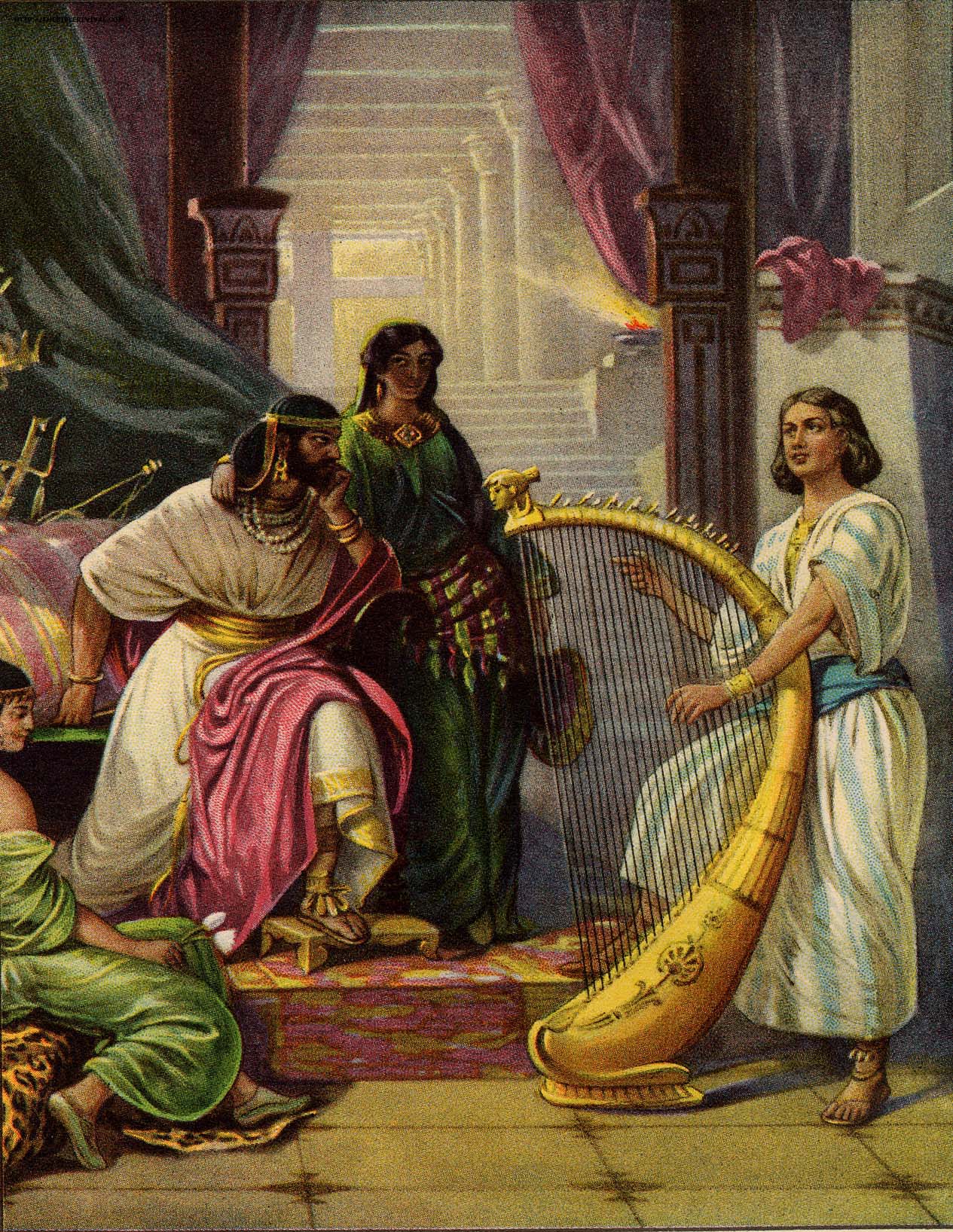
* David plays the harp before troubled Saul. This would not have been the harp that David played. Author unknown. This is a fine example of pointillism.
>8. Consider where Apostle Paul placed the meaning of verse 22. How does that help in understanding this psalm? In applying it to our lives?
* Psalm 69:22 "May the table set before them become a snare; may it become retribution and a trap."
* Stanza 8 is verses 22-25 as I see it. See question 1.
* Apostle Paul quotes verse 22 as a prophecy of the wickedness of the Jews, and the punishment they were to receive in Romans 11:9.
* Romans 11:9-10 "And David says: 'May their table become a snare and a trap, a stumbling block and a retribution for them. May their eyes be darkened so they cannot see, and their backs be bent forever.'"
* Blessings shall become curses.
* The Jewish people, other than the selected few, refused to receive the Messiah. They have only themselves to blame. Jesus did all he could do to convince them that he was the awaited Messiah.
>Consider where Apostle Paul placed the meaning of verse 23. How does that help in understanding this psalm? In applying it to our lives?
* Psalm 69:23 "May their eyes be darkened so they cannot see, and their backs be bent forever."
* Apostle Paul quotes verse 23 as a prophecy of the wickedness of the Jews, and the punishment they were to receive. See the quote from Romans 11:10 above.
* "May their eyes be darkened so they cannot see" -They would see, but not understand. The Jews saw all the miracles and heard his teachings. Yet, because of this prayer of David, their desire to take power from the King, made them blind until this day.
Jesus quoted Isaiah, a prophet born centuries after David, who foretold similar words to David here. (Isaiah 6:9-13; Matthew 13:13-15; Mark 4:11-15) Matthew 13:13, most likely referring to verse 69:23 recorded Jesus saying, "This is why I speak to them in parables: 'Though seeing they do not see; though hearing, they do not hear or understand.'"
* "their backs be bent forever." -Looking down at the ground so they cannot see.
* David prayed this judgment for his enemies. David's request, according to Jesus fell on all those who rejected David's promised Son who would establish a Kingdom that would not end.
>What does David ask? How does such a prayer align with Jesus' words in Matthew 23:13-39?
* Psalm 69:24-25 "Pour out your wrath on them; let your fierce anger overtake them. May their place be deserted; let there be no one to dwell in their tents."
* Matthew 23:13-39 "Woe to you, teachers of the law and Pharisees, you hypocrites! You shut the kingdom of heaven in men's faces. You yourselves do not enter, nor will you let those enter who are trying to.
14
15 "Woe to you, teachers of the law and Pharisees, you hypocrites! You travel over land and sea to win a single convert, and when he becomes one, you make him twice as much a son of hell as you are.
16 "Woe to you, blind guides! You say, 'If anyone swears by the temple, it means nothing; but if anyone swears by the gold of the temple, he is bound by his oath.'
17 You blind fools! Which is greater: the gold, or the temple that makes the gold sacred?
18 You also say, 'If anyone swears by the altar, it means nothing; but if anyone swears by the gift on it, he is bound by his oath.'
19 You blind men! Which is greater: the gift, or the altar that makes the gift sacred?
20 Therefore, he who swears by the altar swears by it and by everything on it.
21 And he who swears by the temple swears by it and by the one who dwells in it.
22 And he who swears by heaven swears by God's throne and by the one who sits on it.
23 "Woe to you, teachers of the law and Pharisees, you hypocrites! You give a tenth of your spices--mint, dill and cummin. But you have neglected the more important matters of the law--justice, mercy and faithfulness. You should have practiced the latter, without neglecting the former.
24 You blind guides! You strain out a gnat but swallow a camel.
25 "Woe to you, teachers of the law and Pharisees, you hypocrites! You clean the outside of the cup and dish, but inside they are full of greed and self-indulgence.
26 Blind Pharisee! First clean the inside of the cup and dish, and then the outside also will be clean.
27 "Woe to you, teachers of the law and Pharisees, you hypocrites! You are like whitewashed tombs, which look beautiful on the outside but on the inside are full of dead men's bones and everything unclean.
28 In the same way, on the outside you appear to people as righteous but on the inside you are full of hypocrisy and wickedness.
29 "Woe to you, teachers of the law and Pharisees, you hypocrites! You build tombs for the prophets and decorate the graves of the righteous.
30 And you say, 'If we had lived in the days of our forefathers, we would not have taken part with them in shedding the blood of the prophets.'
31 So you testify against yourselves that you are the descendants of those who murdered the prophets.
32 Fill up, then, the measure of the sin of your forefathers!
33 "You snakes! You brood of vipers! How will you escape being condemned to hell?
34 Therefore I am sending you prophets and wise men and teachers. Some of them you will kill and crucify; others you will flog in your synagogues and pursue from town to town.
35 And so upon you will come all the righteous blood that has been shed on earth, from the blood of righteous Abel to the blood of Zechariah son of Berekiah, whom you murdered between the temple and the altar.
36 I tell you the truth, all this will come upon this generation.
37 "O Jerusalem, Jerusalem, you who kill the prophets and stone those sent to you, how often I have longed to gather your children together, as a hen gathers her chicks under her wings, but you were not willing.
38 Look, your house is left to you desolate.
39 For I tell you, you will not see me again until you say, 'Blessed is he who comes in the name of the Lord.'"
* Matthew 23:38 has Jesus stating a very similar prophecy, fulfilled in 70 A.D. Look, your house is left to you desolate.
* "Pour out your wrath on them" -As they are pouring out their wrath on him. Jesus predicted this would happen to the Jews who rejected him.
* "let your fierce anger overtake them" -God does have righteous answer. He is just in his anger.
* "May their place be deserted" -Judea and all Israel was deserted twice after this. First, by Babylon, then by Rome.
* "let there be no one to dwell in their tents." -The building remained empty. When Israel returned after WWII, the only people in all Israel, from the Mediterranean Sea to the desert were nomades following flocks.
* Desolate.
Stanza 8, verses 22-25, has been called a curse by some. However, I see it as a prediction of the result of rejecting God's anointed. David never harmed Saul because Saul was God's anointed as he was, though Saul tried to kill him and made David an outcast for years (1 Samuel 26:9-11). However, David's enemies did not learn respect for God's anointed from David. They humiliated David and wanted him dead. The vile of the wicked knows no mercy, righteousness, and justice.
Stanza 8 is also a prophecy as a result of rejecting God's anointed, Jesus, the Messiah. Verses 22 and 23 are quoted by Apostle Paul in Romans 11:9-10 regarding the result of the Jew's rejecting the Messiah, Jesus. He wrote, "And David says: 'May their table become a snare and a trap, a stumbling block and a retribution for them. May their eyes be darkened so they cannot see, and their backs be bent forever.'"
Verse 24 was fulfilled in 70 A.D. when the Roman armies defeated Jerusalem and Judea. They burned the city and temple was burned to the ground. The fierce anger was seen when not one stone was left on another.
Jesus' last words to the Jews in the temple is a repeat of verse 25a. After a series of woes Jesus concludes, "Look, your house is left to you desolate. For I tell you, you will not see me again until you say, 'Blessed is he who comes in the name of the Lord.'" (Matthew 23-38-39) The Jews deserted all the cities in Judea, Samaria, and Galilee.
Apostle Paul, after speaking of God's judgment fulfilling David's prediction here gives the church a warning at the end of chapter 11. "Maybe you think those branches were cut away, so you could be put in their place. That's true enough. But they were cut away because they did not have faith, and you are where you are because you do have faith. So don't be proud, but be afraid. If God cut away those natural branches, couldn't he do the same to you?" (Romans 11:19-21)
Listen to the above comments on Psalm 69:22-25.
>9. Who wounds who and how does that apply to David in this psalm? Who persecutes who and how does that apply to David in this psalm? How do these apply to Jesus?
* Psalm 69:26 "For they persecute those you wound and talk about the pain of those you hurt."
* "they persecute" -The people of Israel persecuted David and Jesus and all his prophets.
* "you wound... you hurt" -God wounds and hurts. God is punishing David for his exposed sin. He never states what the sin was in the Psalm. I believe it is recorded in 2 Samuel 11-12. (see question 1 above.)
* "talk about" -Gossip and lies are included in this.
* Just as Israel persecuted David when we was under God's wrath, so when Jesus was under God's wrath while taking on the sins of the world, others used the opportunity to persecute and talk about his pain and suffering.
* Acts 2:23-24 "This man was handed over to you by God's set purpose and foreknowledge; and you, with the help of wicked men, put him to death by nailing him to the cross. But God raised him from the dead, freeing him from the agony of death, because it was impossible for death to keep its hold on him."
>What else does David ask? What is the book of life? Why is it important that they not be listed with the righteous?
* Psalm 69:27-28 "Charge them with crime upon crime; do not let them share in your salvation. May they be blotted out of the book of life and not be listed with the righteous."
* "Charge them with crime upon crime" -David wanted justice. They committed chrimes. David wanted God to charge them for the crimes.
* "do not let them share in your salvation" -"Salvation" here probably means what Jesus did on Calvary.
* "May they be blotted out of the book of life" -Exodus 32:32 records Moses saying, "But now, please forgive their sin--but if not, then blot me out of the book you have written."
* "not be listed with the righteous." -The righteous are those who will be saved and dwell with the Lord forever.
* Jesus said, "I tell you that to everyone who has, more will be given, but as for the one who has nothing, even what they have will be taken away. As you have done, so it was be done to you. But those enemies of mine who did not want me to be king over them - bring them here and kill them in front of me." (Luke 19:26-27) That is what verse 27 is saying.
>What does David ask again?
* Psalm 69:29 "I am in pain and distress; may your salvation, O God, protect me."
* "I am in pain and distress" -He asked, but the suffering remains.
* "may your salvation, O God, protect me." -The salvation David is asking for is from his current situation.
* The afflicted pious are often denoted by such terms (Psalms 10:17, 12:5).
* Psalm 10:17 "You hear, O LORD, the desire of the afflicted; you encourage them, and you listen to their cry,"
* Psalm 12:5 "Because of the oppression of the weak and the groaning of the needy, I will now arise," says the LORD. "I will protect them from those who malign them."
* Gossip Pain.
David adds details to what people are doing while God punished him for his sins. They gossip. Gossip causes troubles. It is an infection that eats away at not only the subject of the gossip, but also families, society, and the one supplying the gossip. Gossip often contains exaggeration and lies. Gossip adds to the self-interest and attention to the lips that provide it. Lying lips are one the most mentioned sins in the Psalter. All social groups have gossips, congregations not excluded. Jesus experienced the poison of gossiping lips.
David did not take vengeance, even though he was king. Instead, he asks God four things for these gossipers in verses 27 and 28. 1) Make them guiltier than ever, 2) Do not forgive them, 3) Take them out of the book of the living, and 4) Remove them from the list of the innocent.
David concludes by summing up his situation again and asking for God's protection and safety. Are you a gossip? Here is some advice from God.
"A gossip betrays a confidence, but a trustworthy person keeps a secret." (Proverbs 11:13) "A perverse person stirs up conflict, and a gossip separates close friends." (Proverbs 16:28) "A gossip betrays a confidence; so avoid anyone who talks to much." (Proverbs 20:19) "They have become filled with every kind of wickedness, evil, greed and depravity. They are full of envy, murder, strife, deceit and malice. They are gossips..." (Romans 1:29) "The Lord detests lying lips, but he delights in people who are trustworthy." (Proverbs 12:22)
Listen to the above comments on Psalm 69:26-29.
>10. What does he promise?
* Psalm 69:30 "I will praise God's name in song and glorify him with thanksgiving."
* The tenth stanza.
* The psalm switches from a prayer to a promise of praise, or perhaps it should be said the psalm turns into a song of praise.
* The sudden switch makes many believe the psalm was written after the event was concluded including the praise.
* "I will praise God's name in song" -Future tense.
* "glorify him with thanksgiving." -The song is sung with thanksgiving.
>What does he know is most important to God?
* Psalm 69:31 "This will please the LORD more than an ox, more than a bull with its horns and hoofs."
* "This will please the LORD more than an ox" -Oxen being an expensive offering. Oxen were castrated to make them more useful for labor.
* "more than a bull with its horns and hoofs." -Bulls being an even more of an expensive offering than an ox because bulls could be breaded. Bulls were more powerful than ox too. However, they were harder to control. "Horns and hoofs" probably means fully mature and in prime breading age, though some say that this means they were gilded for sacrifice. They Bible did not require gilding a sacrifice.
* Heart felt praise and glorifying should not be replaced.
>How will the poor respond?
* Psalm 69:32 "The poor will see and be glad-- you who seek God, may your hearts live!"
* "The poor will see and be glad" -The poor cannot offer expensive bulls and oxen. But all can sing, play even a simple instrument, and glorify with thanksgiving.
* "you who seek God" -Many poor came to hear Jesus' words and believed while the rich turned away, if they even came at all.
* "may your hearts live!" -Assumed this means forever.
* Anyone can sing songs of praise and thanksgiving. Some will be off key and out of beat. However, they can make a joyful noise unto the Lord.
>Who does the Lord hear? Why them? Why is it important to know he does not despise the captive? (33)
* Psalm 69:33 "The LORD hears the needy and does not despise his captive people."
* "The LORD hears the needy" -Often repeated in the Bible.
* "does not despise his captive people." -David does not say in this psalm that he was physically captive. However, he did appear to be all alone and surrounded by enemies.
* Please the Lord.
Skies -thick and dark today, releasing rain endlessly, with lightning flashes brightly, and thunder claps loudly, the tears of a despairing heart, and whispers of a darkened mind, praying to their maker, will calm tomorrow.
The Lord God Almighty saw David's faith, hope, and love. Jesus' heart was moved. He answered the prayer as David asked. Faith was not choked to death. Hope did not wither on the vine. Love produced fruit. The end of the Psalm is a decision to praise the Lord and give praise to Jesus (30).
Praising God's name in song and glorifying him with thanksgiving pleases the Lord more than expensive and sacrificial gifts (31). If expensive offerings were the most pleasing to God, then the poor would be discouraged (32). However, the dollar amount is not what pleases the Lord; the faith, hope, and love for God behind the offering are what pleases the Lord. The same can be said of the song. If my heart is full of admiration, fear, awe, and love, then the Lord Jesus is pleased.
Listen to the above comments on Psalm 69:30-33.
>11. Who is summoned to praise the Lord?
* Psalm 69:34 "Let heaven and earth praise him, the seas and all that move in them,"
* The eleventh stanza.
* "Let heaven and earth" -Everything. Nothing excluded, living and not alive. Apoostle Paul says all creation waits for the redemption of the saints. "The psalmist has the fullest confidence that God will turn their captivity, and therefore calls upon all creatures to magnify him for his mercy." (Adam Clarke, The Holy Bible with a Commentary and Critical Notes, New Edition, vol. 3, 440.)
* "the seas and all that move in them," -Not just the living creatures, also the sea itself.
* As Jesus calmed the Sea of Galilee more than once, so all creation knows its creator.
>Why? (35)
* Psalm 69:35 "for God will save Zion and rebuild the cities of Judah. Then people will settle there and possess it;"
* "for God will save Zion" -Zion is another name for Jerusalem, the City of David.
* "rebuild the cities of Judah" -Judah is just one of the tribes of Israel. Why David only says this one is not clear. The Babylons called all the people living in the promised land Jews because Israel had already been defeated by Assyria.
* "Then people will settle there and possess it" -After David, Judah was removed from the land twice -once by the Babylonians and another by the Romans. They will leave again when the anti-Christ goes against the treaty they signed with him.
* Zion has been saved and resettled twice already. This will happen again when Jesus comes and is received by all the remaining Jews.
>Who will dwell in Zion and Judah? What is this prophecy about? (Revelation 3:12, 21:2)
* Psalm 69:36 "the children of his servants will inherit it, and those who love his name will dwell there."
* Revelation 3:12 "Him who overcomes I will make a pillar in the temple of my God. Never again will he leave it. I will write on him the name of my God and the name of the city of my God, the new Jerusalem, which is coming down out of heaven from my God; and I will also write on him my new name."
* Revelation 21:2-4 "I saw the Holy City, the new Jerusalem, coming down out of heaven from God, prepared as a bride beautifully dressed for her husband. And I heard a loud voice from the throne saying, "Now the dwelling of God is with men, and he will live with them. They will be his people, and God himself will be with them and be their God. He will wipe every tear from their eyes. There will be no more death or mourning or crying or pain, for the old order of things has passed away."
* "the children of his servants will inherit it" -"In this verse he declares that the blessing now mentioned would extend through a continued succession of ages that the fathers would transmit to their children the possession which they had received, as from hand to hand, and the children to their children; and the enduring possession of all good things depends upon Christ, of whom David was a type. Yet the Psalmist at the same time briefly intimates, that such only as are the legitimate children of Abraham shall inherit the land." (John Calvin, Commentary on the Book of Psalms, vol. 3, 79-80.)
* "those who love his name will dwell there." -"It was needful to take away all grounds for self-gloriation from hypocrites, who, looking to and depending solely upon the circumstances connected with the origin of their race, foolishly boasted that the land belonged to them by right of inheritance, notwithstanding of their having apostatized from the faith of their ancestors. Although that land was given to the chosen people to be possessed until the advent of Christ, we should remember that it was a type of the heavenly inheritance, and that, therefore, what is here written concerning the protection of the Church, has received a more true and substantial fulfillment in our own day. There is no reason to fear that the building of the spiritual temple, in which the celestial power of God has been manifested, will ever fall into ruins." (John Calvin, Commentary on the Book of Psalms, vol. 3, 80.)
* Love His Name.
The last stanza, the eleventh, is a praise-prophecy. David experienced the cruelty of mankind toward the anointed king among those called to be God's people, as witnessed in this psalm (Exodus 6:7; Jeremiah 30:22). I believe he also knew that this psalm would be fulfilled by the Promised Son who would come from his seed and rule the nations forever. In the Lord's promise to David, he said, "I will punish him with the rod of men, with floggings inflicted by men. But my love will never be taken away from him, as I took it away from Saul, whom I removed from before you." (2 Samuel 7:8-17).
David knew, from his own sins, that within the heart of fallen mankind lies the overpowering draw to sin. He knew Judah, even Zion, the city of David, would reject his Lord, the coming promised Son, and fall. He also knew that according to the Lord's promise, God would save Zion and people would settle there and possess it after the fall (35). The children of his servants would inherit it when the Messiah returns (35).
Knowing and believing all this after enduring some of the pain that the Promised Messiah would endure, as recorded here, David did not hesitate to command, "Let heaven and earth praise him, the seas and all that move in them." (34)
Are you pushing away the waters of depression and failing? Do people laugh as you sink in the murky depths of abuse? Does the enemy engulf you with threats of violence? Are you tired of praying for deliverance, "My God, my God why are you quiet?" Consider that you are experiencing what your Lord had to go through to save you. Know the promise stated hear is true, "The children of his Servant will inherit the Kingdom, and those who love his name will dwell there forever with their loving Master." Jesus hears your prayers. They are not in the book of life.