* A depiction of Despairing Defenders of Jerusalem.
The artwork is in the 1890 Holman Bible.
>1. How wrote the psalm and what type is it? What is his request? Is it urgent?
* Psalm 70:1 "Hasten, O God, to save me; O LORD, come quickly to help me."
* The title is "For the director of music. Of David. A petition.
* Introduction.
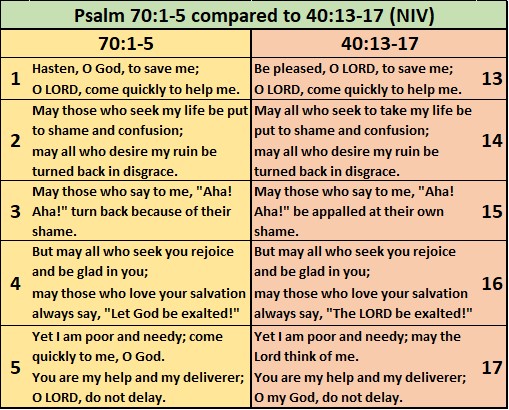
Psalm 70 is the second of three psalm-prayers for deliverance when surrounded by enemies. Some point out that the short Psalm 70 is a repetition of Psalm 40's ending, verses 13-17, with a few variations. "Lord" (YHWH) is changed into "God" (Elohim), except in verse 70:1b, and "Elohim" is changed into "YHWH" in verse 70:5b. By a change of one letter in the Hebrew word "turned back" is substituted for "desolate" in verse 70:3, and "make haste unto me" appears instead of "think of me" in verse 70:5.
Something I add to that insight is that the first part of Psalm 40 seems to be a conclusion and completion of Psalm 69, the first in the prayers for deliverance trilogy at the end of David's psalms (Psalms 72:20). Examples: First, Psalm 40:2 declares, "I waited patiently for the Lord; he turned to me and heard my cry," which is an answer to David's request, "Do not hide your face from your servant," in 69:17.
Second, 69:14-15, referencing 69:1-2, requests, "Rescue me from the mire, do not let me sink... deliver me from the deep waters... do not let the flood waters engulf me or the depths swallow me up, or the pit close its mouth over me," which is answered in 40:2, "He lifted me out of the slimy pit, out of the mud and mire; he set my feet on a rock, and gave me a firm place to stand."
Third, the Lord, not wanting sacrifice and offering but rather songs of praise and thanksgiving, is in both psalms, with Psalm 69 being the revelation and Psalm 40 the reaction to the revelation (40:6, 69:31). I could go on with more parallel examples in these two psalms.
In conclusion, strong evidence exists that Psalms 40, 69, 70, and 71 are connected in some way for David, written in his later years, a conglomerate of emotional experiences, captured in these four acts of an emotional musical-drama or opera. These psalms are connected to David's trials because of his sins with Bathsheba (Psalm 51) and the consequences borne out in Absalom's rebellion. If so, then Psalms 3 and 63 should be added to the four in this rescue from hopeless depression drama. The final act is the Messiah's tragedy turned to triumph, the melody of hope flowing in these deeply dreary psalms, the embedded prophecy fulfilled in Christ.
The drama is a help to the depressed, lonely outcast. Those who are tired of trying to keep their head above the waterline. Those whose last hope is a flickering candle in the dark night, reaching for the Mighty Hand of God to pull them to his safety.
Listen to the above comments on Psalm 70 introduction.
* Considering the points made in Introduction above, I believe it is highly possible that Psalm 40 was written to be sung immediately after Psalm 69 and then followed by Psalm 71. However, those who arranged the psalms, probably included the court musicians appointed by King David, rearranged some of the psalms according to categories to make it easier for them to find for the times they were needed.
Psalm 40 is part of the collection of works to be used by the director of music in Israel's worship services, or that when the psalm was used in the temple worship it was to be spoken by the leader of the Levitical choir - or by the choir itself. (1 Chronicles 23:5, 30, and chapter 25. Also Nehemiah 11:17)
However, they kept the ending of the psalm here to let further generations know that originally David wrote it to be part of a series of songs with a collective theme based on the results of his exposed sins related to Bathsheba (Psalm 51) and against her husband as a warning and an encouragement.
* In the mist of David's troubles his enemies harass him, as in 38:12, 39:8, 40:1-12, 41:5 ,7, and 79, and in other Psalms. David's response it to asked God, may those who wish to put him to shame themselves be put to shame.
* "Hasten" -Not in the original Hebrew. Yet all the English translations that I have include "hast", "hurry", "make haste", or "come quickly", as the opening phrase except the Holman Christian Standard Bible (HCSB) and Young's Literal Translation (YLT) which keeps it in the second half of verse 1.
* "O God" -"Elohim" in the original Hebrew (a transliteration).
* "to save me" -"Nasal" in the original Hebrew (a transliteration) also translated "to deliver me".
* "O Lord" -"YHWH" in the original Hebrew (a transliteration). The special and significant name (not merely an appellative title such as Adonai (Lord) by which God revealed himself to the ancient Hebrews (Exodus 6:2, 3)). This name, the Tetragrammaton of the Greeks, was held by the later Jews to be so sacred that it was never pronounced except by the high priest on the great Day of Atonement, when he entered into the most holy place. Whenever this name occurred in the sacred books they pronounced it, as they still do, "Adonai" (i.e., Lord), thus using another word in its stead. The Massorets (Jewish scribes and scholars from roughly the 6th to 10th centuries AD) gave to it the vowel-points appropriate to this word. This Jewish practice was founded on a false interpretation of Leviticus 24:16. The meaning of the word appears from Exodus 3:14 to be "the unchanging, eternal, self-existent God," the "I am that I am," a convenant-keeping God. (Compare Malachi 3:6; Hosea 12:5; Revelation 1:4, 8)." (Illustrated Bible Dictionary: And Treasury of Biblical History, Biography, Geography, Doctrine, and Literature.)
* "come quickly to help me" -"Hush ezra" in the original Hebrew (a transliteration).
* David has an urgent need. He as many times before goes to the Lord for help.
>What is the details and how to they show the urgency? (2)
* Psalm 70:2 "May those who seek my life be put to shame and confusion; may all who desire my ruin be turned back in disgrace."
* David's problem is life threatening. He has enemies who want him dead. Several people are recorded to wanting David dead in 1 and 2 Samuel.
* David may or may not have attacked these enemies. He did not attack Saul. However, his loyalists did attack his son Absalom who tried to take the kingdom from David (2 Samuel 14-18), and later Sheba who tried to take the northern tribes from David (2 Samuel 20). David says in verse 5 that he is "poor and needy". We do not know if this is literal or poetic. David was both in his lifetime. When he was chased from his home by his enemies like Saul and his son, Absalom, David was poor. When he was king of Judah, then all Israel he was rich. Sometims he was alone and had no one, other times the entire army of Israel was at his disposal.
>What are they saying? What do they mean? How does David want the tables turned on them?
* Psalm 70:3 "May those who say to me, 'Aha! Aha!' turn back because of their shame."
* "Aha! Aha!" -"He ah" in the original Hebrew (a transliteration). They think they know something that will help them in their cause. They think they have special insight and knowledge that will give them victory.
* "be appalled at their own shame." -When they discover their special information, special insight, special wisdom is wrong they will be shamed.
* God can fool even the most knowledgeable and most humanly wise person.
* Do Not Delay
Life dregs accumulate from sin, infirmities, and pestilence that float in the human soul. Their multiplication due to repetitive use clogs the heart's arteries and bursts the aneurysms in the mind. Religious doctors reach into pockets while promising undelivered salvation. Sins overtake the blind patient.
Lying on death's sharp bed of nails only one prayer can save from the accumulated dregs in a lifeless soul's pit. "Be pleased, O LORD, to save me; O LORD, come quickly to help me. (1; 40:13) I trust in your unfailing love; my heart rejoices in your salvation. (13:5)
Jesus, the only truly skilled physician says, "Today salvation has come to this house, because this man, too, is a son of Abraham. For the Son of Man came to seek and to save what was lost." (Luke 19:9-10) "Salvation is found in no one else, for there is no other name under heaven given to men by which we must be saved." (Acts 4:12) Jesus has saved me from the dregs of life. "Therefore I want you to know that God's salvation has been sent to the Gentiles, and they will listen!" (Acts 28:28)
Listen to the above comments on Psalm 70:1-3.
>2. What will David and those like him do? What does this show about their faith in God?
* Psalm 70:4 "But may all who seek you rejoice and be glad in you; may those who love your salvation always say, "Let God be exalted!"
* God's deliverance of his servant will give joy to all who trust in the Lord, because they see in it the assurance of their own salvation.
>What is David condition? What does he repeat? (5b)
* Psalm 70:5 "Yet I am poor and needy; come quickly to me, O God. You are my help and my deliverer; O LORD, do not delay."
* "I am poor and needy" -Times when David was poor, needy, and needed others assistance according the 1 and 2 Samuel. 1) As a fugitive because of Saul. 2) When forced to leave because of Absalom's rebellion. The first does not fit the time frame. This must be the second.
* "come quickly to me... do not delay" -Both the above times were times he was in immediate threats of death.
* Do Not Delay
The Lord be exalted! This be my praise.
The Lord is great! This be my anthem.
The Lord be magnified! This be my song.
The Lord is gladness.
The Lord be my joy.
The Lord is salvation.
The Lord thinks of me though I be poor and needy.
The Lord is my helper.
The Lord be my deliverer.
O my God, do not delay.
Listen to the above comments on Psalm 70:4-5.
II. Do Not Cast Me Away When I Am Old (71:1-13)
>3. Considering Psalm 71 might be have been a continuation of Psalm 70 what is David's updated request? (1)
* Psalm 71:1 "In you, O LORD, I have taken refuge; let me never be put to shame."
* Psalms 1, 2, 10, 33, and a few others also do not have titles.
* Psalm 71 does not have a title either in the oldest Hebrew or Chaldea texts because, as some believe, it was part of Psalm 70 and for some unknown reason it became its own psalm. I have seen no proof of this statement, but find it very plausible.
The Syriac version ascribes it to David per the Barnes Notes on the Old Testament. It reads, "Composed by David. When Saul warred against the house of David. And a prophecy respecting the passion and resurrection of the Messiah". However, David was a young and middle aged man then.
The Vulgate, Septuagint, Ethiopic, and Arabic ancient Bibles have the title, "A Psalm of David for (or "Of") the sons of Jonadab, and the first of those who were led captives." But this title has no authority, as it is not in the Hebrew, and is of little historic value, even countering historical facts.
The KJV, ASV, CSB, and YLT give their own titles. Newer English translations keep the original Hebrew text lack of title.
* "There is some plausibility in the supposition that Psalm 70 might have been placed before it, or in connection with it, as a kind of introduction, or as indicating the character of the psalms among which it is found; but nothing of certainty can be ascertained on that point. It evidently belongs to the "class" of psalms which refer to the trials of the righteous; but it was rather in view of past troubles than of those which were then existing." (Barnes' Notes on the Old Testament)
* Psalm 31:1-3 are very similar to these first three verses with only a small change in the flow.
* "shame" -"Bosh", a verb in the original Hebrew (a transliteration), properly meaning "pale" which the KJV alone translates "put to confusion". Other translations are "disappointed", "shame", "disgraced", and "ashamed to the age".
* Introduction.
Some commentaries say that David wrote this when he was old, but don't say why they make this conclusion. Some add it was during Absalom's rebellion while he was in the Judean desert, already ascribed to Psalm 3 and probably 63. Of course, David could have wrote more than one or even two for one event. Evidence in the psalm, 2 Samuel 11-19, and related Psalms 69, 70, and 40 indicates their belief have merit. Also, Psalm 71 is included in the two Davidic Psalm-Prayers Books (I & II, Psalm 72:20). I have more evidence in my commentary on this psalm.
The psalm reveals that an old man, who believed and trusted in the Lord God Almighty his whole life (5-6), "a portent to many" (7), seen "troubles, many and bitter" (20), played the harp, sang, and composed psalms (22-23), now in trouble, did compose this psalm while he was being chased and about to be captured (10). Verse 5 and 17 says he trusted and was taught by the Lord, "...from my youth," and verse 5 starts, "From birth..." Verse 9b says, "...when I am old... strength is gone." Verse 18 says, "... old and gray..." Something David could truly say at the time when Absalom rebellion happened.
The psalm starts out with a request for deliverance and to never be put to shame, as Absalom shamed David by sleeping with his concubines in public (2 Samuel 14:22). The author wants God to hear him. "Give the command to save..." reminds me of the centenarian whose faith impressed Jesus with, "Just say the word and I know my servant will be healed." Faith asks knowing that the Lord will and can do. David certainly had that kind of faith in the Lord, as we see in all of his the psalms up to know.
Listen to the above comments on Psalm 71 introduction.
>What is David asking the Lord to do? (2)
* Psalm 71:2 "Rescue me and deliver me in your righteousness; turn your ear to me and save me."
* "in your righteousness" -Verses 15-16 says he will tell God's righteousness and verses 19 and 24 he says God's righteousness reaches to the skies. Those verses indicate God's righteous was shown in his salvation actions.
* Very often the "righteousness" of God in the Psalms (and frequently elsewhere in the Old Testament) refers to the faithfulness with which he acts. This faithfulness is in full accordance with his comandments (both expressed and implied to his people with his status as the divine King - to whom the powerless may look for protection, the oppressed for redress and the needy for help. (NIV Study BIble)
* "turn your ear to me" -Hear my prayer, meaning answer my prayer as I am wanting.
* "save me" -The main point summed up. He gives details later in the psalm.
>What does it mean that God is our rock of refuge?
* Psalm 71:3 "Be my rock of refuge, to which I can always go; give the command to save me, for you are my rock and my fortress."
* "Be my rock of refuge" -Often used in the psalms as an allegory.
* "give the command to same me" -Recognizing that the Lord God has an army of servants ready to do his will like a king. This give some credence that the author is King David. Note also that this psalm is in the Book II, the second book of the collection of David psalms.
* "you are... my fortress" -Often used in the psalms as an allegory. Also, gives credence that this was written when in a rocky fortress.
* The Judean desert, east and south east of Jerusalem, following the Jordan River valley north of the Dead Sea, was rocky with many crevices to hide large amount of people. When David left Jerusalem because of Absalom's rebellion he went to one of these natural fortresses to rest during the night. Here he left the women, children, and elderly before the battle.
>What does David need delivery from? What does it mean in the Bible to be wicked, evil, and cruel?
* Psalm 71:4 "Deliver me, O my God, from the hand of the wicked, from the grasp of evil and cruel men."
* "my God" -Personal.
* "wicked... evil... cruel men" -Often used by David to describe his enemies.
* Refuge.
David uses desperate words; Rescue me, deliver me, turn your ear to me, save me, and a second time save me and deliver me. He tells the Lord he has taken refuge in him and asks the Lord to be his rock and refuge. Again he says you are my rock and my fortress. David is poetically stammering in these four verses. The wicked's grasp has squeezed words from his conscience thought (4). Cruel hands have stifled his mind and heart
What can be a pleasant, even a special day can become a day where thoughts are caught in the grasp of evil and cruel people. They can even force us to live in the desert. This is what happened to David.
However, where David was physically and mentally at the hand of even his own son, Absalom, would not have entirely been a surprise to David. Years earlier, the Lord God sent Nathan to David. He reminded him all that he did for him, then said, "You struck down Uriah the Hittite with the sword and took his wife to be your own. You killed him with the sword of the Ammonites. Now, therefore, the sword will never depart from your house, because you despised me and took the wife of Uriah the Hittite to be your own.
Nathan continued, "Out of your own household I am going to bring calamity upon you. Before your very eyes I will take your wife and give them to one who is close to you, and he will lie with your wives in broad daylight. You did it in secret, but I will do this thing in broad daylight before all Israel." Sometimes the rut we live in was dug by our own hands.
However, hope always remains, with a merciful and forgiving God. Being forced out of Jerusalem, far from home, hiding in the Judean Desert, we can ask for mercy in deliverance. Hebrews 4:15-16 says, "For we do not have a high priest who is unable to sympathize with our weaknesses, but we have one who has been tempted in every way, just as we are--yet was without sin. Let us then approach the throne of grace with confidence, so that we may receive mercy and find grace to help us in our time of need."
Listen to the above comments on Psalm 71:1-4.
>4. Is David confident in himself? For long has he been in confident of the Lord God? (5)
* Psalm 71:5 "For you have been my hope, O Sovereign Lord, my confidence since my youth."
* "O Sovereign Lord" -Sovereign Lord means David acknowledges that God has complete control even over this event.
* "my confidence since my youth" -The author will repeat that he has had complete confidence in the Lord since his youth in this psalm.
* "hope" -Being sure of things not yet seen or experienced.
>Is it possible to know if we have been relent on the Lord from birth? If we know this, what should it compel us to do? (6)
* Psalm 71:6 "From birth I have relied on you; you brought me forth from my mother's womb. I will ever praise you."
* "from birth I have relied on you" -A realization that few acknowledge.
* "you brought me forth from my mother's womb" -People who say, "I am a self made person," fail to realize that they did not bring themselves from their mother's womb.
* "I will ever praise you" -Acknowledgment that we depend on God from conception will bring forth praise.
>What is a portent? Why was David one?
* Psalm 71:7 "I have become like a portent to many, but you are my strong refuge."
* "portent" -A letter version of the NIV (2011) has "a sign to many". The WEB has "a marvel to many". Portent means "an exceptional or wonderful person".
* "you are my strong refuge" -David knows that his outward perception to others is because of the Lord's relationship with him. He relies on the Lord for strength.
* "I am a typical person; and many of the things that happen to me are to be considered in reference to him of whom I am a type." But he may mean, "I am a continual prodigy. My low estate, my slaying the lion and the bear, conquering the Philistine, escaping the fury of Saul, and being raised to the throne of Israel, are all so many wonders of thy providence, and effects of thy power and grace." (Adam Clarke, The Holy Bible with a Commentary and Critical Notes, New Edition, vol. 3, 442)
* "The meaning here is, that the course of things in regard to him -the Divine dealings towards him - had been such as to excite attention; to strike the mind as something unusual, and out of the common course, in the same way that miracles do. This might be either from the number and the character of the calamities which had come upon him; or from the narrow escapes which he had had from death; or from the frequency of the Divine intervention in his behalf; or from the abundant mercies which had been manifested towards him. The connection makes it probable that he refers to the unusual number of afflictions which had come upon him, and the frequency of the Divine interposition in his behalf when there was no other refuge, and no other hope. (Albert Barnes, Notes on the Old Testament: Psalms, vol. 2 (London: Blackie & Son, 1870 -1872), 236)
>Did David become proud because of it?
* Psalm 71:8 "My mouth is filled with your praise, declaring your splendor all day long."
* "My mouth is filled with your praise" -Probably meaning in the middle of this crisis.
* "declaring your splendor all day long." -Same as above.
* You Brought Me Forth.
One thing for sure, all those who walked the earth, God brought forth. Though many proclaim with mouth and words, "I made myself who I am," they forget that they did not bring themselves from their mother's womb. They did not bring cells together. They did not form DNA. They did not place themselves where they were born. They did not say, "I will be born at this time, in this place, with these relatives, with these circumstances." Though they claim to control their life, they cannot control the weather, animals, the earth and sun, or even a small a virus. When an unforeseen enemy comes, they have not controlled their sudden downfall. What confidence can they really have when they trust in themselves? Such people are always afraid.
However, the person whose hope is in the Lord Jesus has sure confidence. The man and woman who relies on God will ever praise him. Jesus is a strong refuge from birth to old age, through wealth and hard time, through health and sickness, through attack and victory, and through health and illness.
Why? Because Jesus is Sovereign Lord. Sovereign means he is to total and absolute control. What he says happens. What he stops, no one can start again. When he says, "Be still," the waves and wind are quiet. When he says, "Be healed," the disease is gone. When he says, "Leave him," the demon flees. His name be praise forever more.
Listen to the above comments on Psalm 71:5-8.
* A depiction David getting intelligence by the Kidron stream concerning Absalom's rebellion.
The artwork is in the 1890 Holman Bible.
>5. Did everyone see David as a portent? (9) What stage of life was David? How far advanced?
* Psalm 71:9 "Do not cast me away when I am old; do not forsake me when my strength is gone."
* "Do not cast me away when I am old" -Society's youth, then and now, often consider the elderly as not worth listening to or paying attention to. They often go unnoticed.
* "do not forsake me when my strength is gone." -If David during his son's rebellion, then he was being punished. David was asking for mercy. Forsake means "to leave or abandon". Though he was being punished, he was asking to not completely leave him as he did Saul.
* A parent punishes a child for wrong actions, but still protects them from enemies.
>What were his enemies doing? What were they doing?
* Psalm 71:10 "For my enemies speak against me; those who wait to kill me conspire together."
* "For my enemies speak against me
* "those who wait to kill me conspire together." -Not just one. Absalom consulted with others on how to hunt down David and kill him. Though 2 Samuel does not say he was going to kill David, it is implied he would.
* Many say that Absalom's problem with his father was David's lack of action against Ammon who rapped Absalom's younger sister. David grieved the death of his oldest, Amon, but has no sympathy recorded for his daughter. Though truth exists in these facts, Absalom's problem was also great ambition and pride. He was very handsome. He bought fifty chariots with fifty men to ride through Jerusalem with him to draw attention to himself. He had not experience in leadership and battle, the king's duties, so he had to seek advice on everything, often chosing the worse advice.
>What were they telling themselves and others? What were they inciting?
* Psalm 71:11 "They say, 'God has forsaken him; pursue him and seize him, for no one will rescue him.
* 'God has forsaken him" -If this is David during the time of his son's rebellion, then the Lord had told David through the prophet Nathan that he would be punished through "one close to him". David tried to hide his sin, but God would do the same in public. Absalom, raped the ten concubines David left to keep his palace in a tent so all would see. The people knew that David was being punished by God, as the prophet Nathan foretold. David's enemies believed that God would not protect him during this time of punishment. They believed they could kill David in his weakened and unprotected state.
* "pursue him and seize him" -They believed God would allow it as part of the punishment, for Absalom's rebellion was part of David's punishment.
* "for no one will rescue him." -God had abandoned him and almost all of Israel was on Absalom's side.
* The psalm, as most, do not say the cause of the trouble. However, as outlined aboved, the events described and the timing fit very well into David's life during his old age as recorded in 2 Samuel.
>What, therefore did he ask of God?
* Psalm 71:12 "Be not far from me, O God; come quickly, O my God, to help me."
* "Be not far from me, O God" -To protect him from enemies that want to kill him.
* "come quickly, O my God, to help me." -David had accepted his punishment. First, the death of his son with Bathsheba, then the rebellion of Absalom, his son by Maacah, the daughter of Talmai, the king of Geshur (north of Israel). The Geshurits were one of the people groups the Lord told Joshua and the Israelites to totally destroy. Absalom fled to his grandfather when he left Jerusalem when he killed his half-brother Amnon.
>What did he want of is accusers? How might this happen? What does their planning show about their belief in God?
* Psalm 71:13 "May my accusers perish in shame; may those who want to harm me be covered with scorn and disgrace."
* "May my accusers perish in shame" -If Absalom, then this may reference Absalom's raping David's concubines to shame David. Absalom, through this act, was accusing David of injustice to his sister.
* "may those who want to harm me be covered with scorn and disgrace." -Absalom raped them in a tent on a hill for all Israel to see.
* When I'm 64.
Those who were alive when that song came out, would not have listened to it when it did, if it were not from the artist who wrote and release it. Yet, now our aged generation still can sing at least part of The Beatles' 1967 St. Pepper's Lonely Heart Club Band song. That now aged generation will relate more to verses 9-13 than the younger generations. Still, all can learn from it.
Aging is more than physical changes. We also gain knowledge as we age, how much of it is helpful depends on our preoccupations and life decisions. We should also be wiser, but I see that some remain mostly unchanged then they were in the 1970s. Some have come into a personal loving and forgiving relation with Jesus, as I did at a relatively young age and grown wiser.
Another unexpected change is people die; family, friends, neighbors, acquaintances, politicians, enemies, and coworkers. Yet, as enemies go, new ones arise. For the elderly author of this psalm, new enemies rose. They saw him old and weak. They believed since his strength and youth were gone, he could be pursued and seized. They saw him as easy prey. However, the author's strength has always been his God, even when he was young and strong. So, as before, the author cries out, "Come quickly, O my God, to help me." The old man and woman of faith can be stronger than the young fool.
Listen to the above comments on Psalm 71:9-13.
III. When I Am Old and Grey (71:14-24)
* A depiction of Jesus' Crucifixion.
The artwork is in the 1890 Holman Bible.
>6. Who does the psalm turn back to? What two things does he tell himself in verse 14?
* Psalm 71:14 "But as for me, I will always have hope; I will praise you more and more."
* "But as for me," -The psalm switches to David's thoughts and heart. He reveals his belief and status even though everything has gone wrong.
* "I will always have hope" -Even when there is no evidence to have hope.
* "I will praise you more and more." -I have experience that when all is lost, praising the Lord God Jesus in sone is very good.
>What two more things in verse 15? Does he know all about them? What can be learned about teaching?
* Psalm 71:15 "My mouth will tell of your righteousness, of your salvation all day long, though I know not its measure."
* "My mouth will tell of your righteousness" -In song and word.
* "of your salvation all day long" -He will be God's mouth piece.
* "though I know not its measure." -David did not know to what exetent God's righteousness extended. Since, for the Israelite, God's righteousness was how the Lord God dealt with his chosen people in reguard to the covenant, and the author experienced the Lord dealing with him within the laws of the covenant, he had some knowlege. What he learn was only a fraction. And what he leaned he would share.
* When I go about my day, week, month, and years I need to learn from my life with the Lord. Having a personal relationship with God is learning from him and his word and sharing what I've experienced with others.
>What else does he decide to do in verse 16? Does he say where he will do it? What is God's righteousness?
* Psalm 71:16 "I will come and proclaim your mighty acts, O Sovereign Lord; I will proclaim your righteousness, yours alone."
* "I will come and proclaim your mighty acts" -Mighty acts of his righteousness in history and his personal life.
* "O Sovereign Lord" -Acknowledging that the Lord is in total control, even with the evil people trying to take his life life, the punishment he is receiving.
* I will proclaim your righteousness" -Repeat from verse 16.
* This takes a humble heart.
>What did he learn and then teach all his life? (17) How did he learn it?
* Psalm 71:17 "Since my youth, O God, you have taught me, and to this day I declare your marvelous deeds."
* "Since my youth, O God, you have taught me" -If this was David, and since this psalm is in the Davidic psalms (Books I & II) it most likely is of David, then God taught him practically and taught him with his word. David had access to the first five books written by Moses, Joshua, Judges, Job, and Ruth. David probably had access to the Mosaic laws which should have been in King Saul's possession, per the Mosaic Law concerning the king. However, Saul apparently never moved the Ark of the Covenant nor the Tabernacle to his place of residence in the tribe of Benjamin. So the high priest remained in Shiloh in the tribe of Ephraim, near Bethel, about 25 miles north of what would be Jerusalem, the City of David where iw as since the time of Joshua.
* "to this day I declare your marvelous deeds." -David always talked about the Lord and his works of wonder. David's started writing and singing psalms from his youth as a shepherd boy to his old age. David wrote at least 75 psalms.
*
>After all those statements, what does he ask God? Who will he teach and what?
* Psalm 71:18 "Even when I am old and gray, do not forsake me, O God, till I declare your power to the next generation, your might to all who are to come."
* "Even when I am old and gray
* "do not forsake me, O God,
* "till I declare your power to the next generation" -Let me live long enough to teach Solomon, who is a young boy and will be the next king of Israel.
* "your might to all who are to come." -Every generation to come. Perhaps David had psalms that were not written down, and needed recorded for future generations.
* Something to Teach.
The author declares six different ways in these five verses that he will talk about God's righteous ways, endless salvation, mighty acts, marvelous deeds, and power and might to the next generation and all who are to come. Since his youth the Lord taught him. Now in his old age he will teach the younger generations.
Jesus told his apostles before he left them, "...teach them to obey everything I have commanded you. And surely I am with you always, to the very end of the age." (Matthew 28:20) Apostle Paul wrote to the congregation in Colossi, "Let the message of Christ dwell among you richly as you teach and admonish one another with all wisdom through psalms, hymns, and songs from the Spirit, singing to God with gratitude in your hearts." (Colossians 3:16)
The author of the psalm did not know everything about the righteousness and salvation of God (15), but what he did know from personal application of the word of God, he taught to others with the inspiration of the insight of the Spirit of God. So did the woman who meet Jesus at the well in Samaria and the man who Jesus freed from demon possessed and living in the tombs by the Sea of Galilee.
Listen to the above comments on Psalm 71:14-18.
>7. What is righteousness? How does God's righteousness differ from mankind's righteousness? What question is asked? (19) Why?
* Psalm 71:19 "Your righteousness reaches to the skies, O God, you who have done great things. Who, O God, is like you?"
* "Your righteousness reaches to the skies"
* "you who have done great things"
* "Who, O God, is like you?"
*
* A depiction of King David teaching his son Solomon.
The artwork is in the 1890 Holman Bible."
>Did David experience a carefree life? (20) How did he see most of his life? Did he let that be a determining factor in his belief about his eternal dwelling?
* Psalm 71:20 "Though you have made me see troubles, many and bitter, you will restore my life again; from the depths of the earth you will again bring me up."
* "Though you have made me see troubles, many and bitter"
* "you will restore my life again"
* "from the depths of the earth you will again bring me up."
*
>And even his near future? (21)
* Psalm 71:21 "You will increase my honor and comfort me once again."
* "You will increase my honor" -As a human being and as a king."
* "comfort me once again."
* Righteousness.
"God's righteousness reaches to the skies," so David knows and states, a fugitive seeking refuge from his enemies, his punishment for a past sin. God's righteousness, for David and all Israel, was not one of God's attributes, as the church sees itself because of God's grace (Romans 3:21-26; Hebrews 12:23). An unknown Israel poet wrote, "Righteous are you, O LORD, and your laws are right." (Psalm 119:137; also see Ezra 9:15)
God's righteousness for Israel was his actions in terms of the covenant that the Lord God established with the chosen people, Israel, at Mount Sinai (2 Chronicles 12:6; Psalm 7:9; Jeremiah 9:24; Daniel 9:14). David, in his old age, could say that he had experienced God's many great righteous things. God rewards those who keep the covenant, and punishes those who break the covenant. Surely, God's righteousness reached the skies.
Even though David had seen troubles, many and bitter, he knew God would restore his life. Even from the depths of the grave, David believed God would bring him up (20). Though David experienced shame at the hands of his enemies, he believed, even as he asked, that God would increase his honor and comfort him once again.
Hebrews 11:1-2 states, "Now faith is being sure of what we hope for and certain of what we do not see. This is what the ancients were commended for." Yes, we have made many bad decisions and made evil choices in the past. Those decisions harmed others and we are ashamed of ourselves now, just as David did. The consequences we experience are our fault. Yet, God in his great love forgives and in his mercy removed the just punishment and softens the blow. He restores, he rebuilds, he will again bring us up. In Christ Jesus there is always hope and deliverance.
Listen to the above comments on Psalm 71:19-21.
>8. What was he determine to do even though he see bitter troubles? What did he call his God? (22)
* Psalm 71:22 "I will praise you with the harp for your faithfulness, O my God; I will sing praise to you with the lyre, O Holy One of Israel."
* "I will praise you with the harp for your faithfulness"
* "I will sing praise to you with the lyre"
* "O my God;"
* "O Holy One of Israel."
*
>Will his singing be soft, pleasant, and gentle? (23)
* Psalm 71:23 "My lips will shout for joy when I sing praise to you, I, whom you have redeemed."
* "My lips will shout for joy when I sing praise to you"
* "I, whom you have redeemed."
*
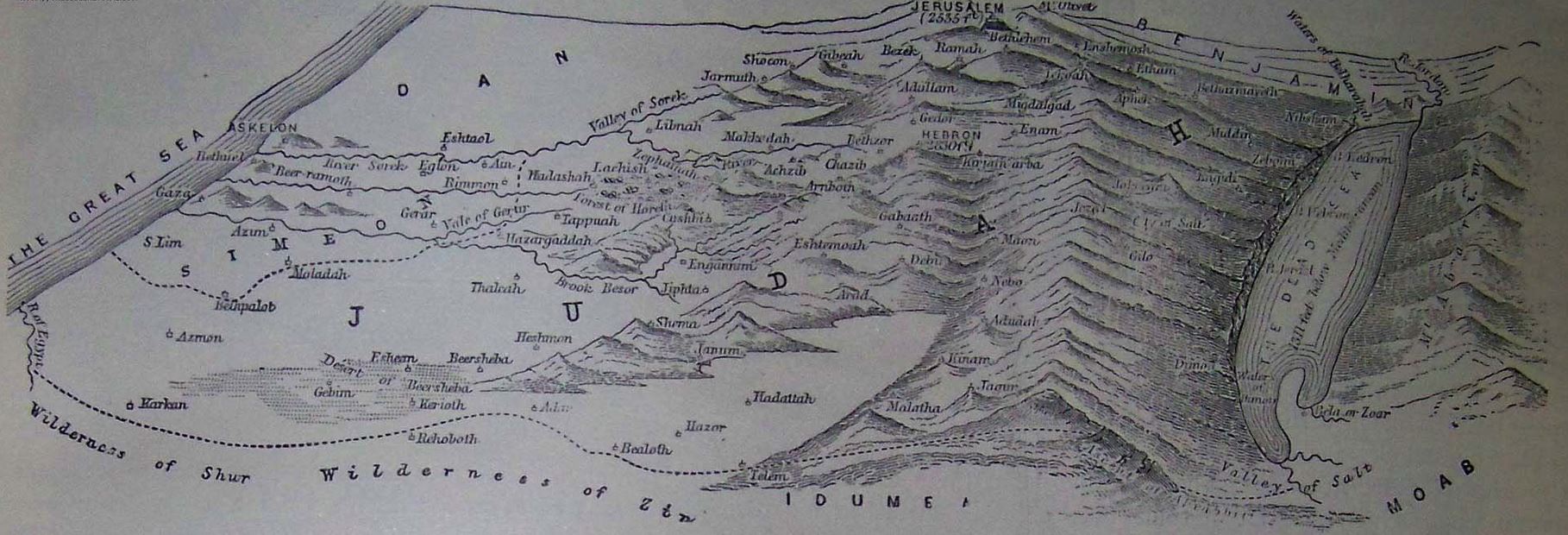
* A Panoramic plan of the tribes of Judah and Simeon.
The artwork is in the 1890 Holman Bible."
>When David says his tongue will tell of God's righteous acts, was he only say with song? How long would he do this? Why?
* Psalm 71:24 "My tongue will tell of your righteous acts all day long, for those who wanted to harm me have been put to shame and confusion."
*"My tongue will tell of your righteous acts all day long"
* "for those who wanted to harm me have been put to shame and confusion."
* David mourned for Absalom's death. He loved him greatly. He tried to hide it. However, many heard him.
* Praise in Song with Musical Instruments and Vocal.
The last stanza ends in a decision to praise the Holy One of Israel in song with harp, lyre, and choir. David would be the lead singer. The reason for the joyous shouts is the righteous acts of the Lord. Those who wanted to harm him have been put to shame and confusion, an answer to David's prayer. Thus, David finalised the psalm some time after the dramatic events took place.
At the battle's conclusion, David was heartbroken. Absalom, his son, was killed by Joab during the battle, a direct violation of the king's command (2 Samuel 18:14, 33). After some time, Israel humbled themselves and asked David to be their king again. He returned to Jerusalem (2 Samuel 19:40).
David's enemies, who conspired with Absalom, thought they would have been able to kill David since David was being punished for his sin with Bathsheba (Psalm 51) and the murder of her husband (2 Samuel 12:11-12). They thought they would take the Lord's discipline into their own hands and kill David, the anointed king. The truth is, they were taking advantage of the circumstances to get what they wanted and justifying it with nonsense. Just because I use the words 'God' and 'Jesus' in a decision does not mean it is a righteous decision.
When the Lord answers prayer, I should not hold back singing songs of praise in the congregation of my choosing.